Hazardous Tree Removal in Eastern NC: Signs, Cost & Liability
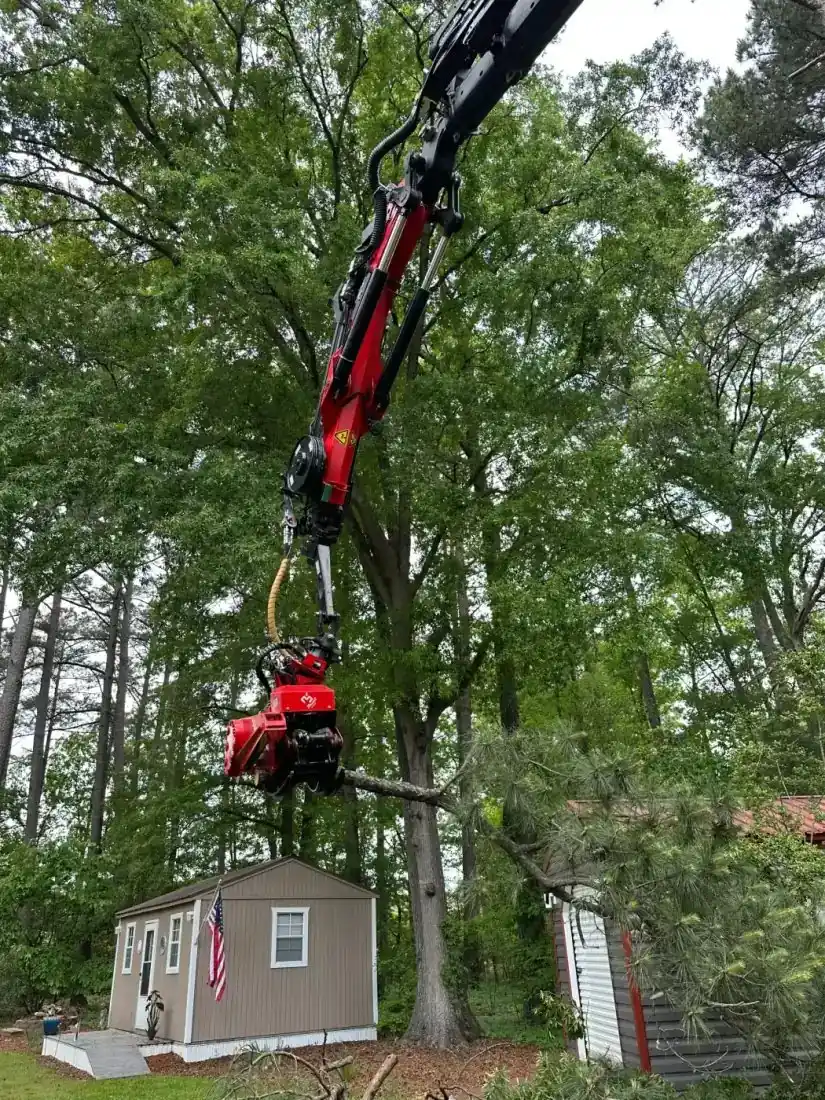


Table of Contents
When a Tree Becomes a Hazardous Liability
Most of the trees on your property are doing what trees do. They grow, they shed leaves, they survive storms, and they don’t threaten anything. Then there’s the other kind. The one with the lean that wasn’t there a year ago. The one with the long crack down the trunk. The one your insurance company sent you a letter about. The one your neighbor keeps mentioning.
That tree isn’t just a tree anymore. It’s a hazard, and depending on where you live and what’s underneath it, it might also be a legal liability.
I’m Anthony Caracappa, owner of DC Tree Cutting and Land Service. We run hazardous tree removals across nine counties in Eastern North Carolina out of our Rocky Mount and Goldsboro offices. The most common conversation I have on a property is some version of this: “I’ve been worried about that tree for two years. I don’t know if it really has to come down or if I’m overreacting.” I’ll cover how to tell the difference, what you’re legally on the hook for, what those insurance letters actually mean, and what the removal costs.
This isn’t a guide for somebody hoping to talk themselves out of dealing with a problem tree. It’s for the person who already knows the tree is a problem and wants to understand the next step.
What Is a Hazardous Tree?
A hazardous tree is one with a structural defect likely to fail and a target the failure could hit. Both pieces have to go together. Without the target, it’s just a sick tree. Without the defect, it’s just a tree near a house.
A rotten, half-dead tree in the middle of an empty field isn’t a legal hazard. It’s a defective tree. There’s nothing for it to hurt when it falls. The same tree leaning over your driveway, your kid’s swing set, or your neighbor’s garage is a hazard, because the defect plus the target equals harm.
When I walk a property, I’m running through what the arborist world calls tree risk assessment. I’m asking three things about every questionable tree:
- How likely is this tree to fail? Is the defect getting worse? Is it a slow decline or an active failure? What load conditions does it face in a bad storm or an ice event?
- Is anything underneath it when it does? Is the target there all the time (a house), or only sometimes (a car parked occasionally in the driveway)? The occupancy of the area under the tree drives the risk.
- How bad is the consequence if it hits? A limb on a fence is one thing. A trunk on a bedroom is another.
When all three answers are bad, that’s a high-risk tree. It should come down on a planned schedule, not after it fails. When two are bad, it’s still worth a conversation. When only one is bad, you’ve probably got time to make a thoughtful decision.
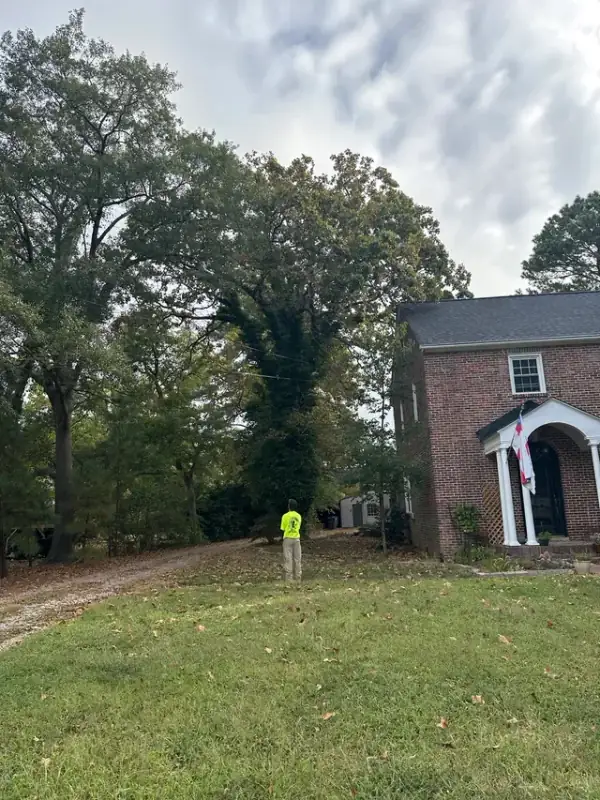
7 Signs of a Hazardous Tree in Eastern NC
Here’s the short version of what I look for on a walk-through:
- A new or worsening lean
- A vertical crack in the trunk
- Mushrooms or conks at the base
- A hollow or cavity in the trunk
- Dead limbs hanging over a target
- Exposed or damaged roots
- A history of limb drop on calm days
Some of these are obvious. A tree that’s already leaning into your house isn’t a judgment call. Others are subtle, and those are the ones that surprise people. Here’s what each sign actually means.
A New or Worsening Lean
A tree that’s grown leaning since it was a sapling is usually fine. A tree that started leaning recently is not fine. A new lean means the root system is failing. The roots that should be holding the tree upright have rotted, broken, or pulled loose from the soil, and gravity is starting to win. If you can see exposed roots on the uphill side of a leaning tree, or if the soil on that side is heaving up, the failure has already started. That tree is going to come down. The only question is whether it comes down on your schedule or its own.
A Vertical Crack in the Trunk
A long vertical crack, sometimes called a frost crack or a structural split, means the trunk has lost integrity. Cracks that go partway up are bad. Cracks that run the full length of the trunk are emergencies. After a heavy wind event or a freeze-thaw cycle, walk every large tree near a structure and look for new splits. A split trunk can let go without warning.
Mushrooms or Conks at the Base
Fungal fruiting bodies on the trunk or root flare mean the inside of the tree is already decayed. The mushroom you see is the visible part of an organism that has been eating the wood from the inside for years. The tree might still look healthy in the canopy. It’s not. Conks on a tree near a target are one of the clearer signals that removal is the right call.
If you’re still at the stage of trying to figure out whether a tree is sick, our dead or dying tree guide covers the species-by-species signs.
A Hollow or Cavity in the Trunk
A cavity is a hole in the trunk, usually where a branch broke off years ago and the wound never healed properly. Once water gets in, decay follows. Some hollow trees are surprisingly stable because a hollow tube retains most of its bending strength as long as the remaining wall is thick enough. The standard arborist rule of thumb (Mattheck’s t/R rule) is that the residual sound wall should be at least 30 percent of the trunk radius. Thinner than that and the tree is at elevated failure risk.
We test this by sounding the trunk with a mallet. Solid wood rings, hollow wood thuds. For significant cavities we measure the residual wall with a drill or resistance probe. A cavity that opens to the outside, runs all the way around the inside, or combines with other defects like cracks or a new lean is a bigger problem than the t/R number alone.
Dead Limbs Over a Target
A few small dead twigs anywhere in a tree are normal. Large dead limbs (4 inches in diameter or more) hanging directly over a roof, a driveway, a sidewalk, or an outdoor sitting area are an active hazard. These are called widow-makers in the trade for a reason. Dead limbs don’t announce when they’re coming down. Most homeowners I talk to know exactly which limbs we’re talking about. They walk under them every day.
Exposed or Damaged Roots
If recent construction, grading, or trenching cut into the root zone within the drip line of a large tree, that tree is now at higher failure risk than it was before. Roots severed close to the trunk lose the structural anchor on that side, and the tree can tip months or years later when wind or saturated soil delivers the load. Pay attention to trees whose roots got disturbed during driveway work, septic installation, or new construction.
A History of Limb Drop
A tree that has dropped large limbs once or twice without a clear cause (no storm, no obvious damage) is telling you the wood quality is failing. Arborists call this “summer branch drop.” A tree drops a healthy-looking limb on a calm summer day for no apparent reason. It happens with water oaks, willow oaks, and a few other species in our area, and once it starts, it usually keeps happening.
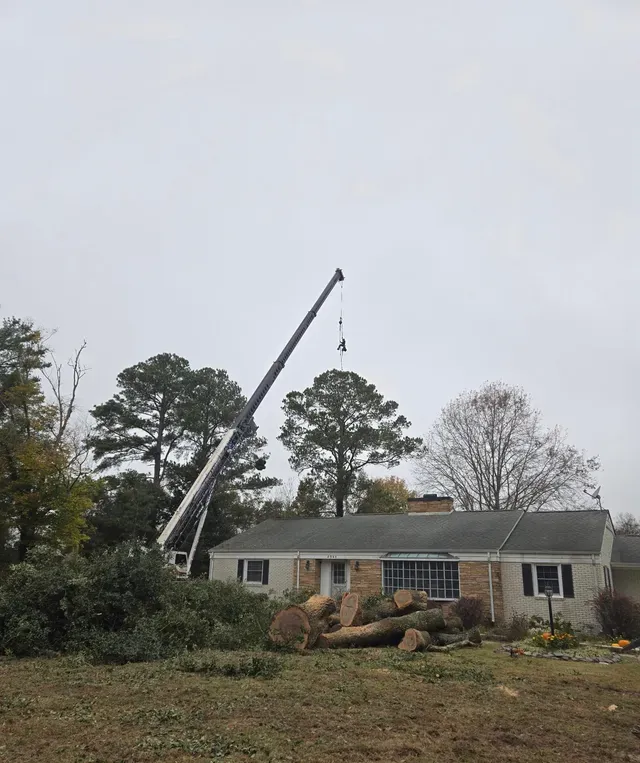
What the Law Actually Says About Your Responsibility
This is the part most homeowners don’t realize until something happens. You have a legal duty to deal with hazardous trees on your property, and that duty has gotten stronger over time.
The old rule treated trees as “natural conditions.” If your tree fell on your neighbor’s house, nobody’s fault, move on. That’s not the rule anymore in North Carolina. Courts here apply a duty of reasonable care. If you knew, or should have known, that a tree on your property was dangerous, and you didn’t take reasonable steps to address it, you can be held liable for damage when it falls. NC State Extension’s farm law page on tree fall liability walks through the standard in detail.
What does “should have known” look like in practice?
- A tree that was visibly dead, leaning, or decayed for months or years before it failed is something you should have known about.
- A tree that fell unexpectedly in a freak storm is generally not something you should have known about.
- A tree your neighbor told you about, even verbally, is now documented. You know about it.
- A tree your insurance company sent you a letter about is definitely documented.
If a dangerous tree on your property falls on a neighbor’s house, car, person, or pet, the conversation between insurance companies starts with whether the failure was foreseeable. If a certified arborist would have called the tree hazardous, and the homeowner did nothing, that homeowner’s liability coverage gets dragged into it. If the homeowner doesn’t have liability coverage, or, worse, if the tree fell on someone and there’s a personal injury claim, the exposure can get serious quickly.
The simplest way to protect yourself is to deal with known hazards before they become incidents. Get a written assessment, document the work, and keep the paperwork. If you have any doubt about a tree, get an opinion from someone qualified to give one.
Insurance Non-Renewal Letters: What They Actually Mean
This is the second most common reason customers call me about hazardous removals, and the one that catches people most off guard.
You open the mail and there’s a letter from your homeowner’s insurance company. Maybe it’s a non-renewal notice. Maybe it’s a “policy change” letter listing conditions you have to meet. Maybe it’s a polite request from the underwriter following a roof inspection or an aerial review. Whatever the wording, the message is the same: remove the tree, or we won’t keep insuring you.
Here’s what’s actually happening:
The insurance company has decided the tree is too risky for their underwriting. Underwriters in Eastern NC have gotten much more aggressive about tree risk after the last several hurricane seasons. Some carriers now review properties from aerial photography on a rolling basis and flag anything that looks like a hazard. The NC Department of Insurance has issued guidance on this practice. If you have a large tree leaning over your roof, a dead pine in the front yard, or an overgrown lot full of stressed hardwoods, expect to hear from your underwriter eventually.
They are not offering to pay for the removal. This is the part that surprises people. The same letter telling you the tree has to come down does not include a check, a reimbursement program, or a contractor referral. They’re requiring the work as a condition of continued coverage. The cost is on you. For the broader question of who pays for tree work in different scenarios (insurance, financing, or out of pocket), see our guide to paying for tree removal in Eastern NC.
You usually have a 30 to 60 day window. Most non-renewal notices in NC are required to give 30 to 60 days’ advance notice before the policy lapses. That advance notice becomes your compliance window in practice. Use it to schedule the work and get documentation back to the underwriter.
Compliance is documented. When the work is done, send your insurance company a paid invoice from the tree service showing the address and the trees removed. We provide that documentation as a matter of course. Some companies want a “before” and “after” photo. We provide those too.
A non-renewal follows you. If you let the policy lapse and shop for new coverage, most applications ask directly whether you’ve been non-renewed in the last three to five years. Carriers also pull claims history from databases like CLUE and A-PLUS. You’ll be answering questions about the tree either way. It’s usually faster and cheaper to remove the tree than to shop for a new insurer with an active problem on your record.
If you got a letter and you’re not sure how to respond, the order of operations is: get a written estimate this week, schedule the work as soon as the crew can fit you in, and send proof of removal to your underwriter the day the job is finished. That’s the path that keeps your policy in force.
What Hazardous Tree Removal Costs in Eastern NC
Hazardous removals cost more than routine removals of the same size tree, and the reason is straightforward: hazardous trees are slower, harder, and more dangerous to take down.
A healthy 60-foot loblolly pine standing alone in an open yard comes down in a couple of hours. The crew fells it in one cut, processes it on the ground, and cleans up. The same tree leaning toward a house, with rotted roots and a hollow trunk, is a full-day job. Every limb gets rigged. The trunk gets sectioned in small enough pieces that the crew can control how each one comes down. The crane comes out for the final sections because no climber is going up a tree that might let go under their weight.
Rough numbers from our recent hazardous work:
| Tree size | Typical cost range | Scenario |
|---|---|---|
| Small (under 30 ft) | $700 to $1,800 | Small dead pine, decayed ornamental, leaner over a sidewalk |
| Medium (30 to 60 ft) near structure | $2,000 to $4,500 | Mid-size oak, sweetgum, or pine with a target underneath. Most of our hazardous work lives here. |
| Large (60 to 80 ft) over structure | $3,500 to $6,500 | Full rigging job, often with a four or five person crew, sometimes crane-assisted |
| Very large (80+ ft) crane-assisted | $5,000 to $9,000+ | Hollow or leaning oak or pine over a house, power lines nearby |
Compared to the same tree in a safe location, hazardous removals typically cost 20 to 50 percent more, and sometimes double in the worst cases. The premium covers the slower pace, the additional rigging, the heavier equipment, and the planning the crew does before any cuts get made.
For our full size-by-complexity matrix on routine removals, see our tree removal cost guide. The numbers above add the hazardous premium on top of those baselines. For crane-specific work, our crane tree removal cost guide has real job examples.
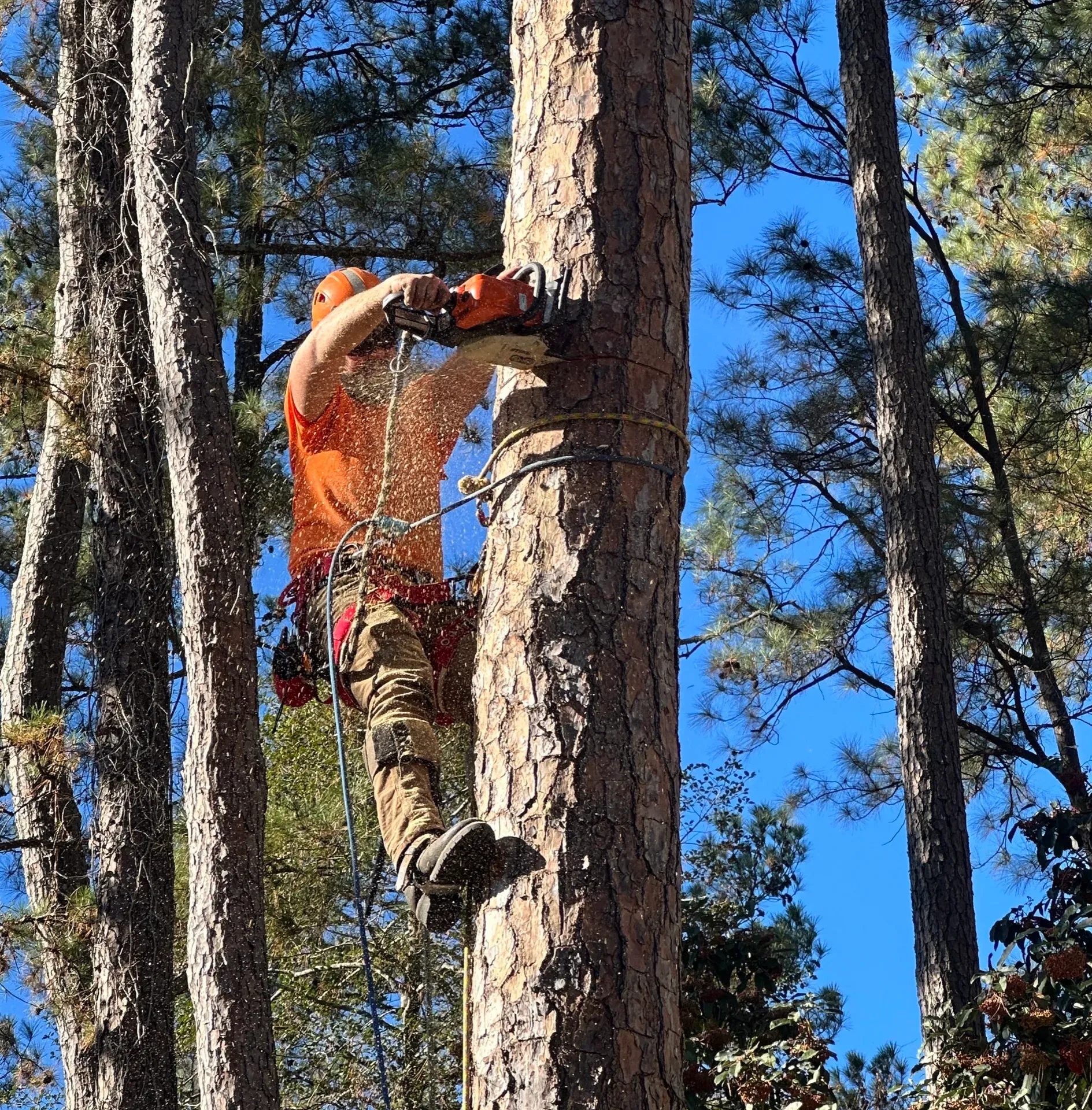
How We Approach a Hazardous Removal
When you call us for a hazardous tree, the first thing that happens is a free site visit. One of us walks the property, looks at the tree, sounds the trunk, evaluates the lean and root condition, identifies the targets, and decides what equipment the job will need. Most assessments take 15 to 30 minutes on site.
From there, the plan depends on the tree.
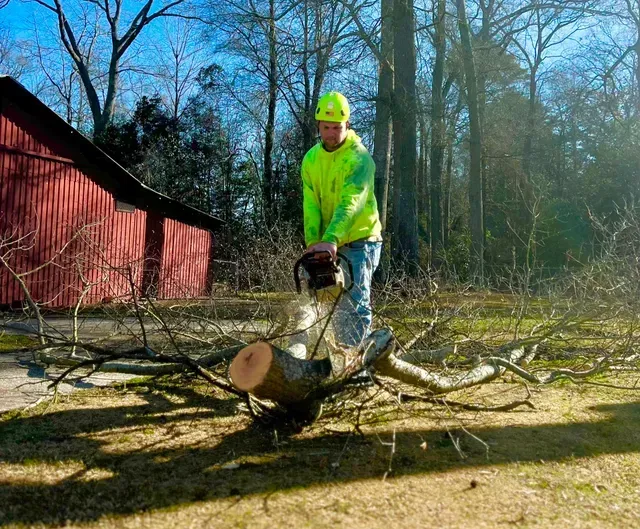
Standard rigging removal. Most hazardous trees come down by hand with rigging gear. A climber goes up (or, if the tree won’t support a climber, we use a bucket truck or tie off from an adjacent tree), and every limb gets lowered with ropes, friction devices, and a ground crew guiding the load. The trunk gets sectioned the same way, working from the top down, until what’s left can be felled in one piece into a clear area. This is the workflow on most of our tree removal work.
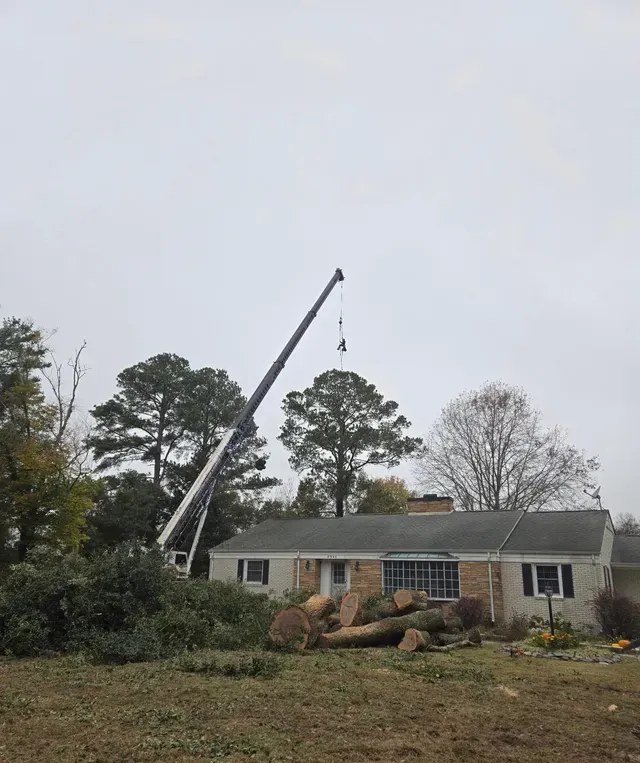
Crane-assisted removal. When a tree is too unstable, too large, or too close to a structure for hand rigging to be safe, we bring in a crane. A climber attaches each section to the crane’s hook before cutting it free, and the operator lifts each section away from the structure to a clear drop zone. Crane work is faster, safer, and more controlled than hand rigging on the worst hazardous trees.
Active emergency response. If the tree is actively failing right now (visible movement, cracking sounds, root plate lifting, contact with a structure or power line), this isn’t a hazardous removal, it’s an emergency tree service call. We run emergency crews 24/7 out of both offices and triage active failures first. Call (252) 506-0099 and tell the dispatcher what you’re seeing.
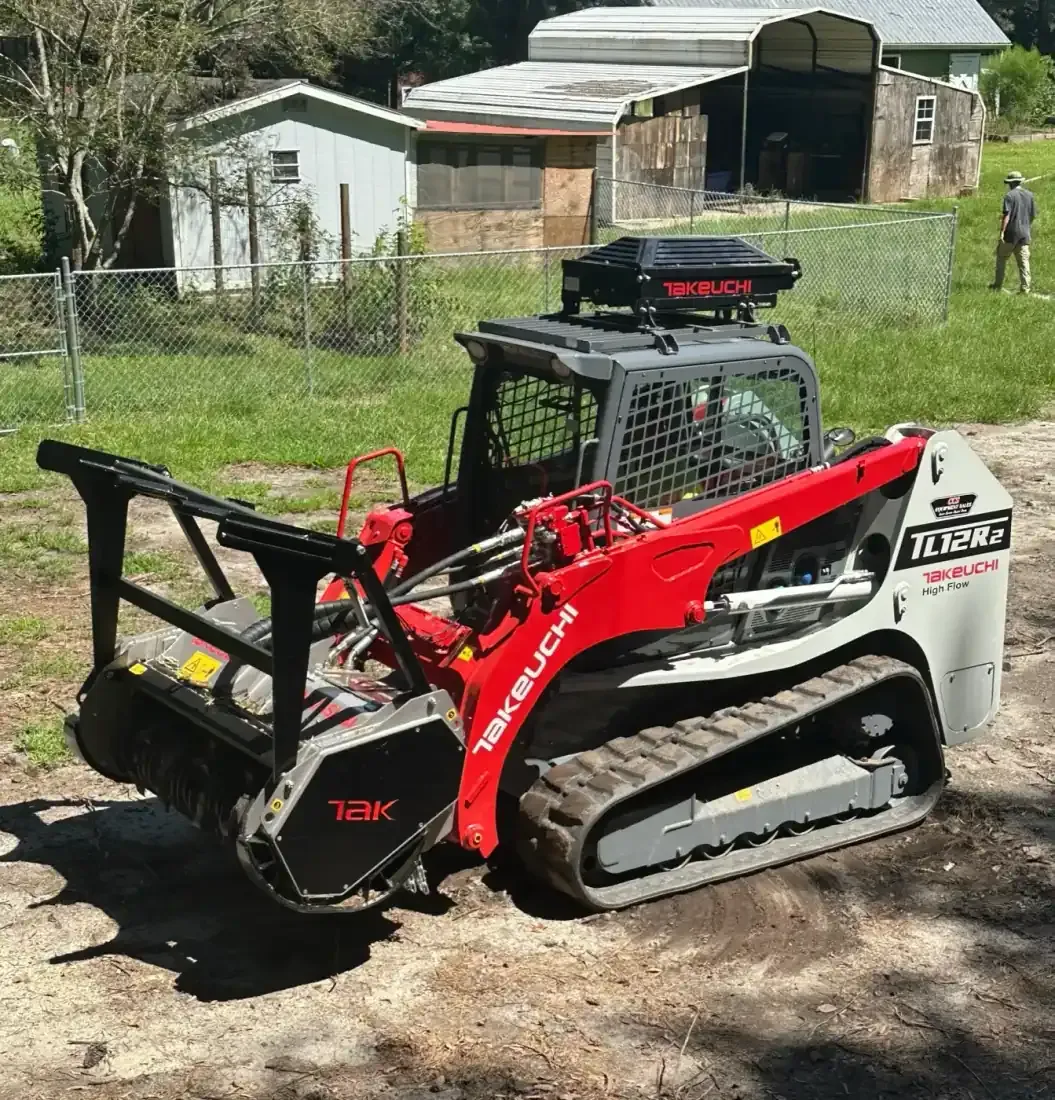
Heavy equipment cleanup. Once the tree is on the ground, we process the wood, chip the brush, and load everything into our Peterbilt grapple truck or onto a trailer for haul-off. A Bobcat or a Hyundai HX120LC excavator handles the heavy material on properties where access permits. The site is left clean.
Insurance documentation. If you got a letter from your insurance company asking for the removal, we provide the paid invoice with photos so you can close the loop with your underwriter the day the work is done. If the tree has already caused damage, we document for your adjuster the same way we document for storm jobs. Our storm damage tree cleanup guide walks through that workflow.
Stump grinding. Most hazardous removals include the option to grind the stump at the same time. Bundling it with the removal is significantly cheaper than scheduling a separate trip.
Why Insurance Verification Matters Even More on Hazardous Jobs
Hazardous tree removal is the category of work where hiring an underinsured operator gets expensive fastest. On a routine job, a mistake is a crushed sprinkler head or a rut across the lawn. On a hazardous job, a mistake is a section of oak through a bedroom ceiling, or a climber in an ambulance because the trunk let go early. There’s no cheap version of that bill.
Make sure whoever you hire carries all three coverages: general liability, workers’ compensation, and commercial auto. Ask for a current certificate of insurance with your name listed as the certificate holder before any work starts. Any legitimate company can provide one within a business day. We’ve written a full guide to verifying tree service insurance that walks through what the certificate looks like and what to check. The NC Industrial Commission enforces the workers’ comp requirement statewide.
DC Tree Cutting carries all three policies and has since day one. Our crews are W-2 employees covered by active workers’ comp. We provide certificates of insurance on request for any job, no questions asked.
Common Questions About Hazardous Trees in Eastern NC
Is a leaning tree always dangerous?
Not always. Some trees grow at a lean from the start, the root system has developed to support that orientation, and they’re stable. A new lean is the warning sign. If you noticed the lean appearing or worsening over the last couple of seasons, the roots are failing now and the tree is moving. New leans toward a target should always be assessed.
How urgent is a hazardous tree?
Depends on the combination of failure likelihood, target, and consequences. A high-likelihood failure over a high-occupancy target with severe consequences is a tree that should come down this week. A defective tree in a low-occupancy area with moderate consequences can wait for scheduling. We give you the honest answer when we look at it.
Can you remove a hazardous tree in winter?
Yes, and winter is often the best time for hazardous removal. The ground is firmer (less rutting from equipment), the trees are leafless (climbers can see structure clearly), and we have more scheduling flexibility outside of storm season. If you got an insurance letter in October, getting the work done in November or December is usually easier than waiting until spring.
What if my hazardous tree is near a power line?
Call us before you call anyone else, and do not let an uninsured operator near a tree touching a power line. If the tree is in contact with a primary line, we coordinate with Duke Energy to de-energize the line before we work. That coordination is part of our normal workflow on power line jobs. Electrocution is one of the leading causes of death in tree work, alongside falls and struck-by incidents, and the homeowner-crew and uninsured-contractor category is where those fatalities concentrate. It’s not worth saving money on.
Will the insurance non-renewal letter come back if I don’t remove the tree?
Almost certainly. Underwriters revisit flagged properties on a schedule, and once a tree has been noted once, it’s in the file. If you delay long enough that your policy lapses, finding a new carrier becomes the new problem. Non-renewal history comes up on the next application.
What to Do Next
If you’re reading this because you have a tree you’re worried about, the next step is short:
- Call (252) 506-0099 or request an estimate online. Tell us what you’re seeing. Leaning, dead, decayed, hit by a storm, flagged by your insurance company. We’ll come look at it within a few days during normal conditions, faster if it’s an active emergency.
- Get a written estimate with the scope and price, and ask any questions you have. We’re happy to walk through how the removal will be approached and what the documentation will look like.
- If insurance is involved, send us a copy of the letter or claim number so we can document the work the way your insurance company needs to see it.
- If the cost is more than you can pay at once, we offer financing through Wisetack with prequalification in about a minute and no impact to your credit score. See our financing page for details.
We respond to free estimate requests across all nine counties in our service area: Nash, Edgecombe, Wilson, Wayne, Halifax, Johnston, Greene, Lenoir, and Pitt.
The Bottom Line
A hazardous tree gets worse and more expensive every month you leave it alone. The tree doesn’t heal. The insurance company doesn’t forget the letter. And the next big thunderstorm is going to hand you a bill a lot bigger than the removal would have been.
Most of the trees on most of the properties I walk are fine, and I say so. But the ones that need to come down need to come down before somebody gets hurt or something gets broken. Call us if you have one you’re not sure about. We’ll give you the honest answer when we look at it.
Frequently Asked Questions
What is a hazardous tree?
Can I be sued if my tree falls on my neighbor's property?
My insurance company sent me a letter saying I have to remove a tree or they'll cancel my policy. What do I do?
How much does hazardous tree removal cost compared to a regular removal?
Will my homeowner's insurance pay to remove a hazardous tree before it falls?
How fast can you remove an actively dangerous tree?
Owner, DC Tree Cutting and Land Service
Anthony runs DC Tree Cutting from Rocky Mount, NC. Every article is based on real jobs, real equipment, and real pricing from across Eastern North Carolina. More about Anthony →