

What Tree Removal Actually Involves
Cutting down a tree isn’t the hard part. Getting it on the ground safely - without hitting your house, your fence, your neighbor’s car, or the power line running through the canopy - that’s the job.
We remove trees of every size across Nash, Wayne, Wilson, Edgecombe, Halifax, Greene, Lenoir, Johnston, and Pitt counties. From a 20-foot ornamental blocking your driveway to an 80-foot oak leaning over your roof, the approach changes but the standard doesn’t. Every job gets a plan, proper equipment, and a clean yard when we leave.
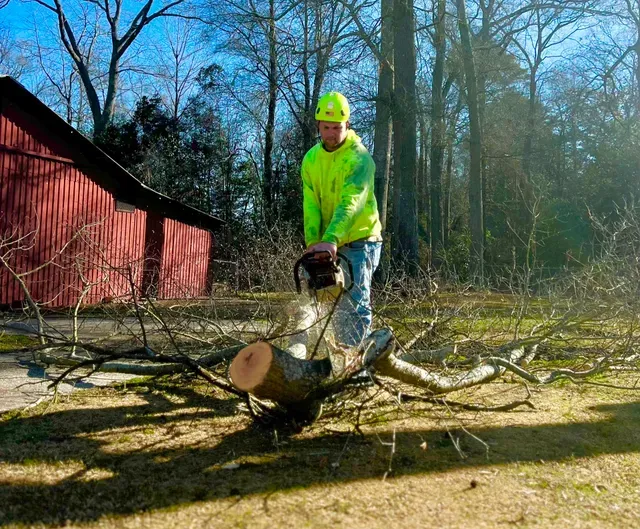
Our Process: How We Take Down a Tree
1. On-Site Assessment
We walk the property and look at the tree before quoting anything. We’re checking:
- Species and condition. A dead pine and a live white oak are completely different jobs. Dead wood is unpredictable - branches snap, trunks split. Hardwoods are heavier per foot than softwoods.
- Lean and weight distribution. Where does the tree want to fall? Where do we need it to fall? Those are often two different directions.
- Surroundings. Structures, fences, other trees, power lines, septic lines, driveways. Anything that can be damaged determines how we approach the removal.
- Access. Can we get equipment in? Is the yard soft? Is there a gate we need to fit through? Access affects time, and time affects cost.
2. Rigging Plan
Every tree gets a plan. For open-area trees, that plan might be simple: establish a drop zone, make the cuts, lay it down. For trees near structures or in tight spaces, the plan involves ropes, rigging hardware, and controlled lowering of each piece.
We decide at this stage whether the tree is a:
- Straight fell - open space, predictable lean, cut and drop.
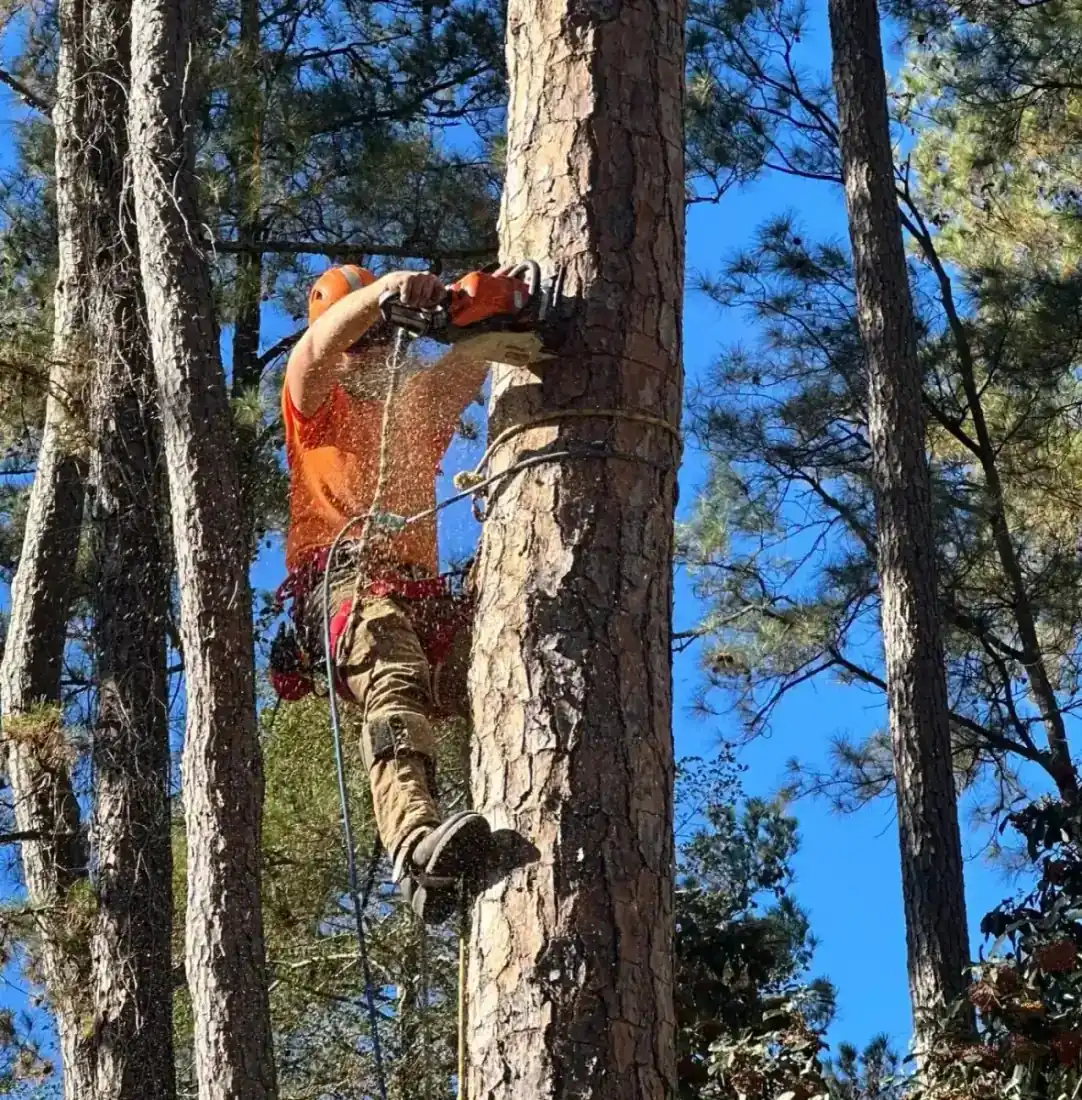
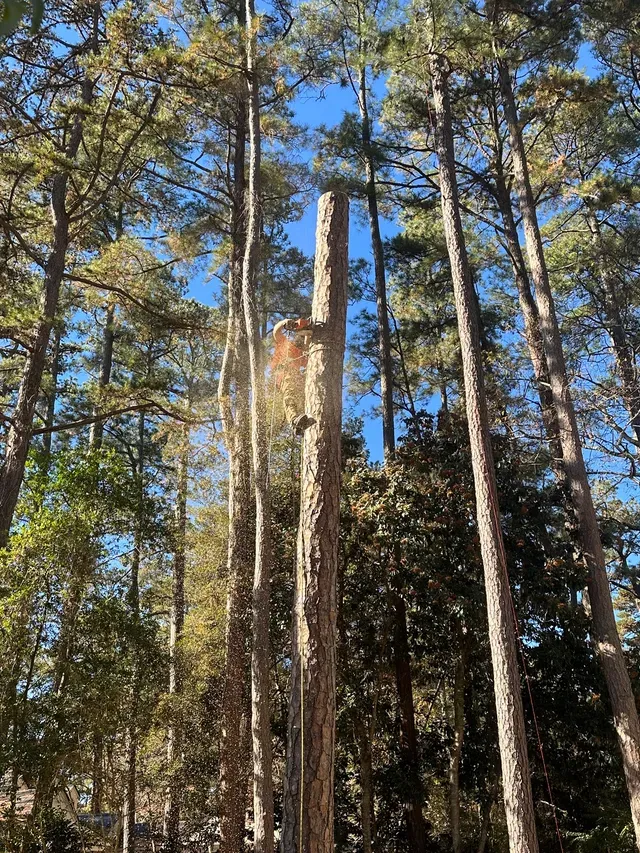
- Sectional removal - climber works from the top down, cutting manageable sections that are either free-dropped into a clear zone or lowered on ropes.
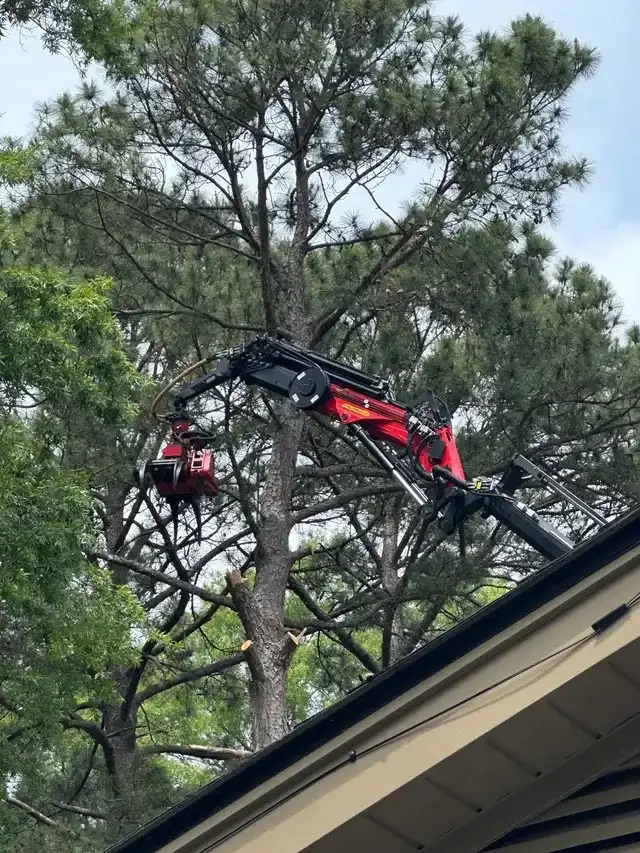
- Crane removal - the tree is too large, too close to a structure, or in a spot where rigging from the tree itself isn’t safe or practical.
3. Execution
Depending on the plan, our climber goes up or the crane comes in. Sections come off the top first, working down. Ground crew processes everything as it comes down - cutting logs to manageable lengths, feeding brush into the chipper, keeping the work area organized.
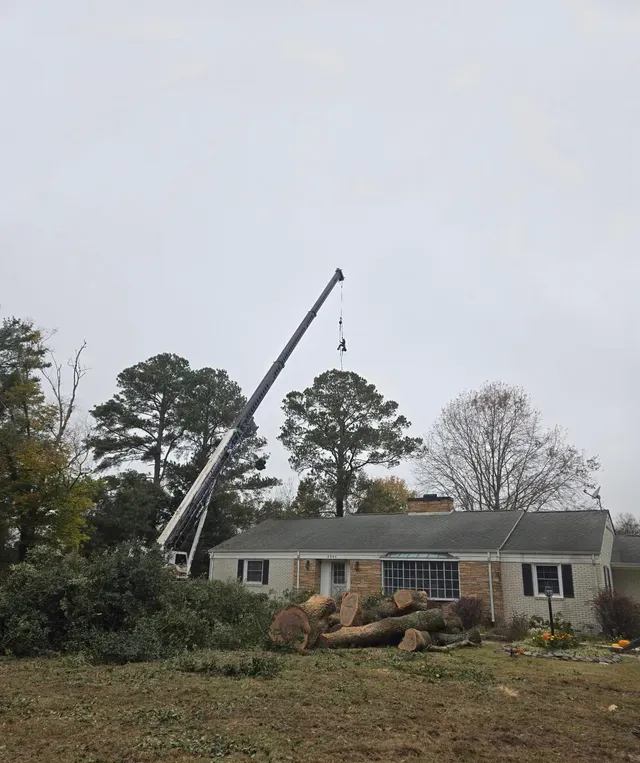
For crane removals, we subcontract Stewart’s Crane out of Wendell. The crane operator picks sections while our climber makes the cuts. It’s faster than climbing for big trees and eliminates most of the risk of dropping wood near structures. A crane can lift a 5,000-pound section straight up and set it down in the street. Try doing that with ropes.
4. Cleanup
Cleanup is not an add-on. It’s part of the job. We chip brush, haul logs, rake the area, and blow off your driveway. When we pull out, the only evidence we were there is the missing tree and a stump.
Types of Tree Removal We Handle
Single Tree Removal
The most common call. One tree that’s dead, dying, too close to the house, or just in the way. Most residential single-tree jobs in Rocky Mount, Goldsboro, Wilson, NC, and surrounding areas run $1,500-$5,000 and take a few hours.
Multi-Tree Removal
Clearing several trees from a lot is more efficient per tree than one-offs. If you’ve got 5-10 trees that need to come down, we can usually do it in a day and the per-tree cost drops. This is common for property owners prepping for construction in fast-growing Johnston County, clearing a backyard, or dealing with a stand of dead pines.
Hazardous and Leaning Trees
Trees that are actively failing - split trunks, major lean toward a structure, root heave, large dead limbs hanging in the canopy. These need to come down before they come down on their own. Hazardous removals often require more rigging because the tree’s structural integrity is compromised. You can’t trust a dead trunk to hold a climber’s weight the same way you trust a live one. For the warning signs, your legal liability in NC, and what these jobs cost, see our full hazardous tree removal guide.
Trees Near Structures
The roof of your house is not a drop zone. When a tree is growing against or over a structure, every piece comes off controlled. Ropes, pulleys, and a ground crew managing each lowered section. It’s slower and costs more, but that’s the only way to do it without putting the structure at risk.
Trees Near Power Lines
We do not work on trees actively contacting power lines - that’s the power company’s responsibility. But we remove trees that are near lines, growing toward lines, or at risk of falling into lines. Depending on proximity, we may coordinate with the utility for a temporary disconnect before we start.
Crane-Assisted Removal
When a tree is too large to rig from itself safely, or when it’s sitting directly over a house and there’s no room for error, the crane comes in. Common scenarios:
- 80+ foot hardwoods in residential yards
- Trees completely enclosed by structures
- Storm-damaged trees that are structurally unpredictable
- Jobs where speed matters (commercial properties, road clearance)
Crane jobs cost more due to the equipment, but they’re often faster and safer than the alternative.
Should You Remove the Tree or Just Trim It?
You don’t need an arborist certification to work through this. You need five honest answers.
1. Is the tree sound enough to respond to pruning?
A sound tree walls off pruning cuts and keeps growing — arborists call it compartmentalization. A stressed or declining tree can’t do that well. Every cut becomes an entry point for decay. If your tree has 30% or more dead canopy, major trunk wounds, or fungal growth at the base, trimming won’t help. It’ll just cost money now and cost more later.
For trees in the early stages of decline — thinning canopy, some deadwood, smaller leaves than usual — trimming can buy years. But you’re managing decline, not reversing it. Know that going in.
2. Does trimming actually solve the problem long-term?
If the issue is deadwood over the roof, a one-time trim handles it for 2-3 years. Done.
If the issue is the tree is too big for the space, trimming is a temporary fix. You can reduce a canopy by about 25% per session without hurting the tree — that’s the ANSI A300 standard, and it’s the line we follow. A 60-foot water oak with a 50-foot lateral spread isn’t becoming a 40-foot tree through trimming. It’s becoming a 55-foot tree this year and a 60-foot tree again in three seasons. At some point you’re paying $1,500 every other year for a tree that will never fit the lot.
And if the tree overhangs a neighbor’s yard, that changes the math. A limb that drops on their car or their roof is your problem under NC law if you knew the tree was a concern and did nothing. See our hazardous tree guide for the legal details.
3. What will the ongoing maintenance cost you?
Get both estimates — trimming and removal — and run the five-year comparison.
| Scenario | Trim | Remove |
|---|---|---|
| Sound 50-ft oak, deadwood and clearance | $800-$1,200 every 3 years | $2,500-$3,500 one time |
| 60-ft water oak crowding the house, full reduction | $1,500-$2,000 every 2 years | $3,000-$4,500 one time |
| 80-ft loblolly pine, 15 ft from garage | Can’t be trimmed to safe distance | $3,000-$5,000 one time |
| Row of 3 Bradford pears near driveway | $500-$600 each per trim, but they split anyway | $1,500-$3,000 total removal |
The sound oak is a keeper. No question. Over five years you’ll spend $1,600-$2,400 and keep a tree that adds shade, value, and character. The water oak crowding the house? $3,000-$4,000 in trimming and it’s still too close. The loblolly can’t be trimmed shorter. Pines don’t work that way. And the Bradford pears are going to split in a storm no matter what you do.
If the cost of preventive removal is more than you can handle at once, we offer financing through Wisetack.
4. What species are you dealing with?
Some trees earn decades of maintenance. Others don’t. Here’s how the most common Eastern NC species break down — see our NC tree guide for full profiles.
Keep these:
- Willow oak — deep roots, strong wood, 100+ year lifespan. The best shade tree in Eastern NC. A mature willow oak might need trimming once a decade. Every dollar you spend on it is money well spent.
- Pecan — the only tree on this list that feeds you. Long-lived, valuable, strong trunk. The long lateral limbs are the only concern — they get heavy, and summer branch drop is real with pecans. Keep the deadwood out and address any V-crotches before they become the weak point. Don’t cut down a sound pecan unless you absolutely have to.
- White oak — slow growing, nearly indestructible. A mature white oak might need trimming once a decade. If you have one, keep it for your grandkids.
Judgment calls:
- Water oak — fast growth, 60-80 year lifespan, but internal rot starts showing up after 40. Worth maintaining when young and sound. Past 50 with a thinning canopy or mushrooms at the base, start planning the removal. The longer you wait, the bigger the bill.
- Red maple — codominant stems are the problem. If the main fork has tight bark pinched between the leaders, that union will split eventually. Consider removal before it splits on its own and hits something. Clean structure with a single leader? Trim and maintain.
- Sweetgum — sound trees are fine to maintain above ground. But the roots run shallow and they’ll heave a driveway right up. If your concrete is already cracking, trimming the canopy doesn’t fix what’s happening underground. That’s a removal.
Don’t bother:
- Bradford pear — structural defect at every branch union. Included bark, weak wood. Trimming them is like patching a tire with a bad sidewall. Remove it.
- Leyland cypress rows past 30 feet — brown and dead on the inside, can’t regenerate from old wood. Cutting them to 20 feet leaves dead sticks. Remove and replant with something that works at the right scale.
- Any tree with confirmed internal rot — mushrooms at the base, hollow trunk when you knock on it, soft spongy bark. Trimming the canopy doesn’t fix what’s rotting inside. That’s not a trim-vs-remove decision anymore. That’s a removal and stump grinding call. See our dead tree guide for the full diagnostic.
5. Is trimming just delaying an inevitable removal?
This is the question people don’t want to answer. And it’s the one most tree companies won’t bring up, because trimming a declining tree every couple years is steady revenue for them.
Run the math on a declining water oak: $1,500 in trimming every couple of years, on a tree that’s rotting from the inside out and coming down eventually anyway. I’d rather tell you to spend $3,500 now and be done with it than watch you spend $6,000 in trimming over four years and then pay for the removal on top of it. That’s the trap — paying maintenance on a tree you already know is going to come down.
And with hurricane season starting June 1, a tree you’re on the fence about becomes a very different conversation when there’s a storm warning in the forecast. The question stops being “trim or remove” and starts being “why didn’t I deal with this in April.”
What Affects the Price
Tree removal pricing isn’t arbitrary. These are the variables:
- Diameter and height. Bigger trees produce more wood, take more time, and require heavier equipment.
- Species. Hardwoods (oak, maple, sweetgum) are denser and heavier than softwoods (pine, cedar). More weight means more rigging, more time processing, more loads to haul.
- Location on the property. A tree in an open field is a fraction of the cost of the same tree wedged between a house and a garage.
- Condition. Dead trees are unpredictable. Hollow trunks, brittle wood, hanging dead limbs - all of it adds risk and time.
- Access. If we can get the chipper and truck close, we’re efficient. If everything has to be hand-carried 200 feet through a backyard, that adds labor.
- Crane requirement. Crane mobilization adds to the total, but can actually save money on very large trees by cutting the labor time dramatically.
Typical Pricing in Eastern NC
| Job Type | Typical Range |
|---|---|
| Small tree (under 30 ft) | $500 - $1,500 |
| Medium tree (30-60 ft) | $1,500 - $3,500 |
| Large tree (60-80 ft) | $3,000 - $6,000+ |
| Crane-assisted removal (80+ ft) | $5,000 - $9,000+ |
| Multi-tree (5+ trees) | Per-tree discount applies |
These are ranges, not quotes. Every tree is different. We give free estimates on site because photos don’t tell the whole story. For a detailed cost breakdown based on our last 112 tree removal jobs, see our guide to tree removal costs in Eastern NC.
Stump Grinding Add-On
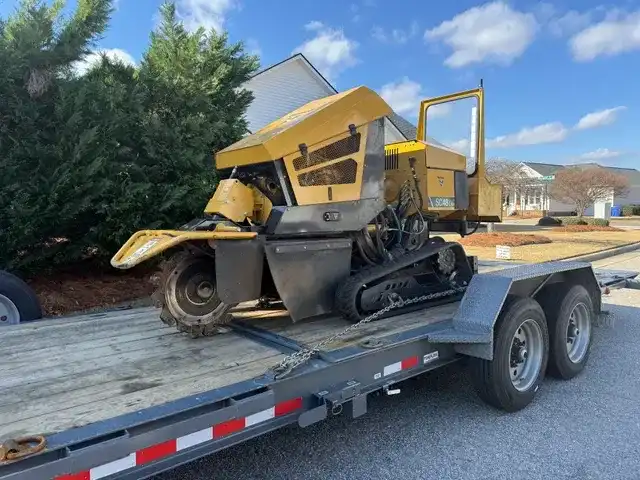
We don’t leave stumps unless you want them left. Most customers add stump grinding to their tree removal job. It’s faster and cheaper to grind the stump while we’re already on site with equipment. See our stump grinding page for details on the process and pricing.
Related Services
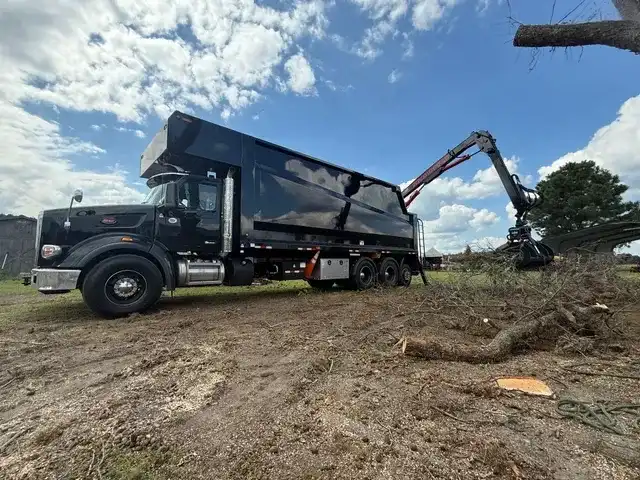
Pair tree removal with stump grinding for a clean finish - most customers bundle these. For multi-acre projects, our land clearing service is more efficient. Need the debris hauled? Our grapple truck handles that at $900/load. In an emergency? Our 24/7 emergency service responds fast.
What to Expect on the Day of Your Tree Removal
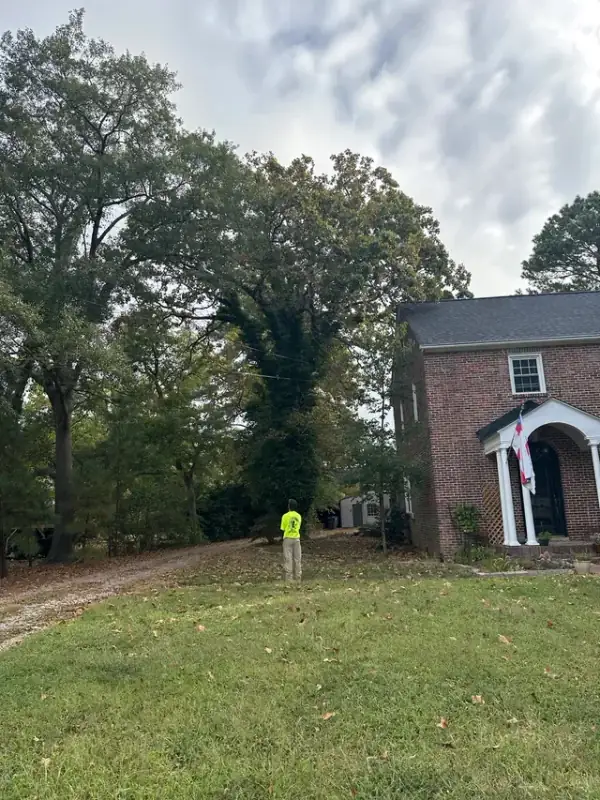
Most single-tree removals take half a day. Multi-tree jobs or crane-assisted removals can run a full day. We’ll give you a time estimate when we quote the job.
The crew shows up with everything they need — no second trips. We walk the site with you before we start, confirm the plan, and answer any questions. If we need to cross a neighbor’s yard or block part of the street, we handle that coordination.
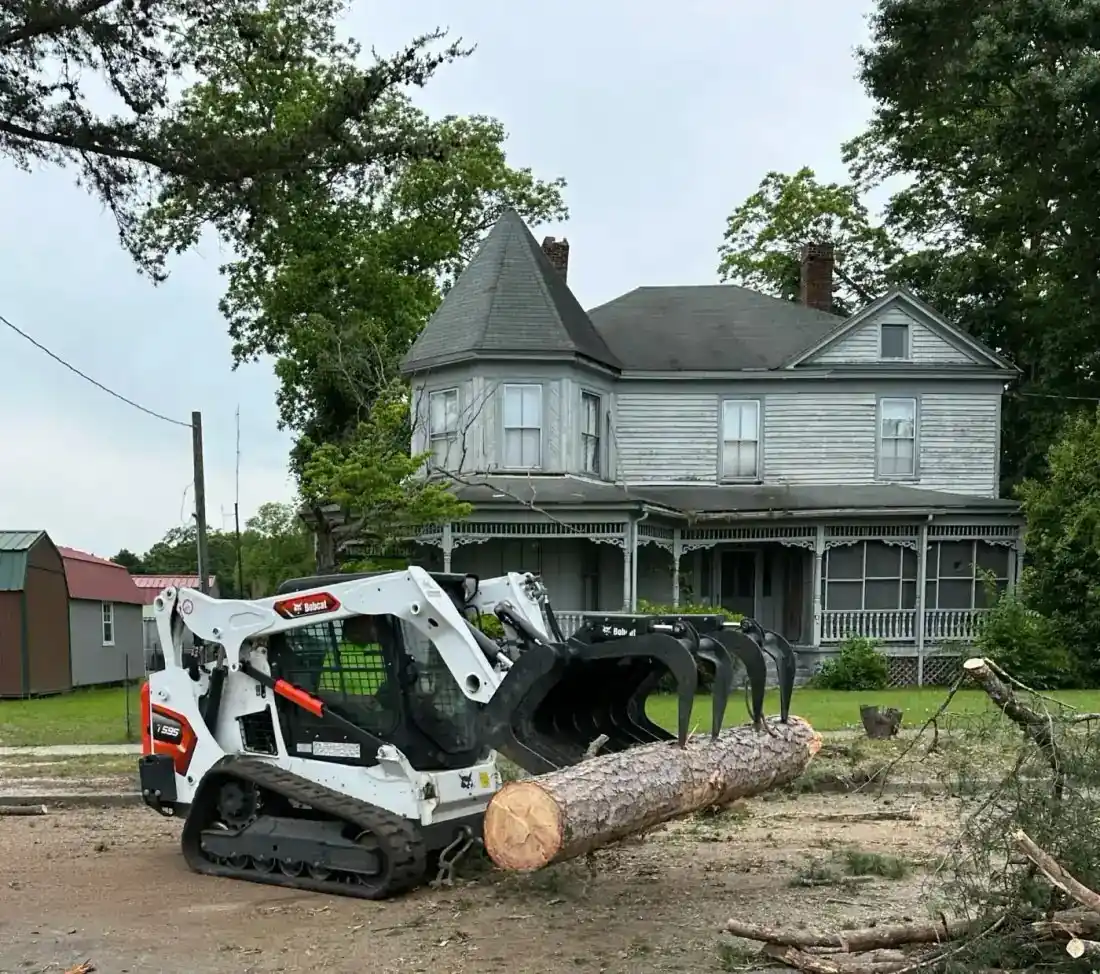
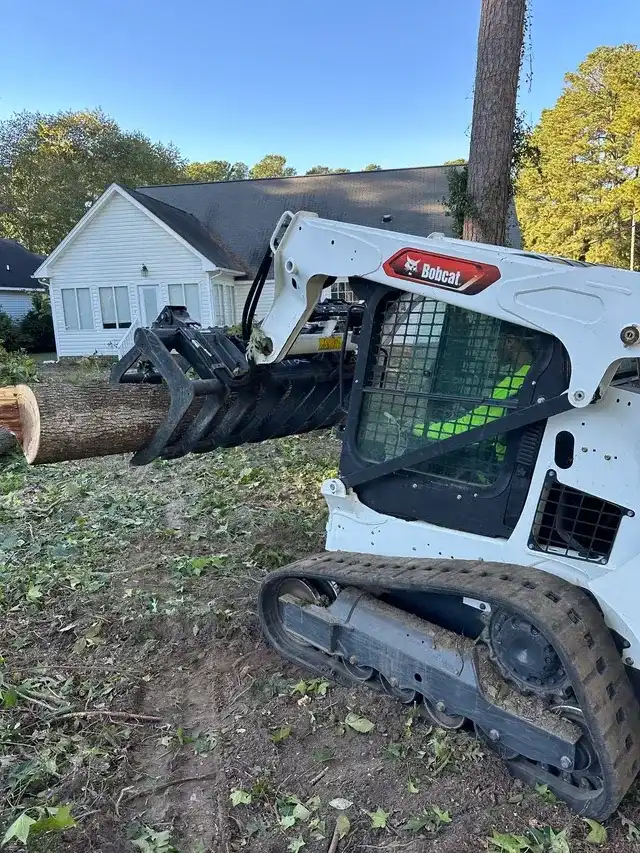
We protect your yard. Drop zones get matted or blocked. We cut and lower sections with rigging, not gravity. When we’re done, we chip the brush on-site, haul everything out with the grapple truck, and rake the area clean. You shouldn’t be able to tell we were there — other than the missing tree.
Service Area
We operate out of two locations - Rocky Mount and Goldsboro - which puts us within easy reach of most of Eastern NC. Our core tree removal service area covers:
- Nash County - Rocky Mount, Nashville, Spring Hope, Bailey
- Wayne County - Goldsboro, Pikeville, Fremont, Mount Olive
- Wilson County - Wilson, Lucama, Elm City, Black Creek
- Edgecombe County - Tarboro, Pinetops, Speed
- Halifax County - Roanoke Rapids, Weldon, Enfield, Scotland Neck
- Greene County - Snow Hill, Walstonburg, Hookerton, Maury
- Lenoir County - Kinston, La Grange, Deep Run, Pink Hill
- Johnston County - Smithfield, Selma, Four Oaks, Clayton (eastern areas)
- Pitt County - Greenville, Winterville, Ayden, Farmville
Why Hire a Professional
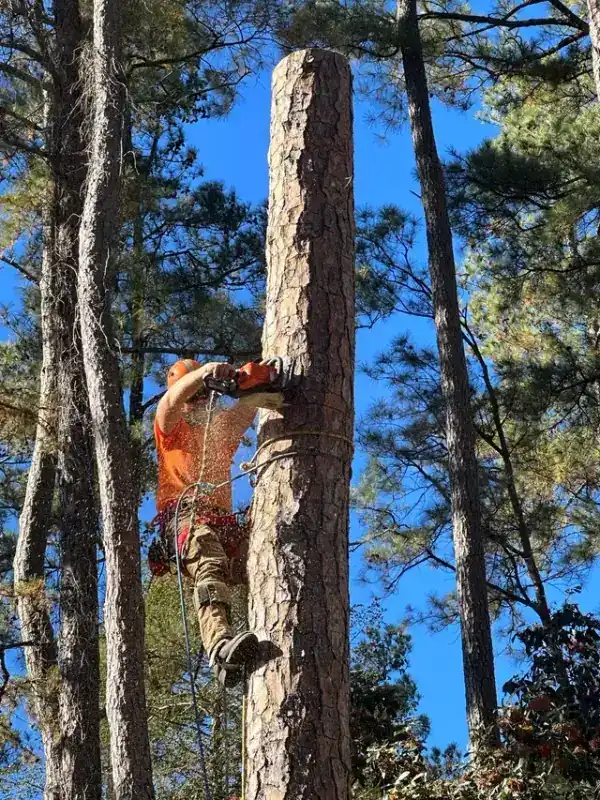
We get it - chainsaws are available at Home Depot. But there’s a reason tree work has one of the highest fatality rates of any occupation. The risks aren’t obvious until something goes wrong:
- A tree that looks like it leans left has a hidden weight bias from a heavy limb on the right.
- A cut that looks right binds the saw because the trunk is under compression you can’t see.
- A dead limb 40 feet up shakes loose when you start cutting below it.
We carry insurance for a reason, and we’ve built the experience to read trees before we cut them. That’s what you’re paying for - not just the cutting, but knowing where and how to cut.
Typical Price Range
$500 - $9,000+
Actual price depends on the specific job. See all service pricing