April 1, 2026 by Anthony Caracappa
Crane Tree Removal Cost: What to Expect in Eastern NC
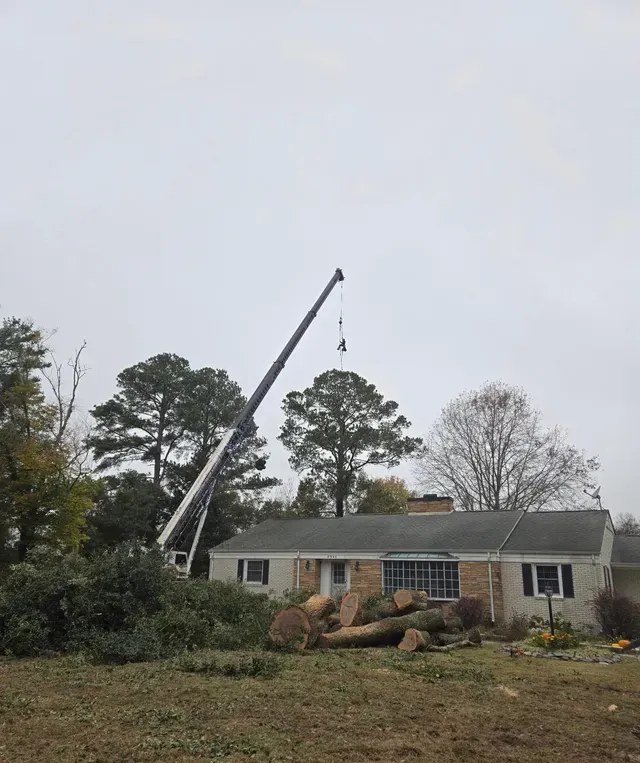
Table of Contents
When Does a Tree Need a Crane?
Most big trees don’t need a crane. A good climber with the right rigging can handle a lot more than people think. But there are trees where skipping the crane means somebody’s getting hurt or your roof is getting a new skylight — and I’ve seen both happen.
I’m Anthony Caracappa, owner of DC Tree Cutting and Land Service. We run crews across nine counties in Eastern NC from our offices in Rocky Mount and Goldsboro. I’ve been on enough crane jobs to know when one is actually necessary and when somebody’s just padding a quote. If you’re researching crane tree removal cost, here’s what it actually looks like in our market — same deal as our tree removal cost breakdown. I’d rather you know what you’re looking at before you call.
Some situations where skipping the crane is just asking for trouble:
The tree is over your house. An 80-foot oak with canopy directly over your roof and nowhere to drop sections — you’re not roping that down piece by piece and hoping for the best. A crane picks each section straight up and swings it clear. Try doing that with a guy on a branch and some rope.
The tree is dead or falling apart. A live tree holds a climber’s weight. A dead tree might not. The wood is brittle, internal decay is invisible from the ground, and limbs snap without warning. I’m not sending a climber up a dead 70-foot tree when a crane can pick the whole thing apart from the outside. If you’ve got a dead tree you’ve been putting off, read our post on signs your tree is dead or dying — the longer you wait, the worse it gets.
There’s no room to screw up. Trees between two buildings, over a pool, next to a propane tank, tangled in power lines — a crane operator can place a 2,000-pound section within inches of where it needs to go. You can’t do that with a rope and a good attitude. If power lines are involved, we coordinate with the utility company and follow emergency tree service safety protocols.
The tree is just too big to rig efficiently. A 90-foot pecan with a 60-foot canopy spread could take three days to piece down manually. A crane does it in half a day. Sometimes the crane premium actually pays for itself in reduced labor hours.
What Crane Tree Removal Costs in Eastern NC
Here’s what large tree removal and crane-assisted work actually runs based on our completed jobs.
By Tree Size
Large trees (60-80 feet): $3,000-$6,000. Mature oaks, established pines, big sweetgums. A crane isn’t always needed at this size — plenty of 60-foot trees come down with a climber and rigging. The crane comes into play when the location or condition makes climbing unsafe or impractical.
Very large trees (80+ feet): $5,000-$9,000+. These are the trees that make you stop and look up. Old pecans with trunks you can’t get your arms around, tulip poplars that tower over everything on the street. At this size, you’re almost always looking at crane work — individual sections can weigh several thousand pounds and there’s no safe way to lower that on a rope.
80-Foot Tree Removal: When Crane Work Is Almost Guaranteed
Once a tree hits 80 feet, the math changes. The weight of individual trunk sections, the reach needed for the canopy, and the potential for damage if anything goes wrong — all of it points toward crane work. We occasionally rig an 80-footer by hand in a perfect open-yard situation, but if there’s a house, fence, or power line anywhere nearby, the crane is coming.
For large tree removal cost planning, budget $5,000-$7,000 for a typical 80-foot tree near a structure. The exact number depends on species (hardwood vs pine), access for the crane, and how many structures are in the drop zone.
By Complexity
Crane-accessible, moderate risk: $3,000-$5,000. The crane can set up close, the tree is in reasonable condition, and there’s a clear landing zone. Efficient work for a trained crew.
Tight residential, high risk: $5,000-$7,500. Limited crane positioning, sections swinging over the house, power lines nearby, or a dead tree that needs extra caution. More planning, more crew, slower pace.
The worst-case jobs: $7,000-$9,000+. Huge tree, active power lines, structures on every side, poor access, or a tree that’s already started to come apart on its own. These need a bigger crane, utility company coordination, a larger crew, and sometimes a full day of planning before we even fire up a saw.
What’s Included
Here’s what’s included in every crane job we quote:
- Crane and operator for the duration of the job
- Full climbing crew for rigging and section cuts
- All debris removal and haul-off — your yard gets raked clean
- Stump grinding quoted separately but recommended as a bundle (saves a second mobilization)
- Full cleanup down to bare ground
Why Crane Removal Costs What It Does
The crane is the expensive part, obviously. A 40-ton crane — which handles most residential tree work — runs hundreds per hour with an operator. A bigger 60-80 ton crane for the real monsters costs more. And mobilization isn’t free either — getting a 40-ton crane to your property and back is a production.
What surprises most people is that a crane often saves money compared to the alternative. That 85-foot oak leaning over your house? Without a crane, a climber spends two to three full days rigging every limb down on ropes, one piece at a time. That’s 16-24 hours of skilled labor for a four-man crew. With a crane, the same tree comes down in four to six hours. The crane costs more per hour, but the total job cost is often only 30-50% more than the multi-day hand-rigging approach — and it’s significantly safer.
The cost breaks down roughly like this on a typical $6,000 crane job:
- Crane + operator: ~35% of total
- Crew labor (climber + ground crew): ~30%
- Debris hauling (grapple truck): ~15%
- Equipment, fuel, mobilization: ~10%
- Insurance overhead: ~10%
That last line — insurance — is why you need to be careful about who you hire for crane work. General liability, workers comp, and commercial auto aren’t optional on any job, but they’re especially important when someone’s swinging multi-ton tree sections over your house. A crane job done by an uninsured crew that drops a section on your roof leaves you holding the bag — your homeowner’s insurance won’t cover damage caused by an uninsured contractor. Read our guide on verifying tree service insurance before you sign anything.
Real Crane Jobs From Our Work
85-foot willow oak in Nash County — massive canopy overhanging the house and a detached garage, power line through the lower branches. We brought in a 60-ton crane, coordinated with the power company for a line de-energization, and ran a six-man crew. Took about five hours to get it all on the ground. $7,500. Trying to rig that tree by hand would have taken three days and been far more dangerous.
70-foot dead pine near Wilson — standing about eight feet from the corner of a brick ranch. The tree had been dead for over a year and the trunk was starting to show cracks. Nobody was climbing that. Crane picked the trunk in three sections, crew processed on the ground. Half-day job, around $4,200. Worth noting — that dead pine had been standing long enough that the homeowner was losing sleep over it. If it had come down in a storm instead, they’d have been looking at a roof replacement, emergency removal at double the cost, and an insurance fight over a known hazard tree. $4,200 for planned removal vs $15,000+ in storm damage repairs. That math isn’t hard.
Twin 75-foot oaks in Wayne County — two trees flanking a driveway, both leaning slightly toward the house. Homeowner had been quoted $12,000+ by another company that planned a two-day hand-rigging approach. We brought a crane, took both trees down in a single day, and came in at $8,500 for the pair — that’s $4,250 per tree for 75-foot oaks, which is solidly in our normal range. Crane access was tight — we set up on the street — but the operator made it work.
60-foot sweetgum in Johnston County — between the house and a neighbor’s fence with about 12 feet of clearance on each side. Not a huge tree, but zero room for error. The crane let us lift every section straight up and over, clearing both properties completely. $3,800. Could have been done without a crane, but the homeowner didn’t want to risk it with the fence and the neighbor’s new deck. Smart call.
Got a tree like one of these? Get your free crane removal estimate — we’ll tell you straight up whether it actually needs a crane or if we can save you money with conventional removal.
What Happens If You Wait
I get it — a $5,000+ tree removal is not a fun way to spend money. But here’s what happens when people put off crane jobs:
Dead trees don’t get safer. Every storm, every heavy wind, every ice event is another roll of the dice. The wood gets more brittle, the root plate weakens, and the tree becomes harder and more expensive to remove. A tree we’d quote at $5,000 today might be a $7,000 emergency job after it partially fails in a storm.
Emergency removal costs more. When a tree comes down on your house at 2 AM, you’re paying premium rates for after-hours response, expedited crane mobilization, and damage mitigation. That’s easily 50-100% more than planned removal.
Insurance gets complicated. If your insurance company can show you knew about a hazard tree and didn’t act, they can reduce or deny your claim. A tree that’s been dead for two years with visible cracks isn’t a surprise — it’s negligence. Document it, get it quoted, and get it handled.
Your neighbors notice too. A dead tree on your property that threatens their house or their kids’ play area isn’t just your problem. We’ve had more than a few calls from homeowners whose neighbors finally said something.
When You Don’t Need a Crane
I want to be clear — we don’t push crane jobs on people who don’t need them. A skilled climber handles most of the trees we take down without heavy equipment.
Open yard with clear drop zone. If there’s room to fell sections or the whole tree away from structures, a climber with proper rigging gets it done efficiently. This is how the majority of tree removals happen.
Good health, good access. A live, structurally sound tree that a climber can ascend safely — even a big one — can often be pieced down with ropes and a capable ground crew. We do this regularly on 60-70 foot trees.
Budget is the priority. If the risk profile allows it, hand-rigging costs less. We’ll tell you straight up during the estimate whether skipping the crane is a reasonable call or a bad idea. For more on general pricing, see our tree removal cost guide.
During every free on-site estimate, we assess whether the job actually needs a crane or if conventional removal is safe and practical. We won’t upsell you a crane job if the tree can come down safely without one. But we also won’t hand-rig a tree that needs a crane just because the quote looks better. That’s how people get hurt.
Not sure which category your tree falls into? Request a free estimate or call us at (252) 506-0099. We’ll come look at it and give you an honest answer.
How to Save on Crane Tree Removal
A few ways to keep crane job costs down without cutting corners:
Bundle multiple trees. If you have several trees that need work, doing them all on the same crane visit saves on mobilization. The crane is already there — adding a second tree doesn’t double the cost.
Bundle stump grinding. Getting stumps ground at the same time as removal avoids a second trip. One mobilization, one day, everything handled.
Prepare access. If you know the crane needs to reach the backyard, clearing a path to the setup pad before we arrive saves crew time. Move vehicles, open gates, flag sprinkler heads.
Schedule in the off-season. Winter and early spring typically have better crane availability and shorter lead times. The work quality is identical — trees don’t care what month it is.
How to Get an Accurate Quote
You can’t quote a crane job from photos. I mean, photos help, but they don’t show root condition, lean direction, soil stability, overhead clearances, or where the crane can actually set up. All of that changes the plan and the price.
When you call or request your free estimate, it helps if you know:
- Property address — we need to see the site
- Which tree(s) — point them out or describe their location
- What’s nearby — house, garage, fence, power lines, septic system
- Any urgency — is the tree actively failing or is this planned removal? If it’s leaning, cracking, or has already lost major limbs, don’t wait for scheduling — call us directly at (252) 506-0099
- Access — can a truck get to the tree or is it behind the house?
We’ll come out, assess the tree, determine if a crane is needed, and give you an honest quote that includes everything. No surprise charges, no vague “it depends” non-answers.
Our Service Area
We provide crane-assisted tree removal across Nash, Edgecombe, Wilson, Wayne, Halifax, Johnston, Greene, Lenoir, and Pitt counties in Eastern North Carolina. Our offices are in Rocky Mount and Goldsboro, and we run crews throughout the region daily.
Related Work You Might Need
Big tree removals usually come with other work on the same visit:
- Stump grinding — $250-$1,000 per stump, cheaper when bundled with removal
- Land clearing — if you’re clearing a whole lot, crane removal of the largest trees plus forestry mulching for everything else is often the most efficient approach
- Grapple truck debris hauling — our 70-yard grapple truck handles all debris from crane jobs, included in every quote
For the full breakdown of all tree removal pricing by size and complexity, see our tree removal cost guide. For a summary of all service pricing, visit our pricing page.
Frequently Asked Questions
How much does crane tree removal cost? +
When is a crane needed for tree removal? +
Is crane tree removal more expensive than regular tree removal? +
How much does it cost to remove an 80-foot tree? +
How long does crane tree removal take? +

Anthony Caracappa
Owner, DC Tree Cutting and Land Service
Anthony runs DC Tree Cutting from Rocky Mount, NC. Every article is based on real jobs, real equipment, and real pricing from across Eastern North Carolina.