Land Clearing Cost Per Acre in Eastern NC: What Our Real Jobs Cost (2026)


Want a firm price instead of a ballpark? Free estimate in about 2 minutes.
Get Free EstimateTable of Contents
The Real Cost of Clearing Land in Eastern NC
Every land clearing cost article on the internet gives you the same answer: “$1,500 to $5,000 per acre.” That’s technically not wrong, but it’s so vague it’s useless. An acre of knee-high brush on flat ground is not the same job as an acre of 60-foot hardwoods on a slope with a creek running through it. Quoting the same price range for both is like saying a car costs “$5,000 to $100,000.”
I’m Anthony Caracappa, owner of DC Tree Cutting and Land Service. We clear land out of Rocky Mount and Goldsboro across nine counties in Eastern NC. Instead of recycling national averages, I pulled our actual invoices: our recent land clearing jobs ran between $2,000 and the low $20,000s, with a median right around $4,000. That spread is the honest answer to “what does land clearing cost” — and the rest of this guide explains where your property lands in it.
Land Clearing Cost Per Acre: Quick Reference
Most residential land clearing in Eastern NC prices between two anchors:
| What’s on the Land | Cost Per Acre | What’s Involved |
|---|---|---|
| Light brush and scattered small trees | $2,500 - $4,000 | Forestry mulching handles most of it in a single pass |
| Heavy: large trees with dense underbrush | $8,000 - $15,000+ | Full crew, chainsaw felling, excavator work, grapple truck haul-off |
Most real properties fall between the anchors — some sections mulch in a pass, others need trees felled and hauled — which is why the median job lands near the light/heavy boundary rather than at either end.
If you need site prep for construction, including grading and stump removal, add $500 to $1,500 per acre on top of clearing.
For lots under one acre, there’s typically a minimum job charge of $2,500 to $3,000 because we’re mobilizing the same heavy equipment whether you have a quarter acre or two acres.
What Our Recent Land Clearing Jobs Actually Cost
These are real, completed jobs from our books — town, season, and invoice total, straight from our job records (totals rounded to the nearest $500). No composites, no “typical customer” stories.
| When | Where | Job | Invoice |
|---|---|---|---|
| Spring 2025 | Kinston | Land clearing, multi-day | $18,000 |
| Late spring 2025 | Goldsboro | Root raking | $8,500 |
| Fall 2025 | Wayne County | Tree removal + land clearing combo | $20,000+ |
| Fall 2025 | Greene County | Land clearing | $9,500 |
| Early winter 2025 | Greene County | Land clearing | $3,000 |
| Winter 2025 | Rocky Mount | Tree removal + land clearing combo | $3,500 |
| Spring 2026 | Wilson | Land clearing | $3,500 |
| Spring 2026 | Winterville | Tree removal + lot clearing combo | $5,000 |
| Summer 2026 | Goldsboro | Lot clearing | $2,000 |
Three things worth noticing in that table:
The same town can produce a $3,000 job and a $9,500 job weeks apart. Both Snow Hill jobs were “land clearing.” The difference was what was standing on the land — which is why nobody can quote your property from a phone call description alone.
Combo jobs climb fast. The $23,000 Wayne County job was tree removal plus clearing on the same property. When large trees have to come down before the ground work starts, you’re paying for two phases of work, and the debris volume multiplies.
Root raking is its own line item. The $8,500 Goldsboro job was root raking — pulling the root mat after clearing so the ground is actually plantable or buildable. If your end goal is a pasture, food plot, or building pad, budget for it; if you just want the brush gone, skip it.
What’s Included in Land Clearing Cost
Land clearing isn’t one thing. It’s a sequence of steps, and the price reflects how many of them your land needs.
Vegetation Removal
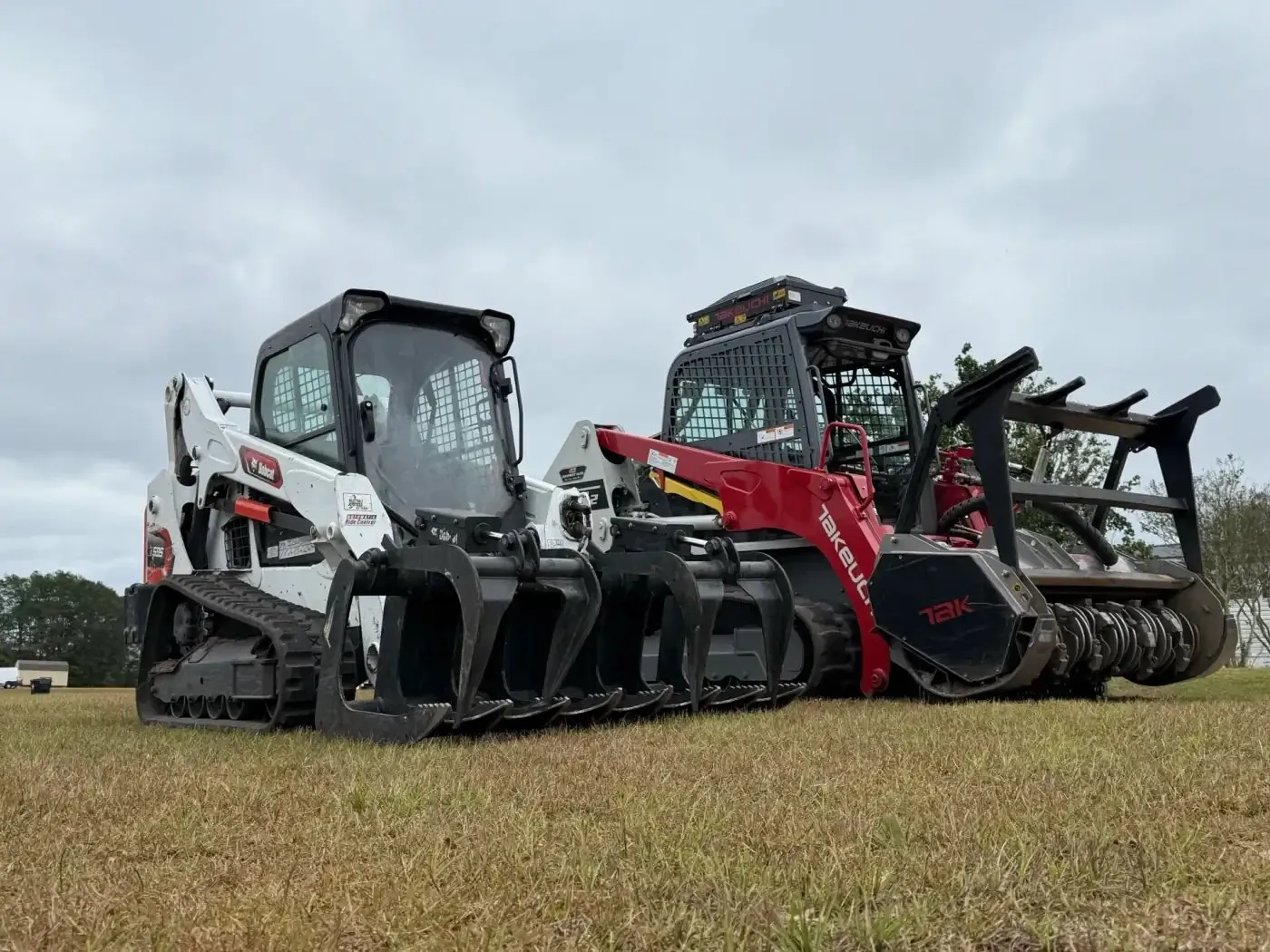
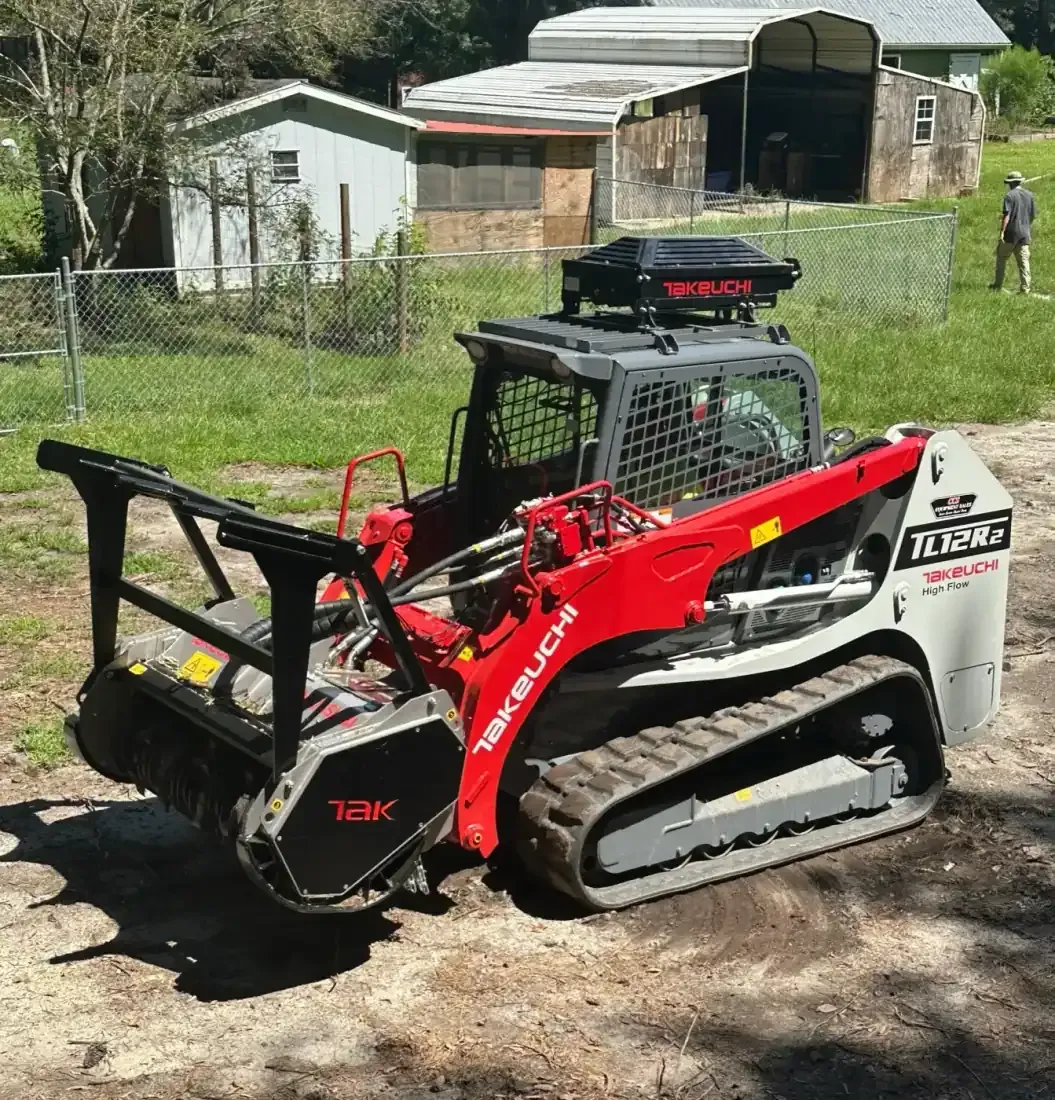
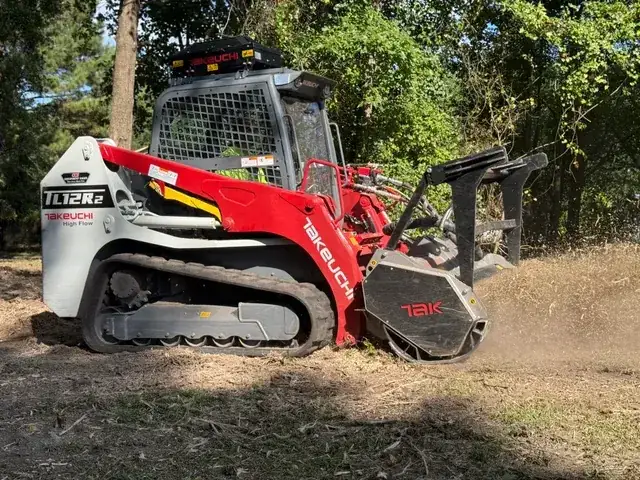
This is the core of the job. Every tree, bush, vine, and sapling on the parcel has to come down. On light-density land, our forestry mulcher handles this in a single pass. The Takeuchi TL12R2 drives through and grinds everything into mulch that stays on the ground. No hauling, no burning, no brush piles.
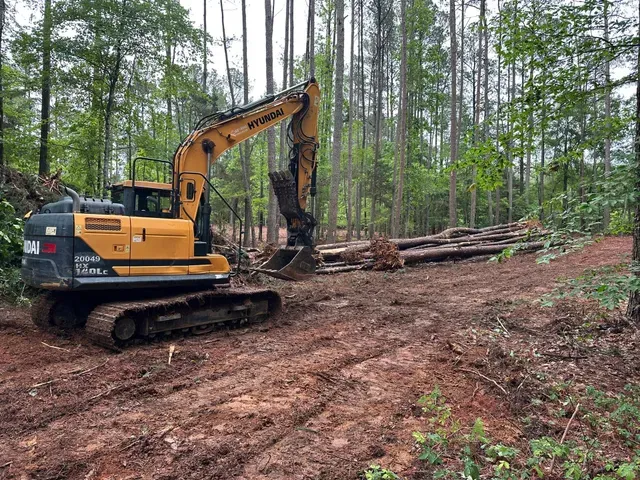
On heavier land with larger trees, we fell them with chainsaws, then process the brush with the mulcher or push it with an excavator run by our operator partners. The bigger the trees, the more crew time and equipment transitions are involved.
Debris Handling
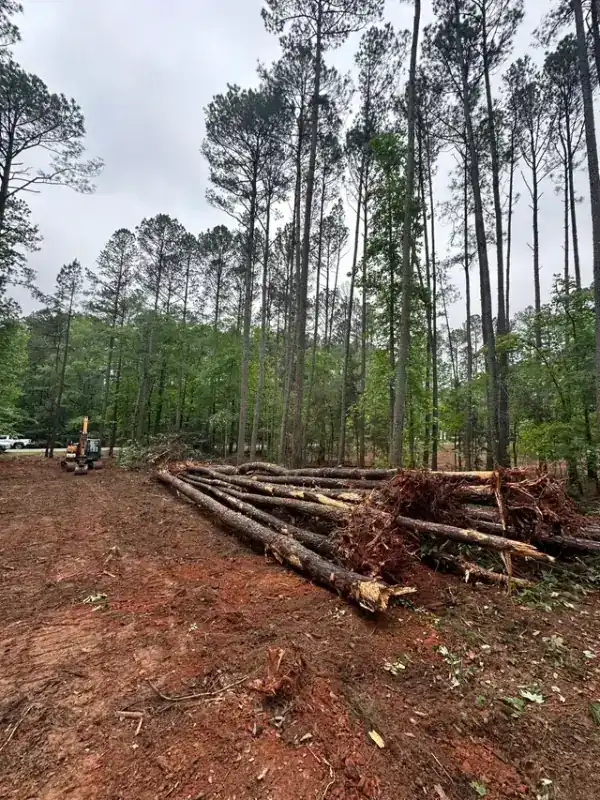
Everything that comes down has to go somewhere. Forestry mulching leaves the material on the ground as mulch. That’s one reason it’s cheaper for light-to-medium vegetation. Traditional site clearing generates piles of logs, brush, and root balls that need to be loaded and hauled.
Our grapple truck handles debris at $900 per load or $700 per load at a three-load minimum. Each load fills a 70-yard box, so one trip moves a lot of material. The number of loads depends on tree size, density, and how much can be mulched in place vs hauled. On heavy clearing jobs, debris hauling can be 20 to 30% of the total project cost.
Stump Removal
Stumps are quoted separately because not every job needs them gone. If you’re clearing for a home site, driveway, or any construction, stumps have to come out — excavator work through our operator partners pulls them, or our stump grinder takes them below grade. See our stump grinding vs removal comparison for more on the options.
If you’re clearing for hunting land, pasture, or general property maintenance, leaving stumps to rot naturally saves real money. An acre with 20 stumps can add over $1,000 to the job if you grind every one of them.
Site Prep and Grading
If the cleared land needs to be level for construction, that’s a separate step after clearing. Rough grading typically adds $500 to $1,500 per acre. This isn’t fine grading for a building pad. It’s filling holes, smoothing ruts, and knocking down high spots left from stump removal.
What Drives the Price Up
Tree Size and Species
This is the single biggest cost driver. An acre covered in 4-inch volunteer loblolly pines is a fundamentally different job than an acre of 20-inch water oaks.
Small pines grow straight, they’re relatively light, and the mulcher handles them in one pass. Large hardwoods have massive canopies, dense wood that’s heavy to handle, and root systems that fight the excavator. Species matters. A sweetgum is easier to process than a white oak of the same size.
Density
How many trees per acre? A stand of scattered pines with grass growing between them clears fast. A wall of privet, wisteria, and volunteer growth where you can’t see 10 feet ahead takes two to three times longer. Vine-covered land is especially slow because vines wrap around everything and tangle in the equipment.
Terrain
Flat land clears fastest. Slopes slow the equipment down, increase fuel consumption, and require more careful operation. Wet ground or clay soil (common in Wayne County and Wilson County) can limit equipment access entirely during wet periods. Rocky areas are rare in Eastern NC but they do show up. They wear equipment faster and slow production.
Access
Can we drive equipment directly to the work area? Or do we have to cross a ditch, navigate through a tree line, or build a temporary access path? Properties with good road frontage and firm ground clear faster and cheaper than landlocked parcels.
Haul Distance
Debris goes to a disposal facility. If the nearest one is 5 miles away, that’s one thing. If it’s 30 miles, every grapple truck trip takes an hour longer. On heavy clearing jobs with 10+ loads, haul distance can really move the total price.
What Drives the Price Down
Forestry Mulching Instead of Traditional Clearing
For land with mostly brush and small trees (under 6-8 inches), forestry mulching eliminates the most expensive part of traditional clearing: debris handling. The mulcher grinds everything in place. No hauling, no dump fees, no burn permits. On the right property, mulching can cut the total clearing cost by 30 to 50% compared to traditional methods.
Forestry mulching can’t handle large trees (anything over 6-8 inches in diameter), doesn’t remove stumps below surface level, and leaves mulch on the ground instead of bare dirt. If you need clean dirt for construction, traditional clearing is usually the better call.
Volume
Clearing 5 acres is cheaper per acre than clearing half an acre. Equipment mobilization, loading the machines, driving the grapple truck to your property, setting up, costs the same whether it’s a small lot or a large parcel. That fixed cost spreads across more production acres on bigger jobs.
Good Access and Flat Ground
If we can drive equipment off the trailer and straight into the work area on firm, flat ground, everything runs faster. No time building access, no working around slopes, no dealing with soft ground.
Keeping Logs on Site
If you don’t need every piece of wood hauled off, we can leave log piles on the property for firewood or let them decompose. This cuts debris hauling costs, sometimes by several grapple truck loads worth.
Timing
Late fall and winter are our slower months for land clearing. Scheduling during this window can mean more flexibility and sometimes better pricing. The ground is also typically drier in fall, which helps with equipment access. Spring is peak season, and that’s when demand spikes and schedules fill up. You can see it in our own job history above — the two smallest invoices landed in early winter and mid-summer, outside the spring rush.
Choosing the Right Equipment for Your Land Clearing Job
Not every piece of land needs the same treatment. Our core fleet covers the full clearing sequence: Takeuchi TL12R2 with FAE forestry mulcher head, Bobcat T595, Vermeer SC48TX stump grinder, Peterbilt grapple truck, and chainsaw crew — with excavator and crane work handled through our operator partners when a job calls for it. Knowing which combination handles your specific land fastest is what separates a good clearing job from an expensive one.
A customer who calls asking for land clearing might get a quote that’s 100% forestry mulching if the vegetation is all brush. Or it might be a hybrid job. Tree removal crew drops the big ones, mulcher handles the underbrush, grapple truck hauls what can’t be mulched. You tell us the result you want and we figure out the fastest way to get there. For more on how we price tree removal as part of a larger clearing job, see our tree removal cost guide.
A company with one piece of equipment gives you one option. If all they have is a bulldozer, everything gets dozed, whether that’s the best approach or not. We match the equipment to the land, which usually means faster work and lower cost.
Commercial land clearing for developers, municipalities, and large-scale projects follows a different pricing structure. Contact us for commercial quotes.
Land Clearing vs Forestry Mulching: Which Do You Need?
If you’re not sure whether your project is “land clearing” or “forestry mulching,” here’s the simple version.
Forestry mulching is best when your land is mostly brush, saplings, and small trees under 6-8 inches in diameter, and you don’t need bare dirt. Cheaper, faster, less soil disturbance. Read our complete forestry mulching guide for how it works, or the forestry mulching cost breakdown for its pricing.
Traditional land clearing is what you need when there are large trees, you need stumps removed, or you need clean dirt for construction or site prep. More equipment, more crew time, debris hauling — but it gets the land to a buildable or plantable state that mulching alone can’t achieve.
Most jobs are a mix of both — which the invoice table above shows better than any theory: that’s why real totals cluster near the boundary between the light and heavy per-acre bands.
Land Clearing Cost in NC vs National Averages
If you Google “land clearing cost per acre,” you’ll find articles quoting $1,500 to $5,000 as a national average. That number comes from aggregated data across the entire country, including flat Kansas grassland and Arizona desert scrub. Eastern NC is a different animal. The growing season runs nine months, the soil is fertile, and neglected land fills in with brush and volunteer trees faster than anywhere else on the East Coast.
The other reason online estimates run low: they often don’t include everything. A quoted price of $2,000 per acre for “clearing” might not include stump removal, debris hauling, or site cleanup. Our pricing covers the complete job. Everything comes down, gets hauled, and you’re left with usable land.
We also carry full insurance on every job: general liability, workers compensation, and commercial auto. That’s not cheap, and companies quoting 40% less are usually cutting costs on coverage. If an uninsured crew damages your property or an employee gets hurt on your land, you’re exposed. For more on why insurance matters, read our guide to verifying tree service insurance.
Get a Free Land Clearing Estimate
Every property is different. Aerial photos help us get a rough idea, but the only way to give you an accurate price is to walk the land in person. We look at tree density, diameter, species mix, terrain, access, and what you want done with the cleared land. Have your parcel number and acreage ready when you call and we can usually give you a ballpark before we even come out.
We provide free estimates across all nine counties in our service area: Nash, Edgecombe, Wilson, Wayne, Halifax, Johnston, Greene, Lenoir, and Pitt.
Call (252) 506-0099 or request an estimate online.
For a side-by-side look at all our service pricing, see our 2026 cost guide.
For a detailed breakdown of all our service pricing, see the pricing page.
Frequently Asked Questions
How much does land clearing cost per acre in North Carolina?
What is the cheapest way to clear land in NC?
How long does it take to clear 1 acre of land?
Does land clearing include stump removal?
Is it cheaper to clear land in winter?
Do I need a permit to clear land in NC?

Owner, DC Tree Cutting and Land Service
Anthony runs DC Tree Cutting from Rocky Mount, NC. Every article is based on real jobs, real equipment, and real pricing from across Eastern North Carolina. More about Anthony →