March 27, 2026 by Anthony Caracappa
Forestry Mulching Cost Per Acre (2026 Pricing)
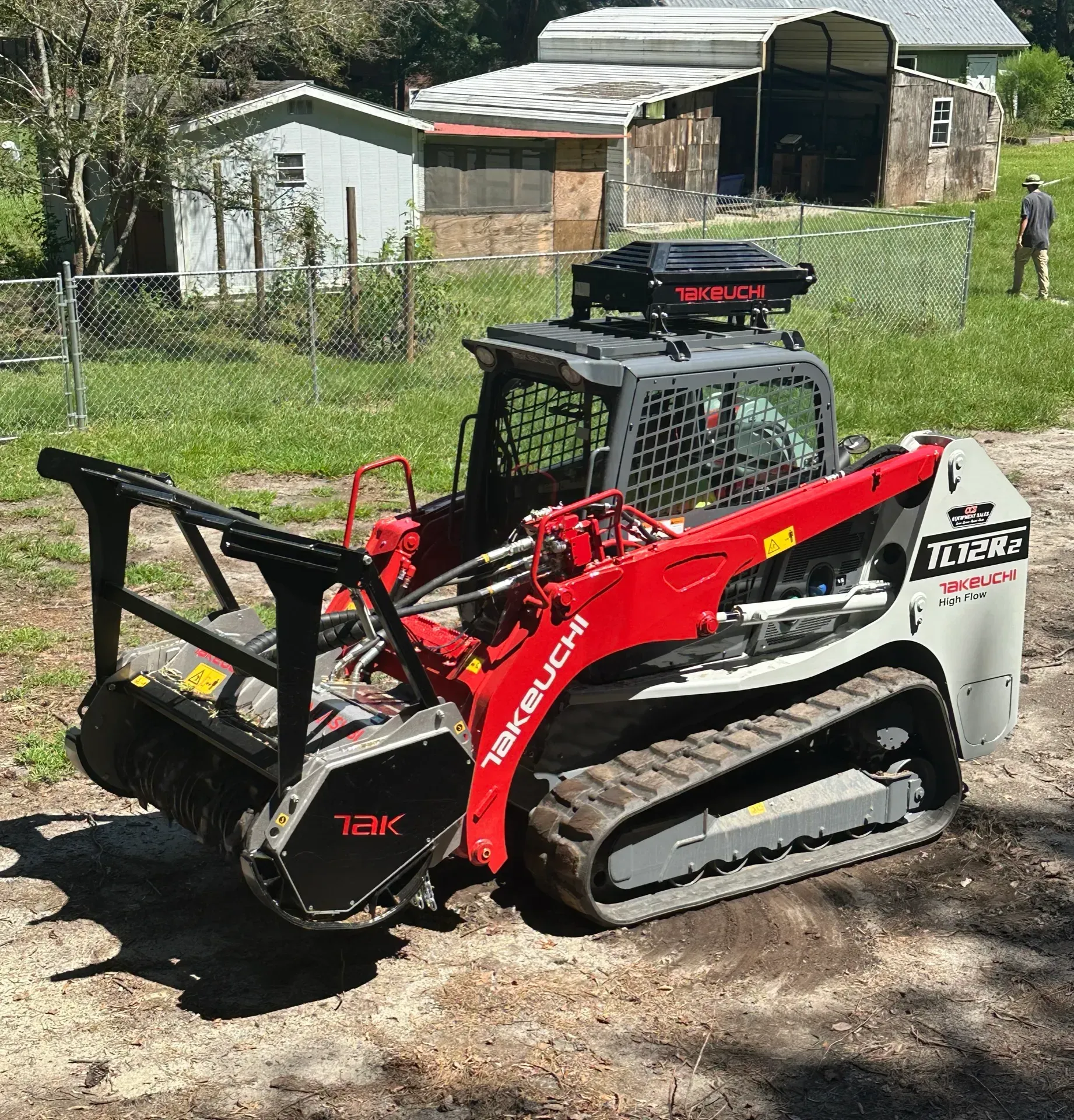
Table of Contents
How Much Does Forestry Mulching Cost in Eastern NC?
If you search “forestry mulching cost per acre,” every result gives you the same number: “$600 to $3,000 per acre.” That range comes from national data that includes flat pasture in Texas and scrubland in Arizona. It has almost nothing to do with what you’ll pay in Eastern NC. The growing season is long, the underbrush is thick year-round, and a neglected lot can go from open field to jungle in five years.
I’m Anthony Caracappa, owner of DC Tree Cutting and Land Service. We run a forestry mulching operation out of Rocky Mount and Goldsboro, covering nine counties in Eastern NC. Whether you call it forestry mulching, brush clearing, or land mulching, the cost drivers are the same. I’m going to break down our actual pricing and show you where the real savings are.
The short version: most forestry mulching in our service area runs $2,500 to $5,000+ per acre on 1-2 acre projects. Per-acre cost drops on bigger jobs. Small backyard cleanups start at $1,500.
Those numbers are higher than the national averages you’ll find online. They’re also 27 to 42% lower than what daily-rate companies charge for the same work. I’ll show you the math on that below.
How Our Pricing Works
Most forestry mulching companies charge a daily equipment rate plus labor plus cleanup. That model stacks costs on top of each other and the customer has no idea what they’re paying for until the invoice shows up.
We use a deployment model. Here’s how it breaks down.
Peak Season (March through October)
$3,500 deployment covers equipment mobilization and 6 hours of machine run time. After that, it’s $250 per hour.
That’s machine run time, not time on site. If we spend 30 minutes loading the trailer, an hour driving to your property, 20 minutes setting up, and then run the mulcher for 6 hours, those 6 hours of actual mulching are what counts against the deployment.
Slow Season (November through February)
$1,500 to $2,000 deployment covers mobilization and 3 to 6 hours of machine time. After that, same $250 per hour.
The lower deployment cost reflects lower demand during these months. The machine does the same work at the same speed. You’re getting the same result for less money because our schedule has more open slots.
Why You Pay Less With This Model
A deployment model means the price is tied to production, not to the clock. If our operator clears your property faster than estimated, you pay less. If we quoted 8 hours and it takes 6, you’re not paying for those last 2 hours of equipment sitting idle.
It also means bigger projects get cheaper per acre. That $3,500 deployment cost is the same whether you have half an acre or three acres. On a 3-acre job, the deployment spreads to roughly $1,167 per acre. On a half-acre job, it’s $7,000 per acre just for deployment. The math rewards volume.
Forestry Mulching Cost by Density and Acreage
These ranges are from our completed jobs across Nash, Wayne, Wilson, and Edgecombe counties.
1-2 Acre Projects
| Density | What’s Growing | Cost Per Acre |
|---|---|---|
| Light | Scattered brush, some saplings, mostly grass | $2,500 - $4,000 |
| Medium | Dense brush, saplings to 4”, tangled growth | $3,500 - $5,700 |
| Heavy | Wall-to-wall growth, trees to 6-8”, vines | $5,000 - $10,000+ |
3+ Acre Projects
| Density | Cost Per Acre |
|---|---|
| Light | $2,400 - $2,700 |
| Medium | $3,300 - $3,800 |
| Heavy | $5,500 - $6,700 |
That’s a 15 to 25% drop per acre on larger jobs. The equipment gets there once, sets up once, and runs all day. More acres, same fixed costs.
Small Result-Based Projects
Backyard brush cleanup, an overgrown side yard, a section behind a fence. These start at $1,500 and are priced by the result, not the acre. We look at what you want gone, figure out the fastest way to get there, and give you a flat project price. Sometimes that means the Takeuchi mulcher. Sometimes it means a Bobcat with a lighter attachment. Sometimes it means a chainsaw crew clearing by hand and the grapple truck hauling debris at $900 per load or $700 per load at a three-load minimum.
You tell us the outcome. We pick the equipment. These hybrid jobs are common and they’re usually the cheapest way to get it done because we’re not stuck using one machine for everything.
What Affects Forestry Mulching Cost
Vegetation Density
Density drives cost more than anything else. There’s no comparison between an acre of scattered brush with grass between the stems and an acre where you can’t see 10 feet ahead. Light brush might take 4 to 5 hours of machine time. Heavy growth with 6-inch trees and layered vines can take a full day or more for the same area.
Our production rate ranges from 0.4 to 1.0 acres per day depending on density. That’s a 2.5x difference in machine time, which directly affects cost.
Tree Diameter
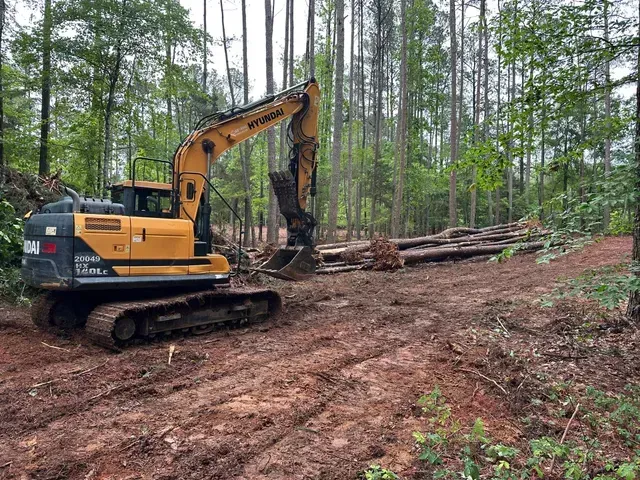
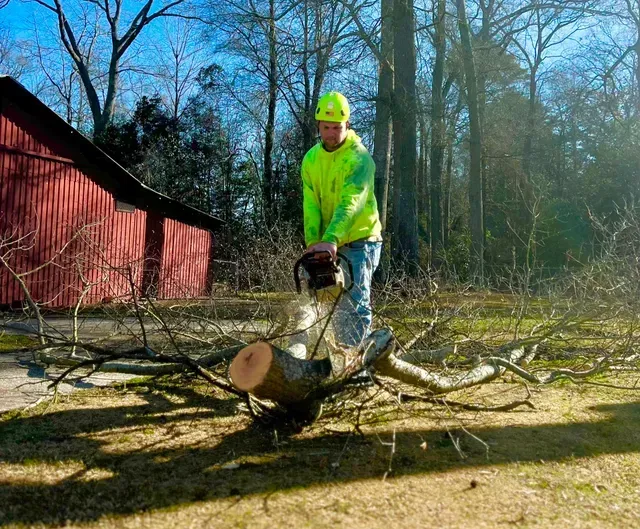
The forestry mulcher handles trees up to 6 to 8 inches in diameter. Anything larger has to be felled with a chainsaw first. If your property has scattered large trees mixed in with brush, that’s a hybrid job. The chainsaw crew drops the big trees, then the mulcher handles everything else. The chainsaw work adds cost, but it’s still cheaper than trying to clear the whole thing with an excavator. See our tree removal cost guide for what the chainsaw crew portion runs.
For properties with significant large timber, full land clearing with an excavator may be the better approach. See our land clearing cost guide for pricing on those jobs.
Terrain
Flat ground clears fastest. The operator can run the machine at full speed in straight passes. Slopes slow everything down because the machine needs more careful handling for traction and stability. Wet clay, common in Wayne County and Wilson County, can stop a job entirely if the ground is saturated. We’ll reschedule before we tear up your property.
Access
Can we unload the Takeuchi off the trailer and drive straight to the work area? Or do we need to navigate through a gate, across a ditch, around a house, and through a tree line? Every obstacle between the trailer and the vegetation is time the machine isn’t mulching.
Haul Distance to Your Property
Equipment mobilization takes time. A job 10 minutes from our Rocky Mount yard has a different mobilization window than a job in Pitt County or Halifax County. This is baked into the deployment cost, not charged separately.
Why Per-Acre Pricing Doesn’t Tell You Much
“What does forestry mulching cost per acre?” is the most common question we get. It’s also the hardest to answer honestly, because per-acre cost changes dramatically based on total project size.
Here’s an example using medium-density brush at peak season pricing.
Half-acre job: The $3,500 deployment covers 6 hours of machine time. Medium brush on half an acre takes roughly 4 to 5 hours. Total cost lands around $3,500 to $4,000. That’s $7,000 to $8,000 per acre if you do the math. But you’re not clearing an acre. You’re clearing half an acre and the deployment cost is eating the budget.
1-acre job: Same deployment, but the machine runs closer to 6 to 8 hours. Total lands around $3,500 to $4,000, possibly $4,500 if it runs over. Per-acre cost: $3,500 to $4,500. Much more reasonable.
3-acre job: The deployment covers the first 6 hours. The remaining time runs at $250 per hour. Medium density on 3 acres takes roughly 12 to 15 hours across two days. Total comes in around $5,000 to $5,750. Per-acre: roughly $1,700 to $1,900. Now we’re well below the national average.
5-acre job: Same math, more spreading. Five acres of medium density takes 3 to 4 days. Total might run $7,000 to $8,500. Per-acre: $1,400 to $1,700.
The per-acre number at 5 acres is less than half what it is at half an acre. The only difference is how many acres absorb the fixed deployment cost.
This is why anyone quoting you a flat per-acre rate without asking about your total acreage is either padding the price on big jobs or losing money on small ones.
Our Pricing vs. Daily-Rate Companies
Some companies price forestry mulching as a daily equipment rate plus daily labor rate plus cleanup. That model looks something like this:
- Equipment: $2,400 to $3,200 per day
- Operator/labor: $800 to $1,300 per day
- Cleanup and mobilization: $1,600
- Total for one day: $4,800 to $6,100
If that company clears one acre per day at medium density, the implied per-acre cost is $4,800 to $6,100. On heavy vegetation where production drops to half an acre per day, the implied cost jumps to $9,600 to $12,200 per acre.
Compare that to our deployment model on the same 1-acre medium-density job: $3,500 to $4,500. That’s a 27 to 42% difference depending on where both estimates land.
The gap gets wider on multi-acre jobs. A 3-acre job under the daily-rate model runs 2 to 3 days, so $9,600 to $18,300. Under our model, that same 3 acres runs $5,000 to $5,750 total (deployment plus overage hours). Less than half.
I’m not saying daily-rate companies are ripping people off. They might have higher overhead. But you should understand the model before you sign anything, and you should compare apples to apples.
Slow Season Savings (November through February)
If your project isn’t time-sensitive, scheduling during our slow season can save you real money.
Peak season deployment is $3,500. Slow season deployment drops to $1,500 to $2,000. That’s $1,500 to $2,000 in savings before a single tree gets mulched.
On a 1-acre medium-density job, peak season pricing runs $3,500 to $5,700. The same job in December or January might come in at $2,500 to $4,000. Same machine, same operator, same result.
The slow season discount exists because demand drops. Fewer people are thinking about land clearing when the leaves are down and it’s 40 degrees outside. That’s exactly when you should be calling. The ground is often drier in fall, which helps with equipment access. Snakes are dormant, and without full leaf canopy the operator can actually see what they’re cutting.
Hunting land prep, pasture reclamation, and construction site prep are all jobs that can wait for the right season.
Real Jobs From Our Service Area
These are actual jobs we’ve completed. Pricing varies, but they give you a realistic sense of what to budget.
1 acre of medium brush in Wayne County, overgrown residential lot. Former side yard that hadn’t been touched in about 8 years. Dense sweetgum saplings, privet, and honeysuckle. Nothing over 5 inches in diameter. The Takeuchi ran for about 6 hours and cleared the full acre. Peak season. Total came in right at $3,700.
2 acres of light brush in Nash County, fence line and field edge. A farmer wanted the brush knocked back along 1,200 feet of fence line plus a strip of volunteer pine along the field edge. Light density, flat terrain, great access. Machine ran about 7 hours across one long day. Total was around $5,200, which works out to $2,600 per acre.
3 acres of heavy growth in Wilson County, abandoned farmland. This property had been idle for over 12 years. Thick mix of pine, sweetgum, and cedar, some trees up to 8 inches, with blackberry and honeysuckle layered through all of it. Two full days of mulching plus a half-day of chainsaw work on the larger stems. Total landed around $17,500, roughly $5,800 per acre. Not cheap, but this was essentially reclaiming land from the woods.
Quarter-acre backyard cleanup in Edgecombe County. Homeowner had an overgrown section behind the house. Brush, small pines, and years of neglect. This was a result-based project. We brought the right equipment for the space and cleared it in a few hours. Under $2,000. Priced by the outcome, not the acre.
5 acres of medium density in Wayne County, hunting land management. Landowner wanted undergrowth cleared to open up shooting lanes and create food plot sites. Mixed brush and saplings on mostly flat ground with good access from a logging road. Three days of mulching. Total was around $14,500, which works out to $2,900 per acre. The volume discount on a job this size makes a big difference compared to per-acre pricing on a 1-acre job.
Forestry Mulching vs. Land Clearing Cost
Knowing the difference between forestry mulching and land clearing saves you money. They overlap, but they’re not the same service.
Forestry mulching handles brush, saplings, and trees up to 6 to 8 inches. Everything stays on the ground as mulch. No hauling. Best for overgrown lots, hunting land, fence lines, pasture reclamation, and site prep phase one.
Traditional land clearing brings in the excavator, chainsaws, and grapple truck. It handles any size tree, removes stumps, and can grade the site. Required when you have large timber, need bare dirt for construction, or need stumps out.
Cost comparison on the same 1-acre lot with medium vegetation:
- Forestry mulching: $3,500 to $5,700
- Traditional land clearing: $4,000 to $8,000 (includes hauling at $900 per grapple load)
Forestry mulching saves 20 to 40% on the right property because it eliminates hauling costs. Traditional clearing generates debris that has to be loaded and trucked out at $900 per grapple load or $700 at a three-load minimum. That adds up fast on any job with significant timber. The mulcher skips all of that.
Where land clearing wins is on heavy timber. If your property has 18-inch oaks and large pines, those logs have value. A clearing crew can sell the timber, which offsets the higher equipment cost. The mulcher can’t process trees that large, and you wouldn’t want to grind sellable timber into chips anyway.
Most of our jobs are a hybrid. The mulcher handles the underbrush and small trees. A chainsaw crew drops the bigger stuff. The grapple truck hauls what can’t stay on site. You tell us what you want the land to look like when we’re done, and we figure out the cheapest way to make it happen. Read our forestry mulching guide for more detail on how the equipment works and what it can handle.
How to Get the Best Price on Forestry Mulching
Schedule during slow season. November through February. Lower deployment cost, same quality work.
Bundle acreage. If you have a neighbor who also needs clearing, combining the jobs saves both of you money. One deployment, two properties.
Good access matters. If you can clear a path for the trailer before we arrive, or make sure gates are open and the route to the work area is passable, that saves setup time.
Know what you want. “Clear everything” is a clear instruction. “Clear some of it but leave the nice trees” requires the operator to slow down and make judgment calls on every stem. Both are fine, but the first one is faster.
Don’t wait. Brush that takes 6 hours to mulch this year will take 10 hours next year. Vegetation in Eastern NC grows fast. A property that’s a $3,500 job today could be a $5,500 job in two years if you let it keep growing.
Get a Free Forestry Mulching Estimate
We can’t quote forestry mulching from a photo or a phone call alone. Aerial images don’t show stem diameter, vine density, or how soft the ground is. We need to walk it. Bring us your parcel info and acreage when you call, and we can usually ballpark it before we come out. The on-site estimate is free and locks in exact pricing.
We cover Nash, Edgecombe, Wilson, Wayne, Halifax, Johnston, Greene, Lenoir, and Pitt counties from our Rocky Mount and Goldsboro yards.
Call (252) 506-0099 or (252) 506-0099, or request an estimate online.
See all our service pricing on the pricing page.
Frequently Asked Questions
How much does forestry mulching cost per acre? +
Why is forestry mulching cheaper than traditional land clearing? +
Is forestry mulching cheaper in winter? +
What is the minimum cost for forestry mulching? +
How many acres can a forestry mulcher clear in a day? +
Does project size affect the per-acre cost? +

Anthony Caracappa
Owner, DC Tree Cutting and Land Service
Anthony runs DC Tree Cutting from Rocky Mount, NC. Every article is based on real jobs, real equipment, and real pricing from across Eastern North Carolina.