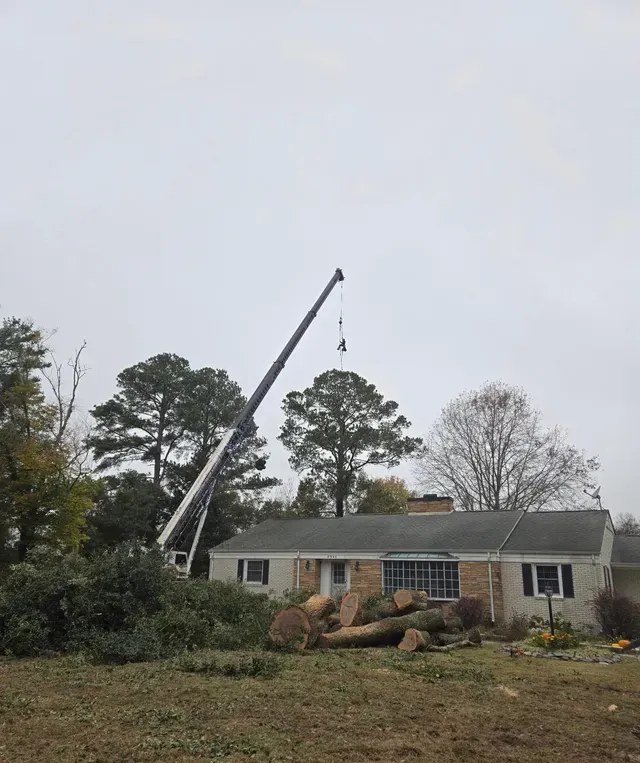
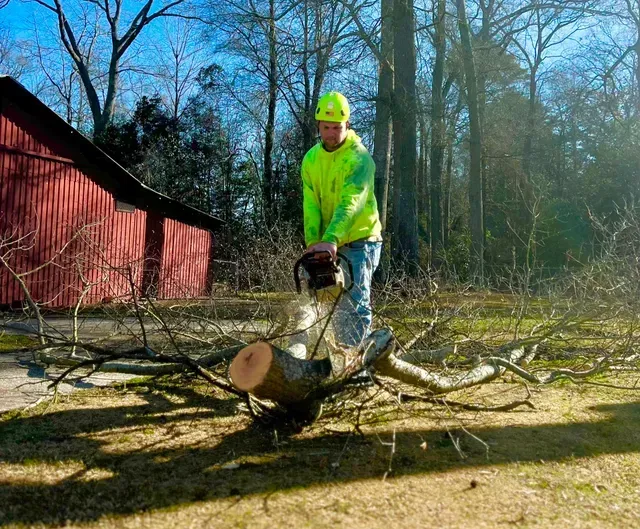
Storm Damage Tree Cleanup in Eastern NC
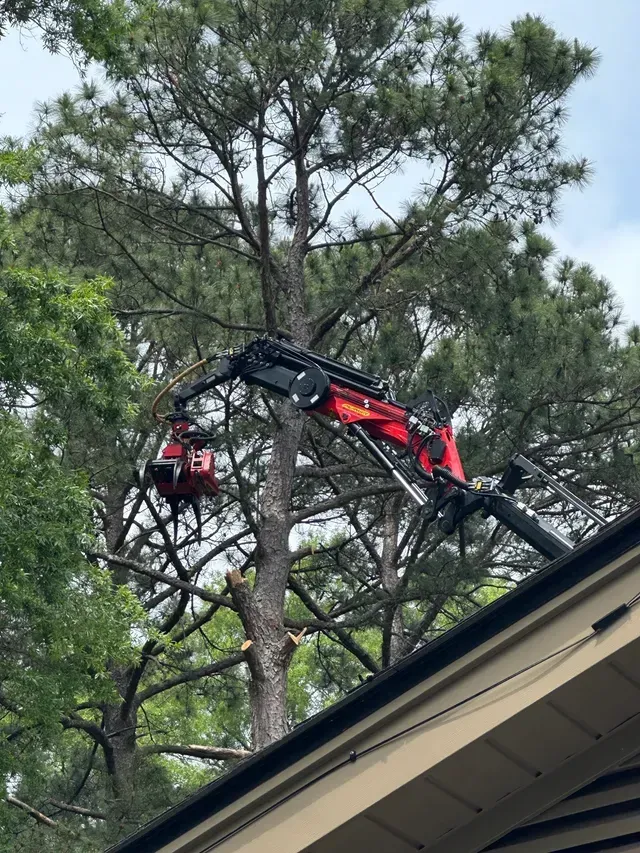


Table of Contents
What to Do When a Tree Falls on Your House
The wind stops. You walk outside and there’s a pine tree across your driveway, a limb through your back deck, and half the neighborhood looks the same. Eastern NC gets hit hard. Hurricane Florence in 2018. Hurricane Matthew in 2016. The derecho in 2022. Ice storms that snap pines across entire counties.
If you have a tree emergency right now, call (252) 506-0099. We answer 24/7.
I’m Anthony Caracappa, owner of DC Tree Cutting and Land Service. We run emergency tree service crews out of Rocky Mount and Goldsboro. We’ve worked every major storm event in the region. I’m going to walk you through what to do when a storm puts trees on the ground, on your house, or across your road.
Storm Damage Safety: What to Check First
Before you touch anything or call anyone, check these:
Power lines. If a tree is on or near a power line, or if a line is down anywhere on your property, stay at least 35 feet away. A downed line can energize the ground around it. Call Duke Energy at 1-800-769-3766. Do not assume a downed line is dead.
Structural damage. If a tree went through your roof or into a wall, do not go into those rooms. The structure may be compromised. Get everyone out and stay out until the tree is removed and the damage is assessed.
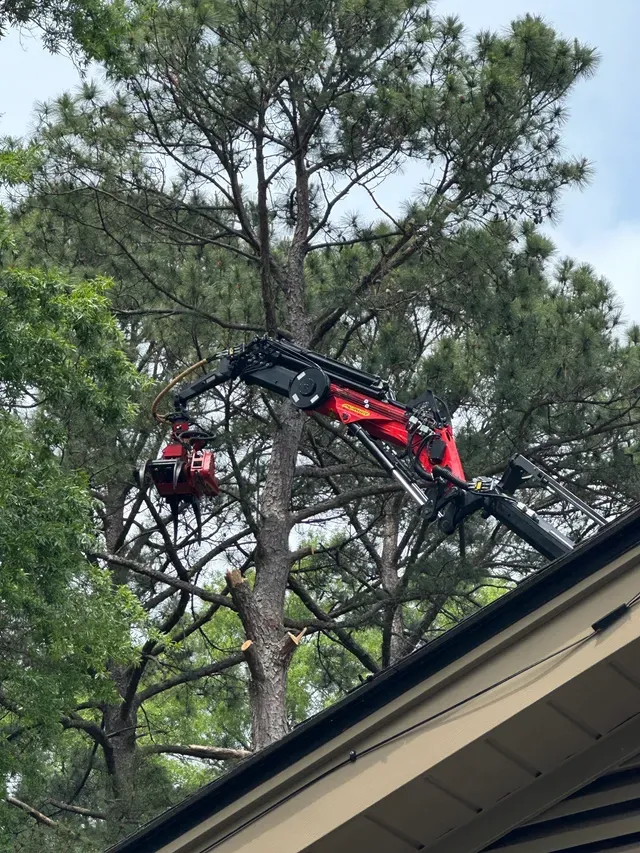
Hanging limbs. Look up before you walk around your yard. Broken limbs wedged in the canopy can drop without warning. These are called widow-makers and they kill people every year after storms. If you see a large limb that’s broken but still hanging, keep everyone away from under it.
Gas lines. If you smell gas or a tree hit your meter, call your gas company and evacuate. This comes before tree removal.
Once you’ve confirmed nobody is hurt and there are no immediate hazards, take photos of everything. You’ll need them for insurance.
Who to Call and in What Order
If anyone is injured or trapped: Call 911. We’re tree guys, not first responders.
If power lines are involved: Call Duke Energy (1-800-769-3766), then call us.
If a tree hit your house: Call us at (252) 506-0099. Then call your insurance company. We can usually get to structure-related emergencies faster than most situations because we triage those first.
If a tree is just down in your yard: Call us to schedule removal, but this is not an emergency. You’ll save money by having it removed at regular rates instead of emergency pricing. A tree lying in your yard that isn’t on a structure or blocking access can wait a few days.
What Storm Damage Tree Removal Costs
Emergency tree work costs more than scheduled work. There’s no getting around that. Our crews respond after hours, on weekends, and during active storm recovery when demand is highest. The premium covers getting a crew out fast and the fact that storm work is harder, messier, and more dangerous than normal removal.
We don’t publish fixed emergency rates because every situation is different. A 30-foot pine across a driveway is a completely different job than a 70-foot water oak through a roof with power lines tangled in the canopy. We give you a price before we start. No surprises.
What I can tell you:
Scheduled tree removal runs $500 to $9,000+ depending on size and complexity. See our full tree removal cost guide for what drives that range. Emergency work on the same tree will cost more because of the response premium, the conditions we’re working in, and the urgency.
The biggest storm cleanup cost driver is complexity, not size. A large tree lying clean in the yard is straightforward. A medium tree on a roof with live wires nearby is a rigging job that takes all day. The location of the tree matters more than the size.
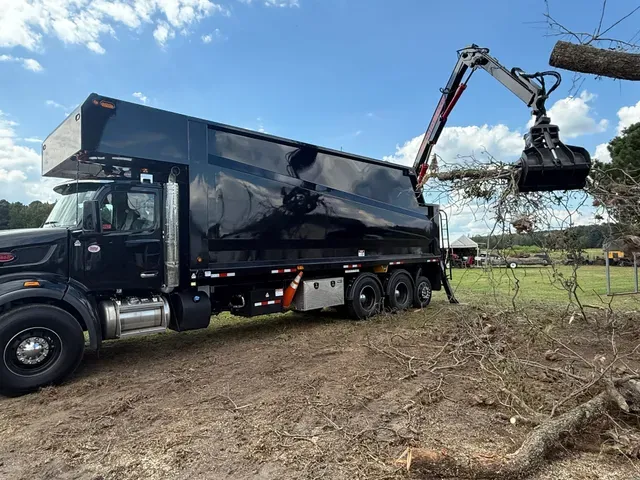
Debris removal adds to the cost. Our grapple truck handles storm debris at $900 per load or $700 at a three-load minimum. For more on how that compares to renting a dumpster, see our grapple truck vs dumpster comparison. After a major storm, there’s usually a lot of debris beyond just the one tree that caused the damage.
Tarping is typically included. If a tree went through your roof, we tarp the opening after removal to prevent water damage. That’s part of the emergency removal price.
How Insurance Works for Storm Damage
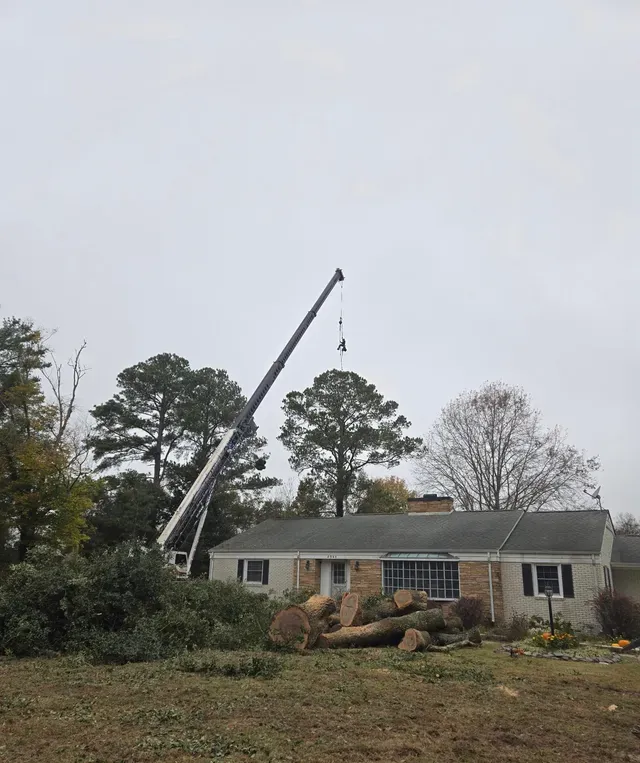
Most homeowner policies cover storm damage tree removal when a tree damages an insured structure. Here’s what we see working with adjusters across Nash, Wayne, Wilson, and the surrounding counties.
What’s Usually Covered
- Tree removal from your house, garage, fence, shed, or other insured structure
- Debris removal from the area around the damage
- Temporary protection (tarping the roof)
- Stump removal if the stump is blocking necessary repairs
What’s Usually Not Covered
- A tree that fell in the yard but didn’t hit anything insured. It just fell. Insurance considers this your problem.
- Preventive removal of a tree that hasn’t fallen yet, even if it looks like it might
- Trees that were clearly dead before the storm. Adjusters check. If it was obviously dead and you left it standing, your claim gets harder.
How to File Your Claim
Document everything before anyone touches the tree. Walk around the damage. Take photos from multiple angles. Photograph the tree where it fell, the point of contact with the structure, and any secondary damage. Timestamp these photos.
File your claim early. After a major storm, claim volume is enormous. The sooner you file, the sooner an adjuster gets assigned.
Get a tree service that documents for adjusters. We photograph before, during, and after removal. Our invoices break everything out the way adjusters want to see it: tree removal, debris hauling, tarping, stump grinding, all separate line items. We can meet your adjuster on site to walk the damage if needed.
Keep the tree service invoice separate from the roofing contractor. Some homeowners combine everything and it creates confusion for the adjuster. Tree removal is one scope. Roof repair is another. Keep them clean.
We don’t file claims for you and we don’t inflate invoices. We charge what the work costs and document it so the claim goes smoothly.
Watch Out for Storm Chasers
After every major storm, unlicensed guys with chainsaws show up looking for quick cash. They go door to door, offer a low price, and disappear. No insurance, no contract, cash only, often out-of-state plates. If they drop a limb on your house or an employee gets hurt in your yard, you’re the one exposed.
Make sure whoever shows up carries liability, workers comp, and commercial auto. Ask for a certificate of insurance. Any real company provides one without hesitation. For more on what to look for, read our guide to verifying tree service insurance.
Preparing Your Property Before Storm Season
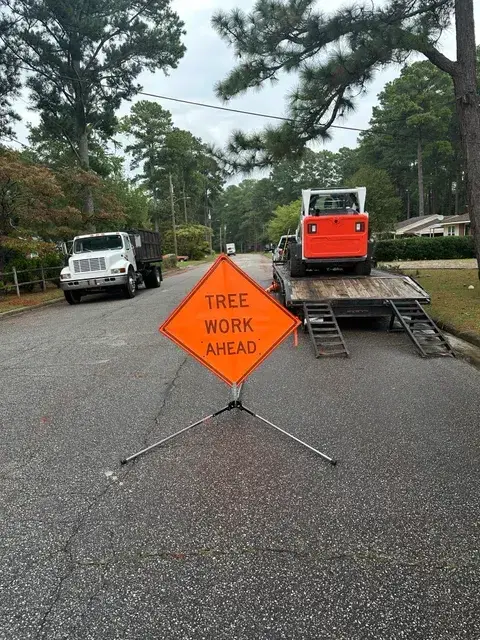
Hurricane season starts June 1 in Eastern NC. Ice storms can hit anytime from December through February. The best time to deal with storm risk is before the storm.
Remove Dead Trees Now
A dead tree standing in your yard is coming down in the next big wind event. You already know where it’s going to end up. Remove it on your schedule and it costs less than emergency removal after it lands on your house. Insurance adjusters also look for evidence of neglect. A clearly dead tree that you left standing for two years before it crashed through your roof is a harder claim than one that was healthy and fell in a freak storm.
If you’re not sure whether a tree is dead or just stressed, read our guide to identifying dead or dying trees. When in doubt, call us for a free assessment.
Trim Overhanging Limbs
Large limbs extending over your roof, deck, or vehicles are the most common source of storm damage. Tree trimming to remove deadwood and reduce the canopy over structures is the best thing you can do before storm season. Trimming a large oak costs $1,500 to $2,500 — see our tree trimming cost guide for the full size-by-scope breakdown. Removing it from your roof after it fails costs significantly more.
Know Your Problem Trees
Some species are more storm-prone than others in Eastern NC:
Water oak is the biggest offender. They grow fast, develop wide canopies, and are prone to internal decay that’s invisible from the outside. A water oak that looks healthy can be hollow in the trunk and nobody knows until the wind test comes.
Loblolly pine breaks clean in high wind because the wood is brittle compared to hardwoods. Tall pines in a line are especially vulnerable because the edge trees catch the full wind load. If you have a row of 80-foot pines along your property line next to your house, those are worth evaluating.
Bradford pear (and the similar Callery pear cultivars) have weak branch structure that splits apart in any significant wind event. If you have one near a structure, plan on it coming apart in the next real storm. For more on species-specific risks, see our Eastern NC tree guide.
Sweetgum has shallow root systems that make it prone to uprooting in saturated soil. After heavy rain followed by wind, sweetgums come out of the ground root ball and all.
Create Defensible Space
You don’t have to clear-cut your property to reduce storm risk. Focus on:
- Get the dead limbs out of any tree near a structure.
- If a tree is leaning toward your house, have it evaluated.
- Thin out dense canopy over your roof so wind passes through instead of catching it like a sail.
- Watch for visible root damage, fungal growth on the trunk, or cracks in the main stem.
If you have multiple trees that need attention, a single visit to trim or remove the high-risk ones is cheaper than dealing with them one at a time after they cause damage.
After the Cleanup: What’s Left to Do
The tree is off your roof, the debris is hauled, and the tarp is up. What now?
Get a roofer. The tarp is temporary. It keeps rain out but it’s not a permanent fix. Schedule a roofing contractor to assess and repair the damage. If your insurance adjuster hasn’t visited yet, tell the roofer to document everything and coordinate with the adjuster.
Check for hidden damage. A tree through a roof can crack rafters, damage insulation, and compromise the ceiling below. Water may have gotten in before the tarp went up. Have the roofer and your insurance adjuster check for secondary damage.
Grind the stump. If the tree left a stump where you don’t want one, our stump grinding service handles that. See our stump grinding vs removal comparison for more on the options. It doesn’t have to happen right away. Most people deal with it once things settle down.
Evaluate remaining trees. A storm that takes one tree often damages others nearby. Cracked branches, shifted root plates, and bark damage from falling debris can turn a tree that survived into the next one to come down. Walk your property after the cleanup and look for new problems. We offer free assessments to check for storm damage you might miss.
Land Clearing After Major Storm Events
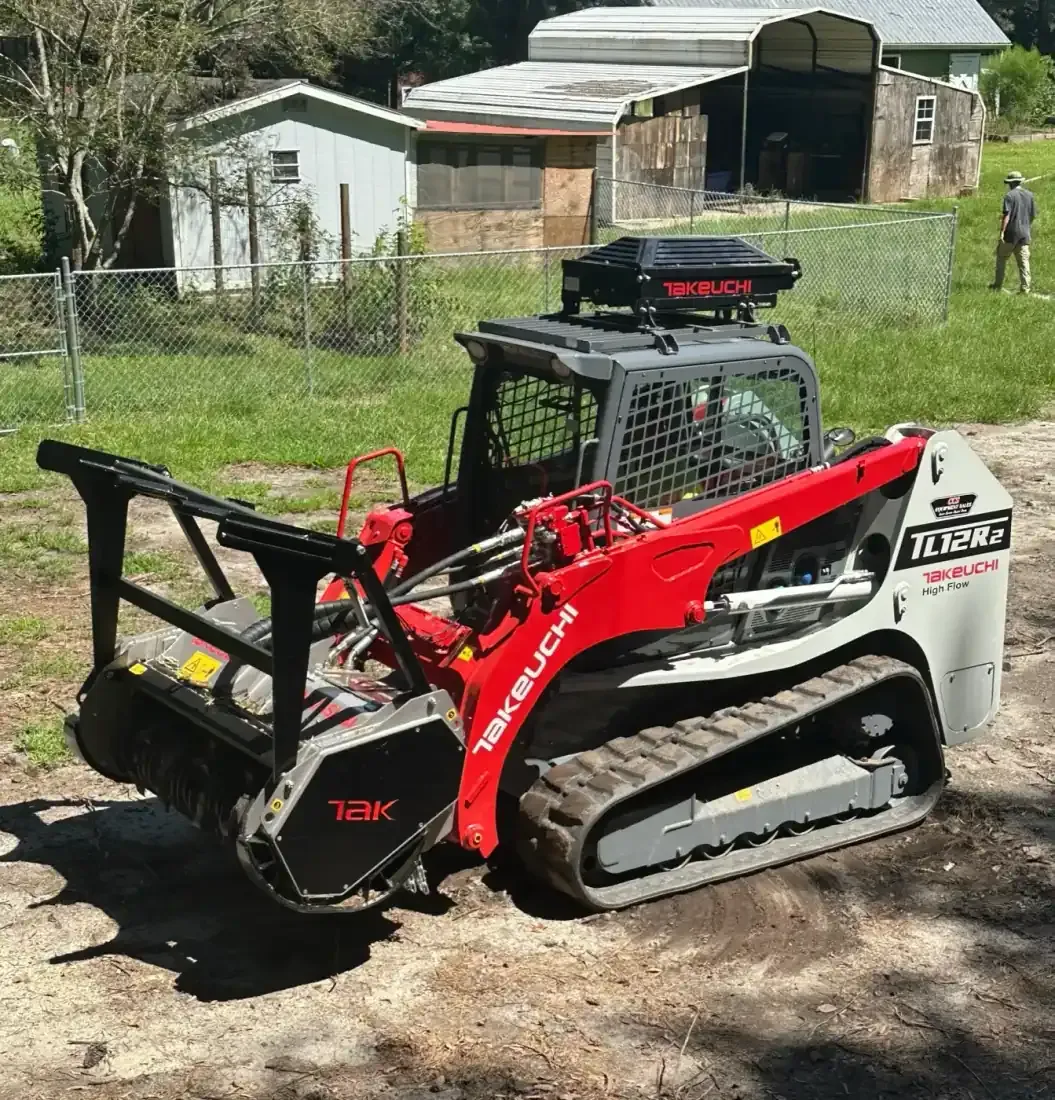
Sometimes a storm does enough damage that the cleanup is really a clearing project. An acre of snapped pines and tangled debris isn’t emergency removal, it’s a clearing job. After the immediate hazards are handled, we bring in the excavator, forestry mulcher, and grapple truck to restore the property. Commercial properties with extensive storm damage often need this approach. See our land clearing cost guide for what those projects typically run.
Call Us Before the Storm, Not Just After
We’d rather help you reduce risk than clean up after the fact. Free estimates for preventive tree trimming and removal are available across all nine counties: Nash, Edgecombe, Wilson, Wayne, Halifax, Johnston, Greene, Lenoir, and Pitt.
For emergencies, call (252) 506-0099 any time, day or night.
For preventive work and scheduled removal, call during business hours or request an estimate online.
For all service pricing, visit the pricing page.
Frequently Asked Questions
What should I do if a tree falls on my house?
Does homeowners insurance cover storm damage tree removal?
How much does emergency tree removal cost after a storm?
Should I remove dead trees before hurricane season?
Will insurance pay for tree removal if the tree didn't hit anything?

Operations, DC Tree Cutting and Land Service
Anthony runs DC Tree Cutting from Rocky Mount, NC. Every article is based on real jobs, real equipment, and real pricing from across Eastern North Carolina. More about Anthony →