How Much Does Tree Trimming Cost in Eastern NC?


Table of Contents
Trimming is the service people put off longest because nobody tells them what it’s going to cost. Removal is simple. The tree comes down and you pay for it. Trimming is messier. “A few branches off the oak” could mean thirty minutes or a full day on a rope, and nobody warns you which one your tree is before you call.
I’m Anthony Caracappa. I own DC Tree Cutting and Land Service out of Rocky Mount, and we run trimming jobs across nine counties in Eastern NC — Nash, Wayne, Wilson, Edgecombe, Halifax, Johnston, Greene, Lenoir, and Pitt. This is the same treatment I gave tree removal cost: real pricing from our work, no national averages, no dodging the question.
The short answer
Most residential tree trimming in Eastern NC costs $500 to $3,000 per tree. A medium yard tree — say 40 feet, deadwood cleaned out, some clearance off the house, canopy thinned a bit — usually lands somewhere between $1,100 and $1,300.
Here’s the range by size:
| Tree Size | Typical Cost |
|---|---|
| Small (under 25 ft) — crape myrtles, ornamentals | $500 – $800 |
| Medium (25-50 ft) — yard trees, young oaks, pines | $800 – $1,500 |
| Large (50-75 ft) — mature oaks, pecans, sweetgums | $1,500 – $2,500 |
| Very large (75+ ft) — specimen trees, old hardwoods | $2,500 – $3,000+ |
Scope matters as much as size. A light clean on a 70-foot tree can cost less than a heavy reduction on a 35-foot one. The ranges above assume average scope on a tree in normal shape. If your tree is hanging over the roof, in a fenced backyard with no truck access, or hasn’t been touched in ten years, expect the top of the range or above.
What drives the price up
Size and canopy spread
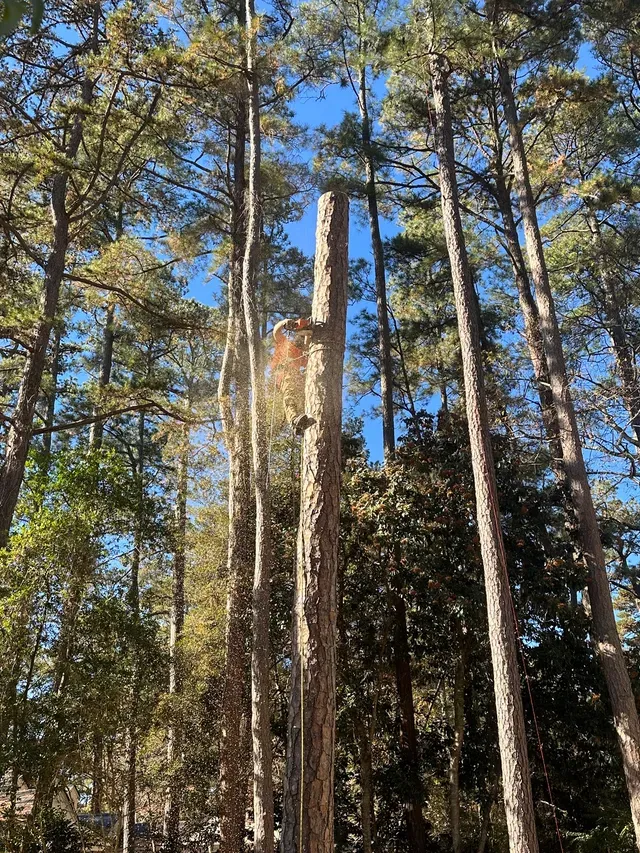
Height is the starting point. Canopy spread matters almost as much. An 80-foot loblolly with a narrow crown is less work than a 50-foot white oak with a 60-foot lateral spread. Climbers get paid for linear feet of branches, not vertical feet.
Scope of work
This is the biggest variable on any given tree, and it’s where two quotes on the same tree can come in at completely different numbers.
A light trim — deadwood out, clearance over the driveway or off the house, maybe a crossing branch or two — is usually one to two hours of climb time. That puts you at the bottom of whatever size range your tree is in.
A full crown reduction — pulling every major branch back to bring the height and spread down — is a completely different job. Every cut is planned. Every piece gets rigged or lowered. A 50-foot tree can easily take a full day, and you’re at the top of the size range or into the next one.
A crown clean plus reduction plus clearance is what most neglected trees actually need. Deadwood out, interior opened up, weight reduced on the extended laterals, clearance restored around the house. On a mature tree that hasn’t been touched in years, that’s most of a day.
When we quote, we’re quoting the scope we agreed on with you during the walkthrough. If you want more while we’re on-site, we’ll adjust. That’s why we walk the property together before anything gets on paper.
Proximity to your house, fence, and anything you’d hate to replace
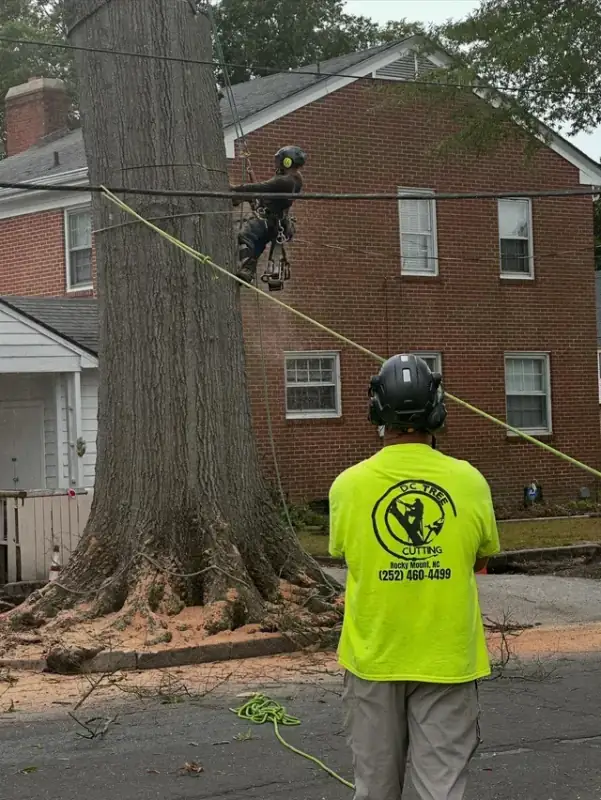
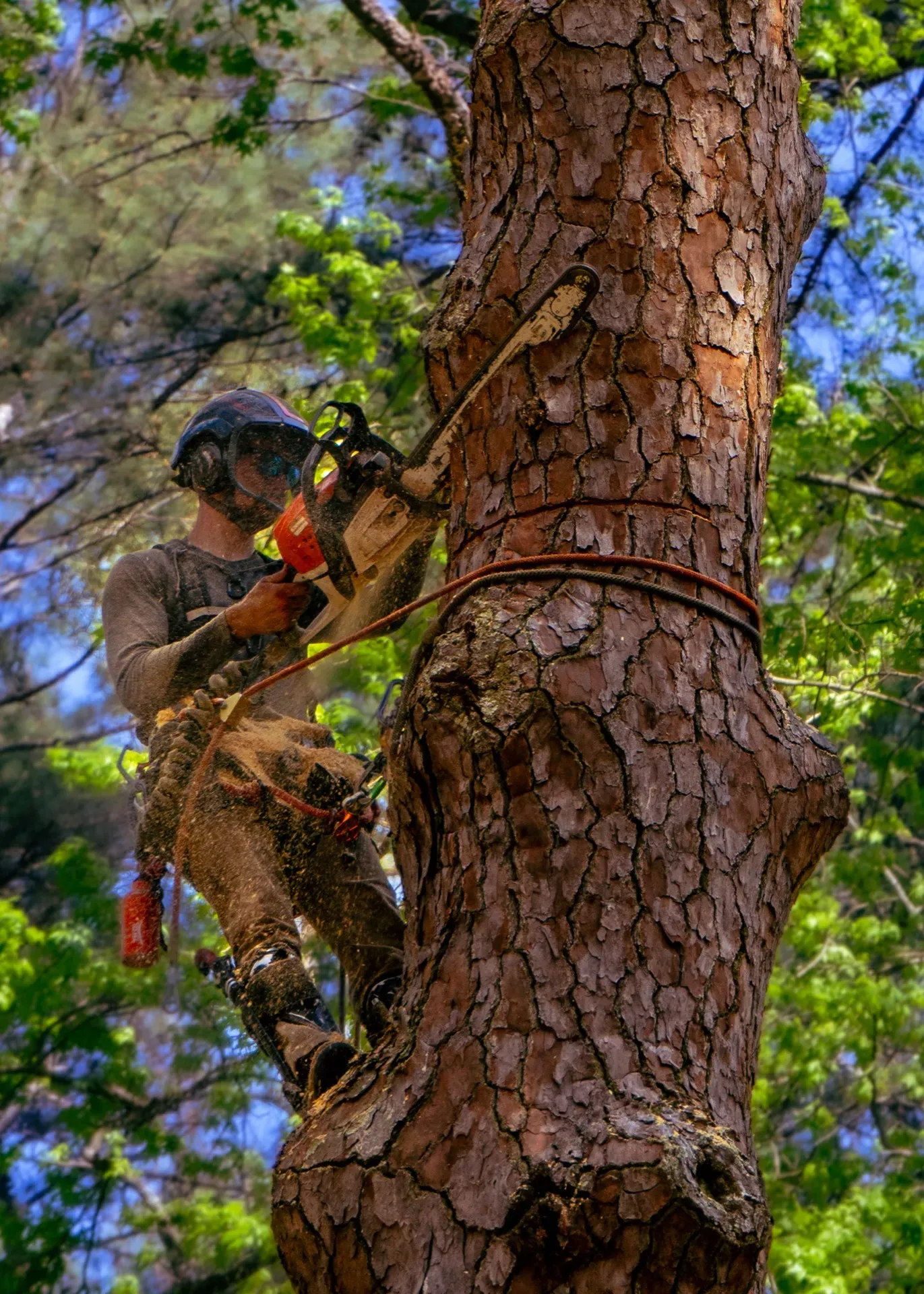
A tree standing alone in the middle of a yard gets trimmed conventionally. Cut, drop, process on the ground, haul it out. A tree twelve feet from your house with limbs over the roof turns into rigging. Every piece comes down on a rope, controlled by a friction device, guided to the ground by the guys below. Rigging is slower than dropping. Always.
A medium oak in the open might be a $900 job. The same tree against a house with rigging on most of the work is closer to $1,400 to $1,800 for the same scope. The tree didn’t change. The risk did.
Power lines
I want to be straight about this one because it’s where homeowners get lied to.
There’s a standard called ANSI Z133, which is what every legitimate tree service in the country follows. It says if you’re not specifically qualified as a line-clearance arborist, you can’t work within 10 feet of an energized line, period. Line-clearance certification is a separate license. We don’t hold it, so we stay outside that 10-foot window. Anything inside it is a job for the utility’s line crew — Duke Energy, your local co-op, or their contractor.
If you’re calling around and someone tells you they’ll handle a branch actually touching the power line, one of two things is true: they’re lying, or they’re about to get somebody killed. Ask. A real tree service will give you the same answer I just did.
Species
This is where Eastern NC gets specific.
Water oak is the tree we see most in residential yards and also the most work per foot. Soft wood, brittle limbs, fast regrowth. You can trim a water oak, come back two years later, and it looks like you never touched it. We recommend a maintenance cycle closer to every two or three years on these, not five.
Willow oak is the big-canopy tree on a lot of our properties. An 80-foot willow oak can have a canopy spread bigger than the house underneath it. All of that spread is linear feet of climbing.
Pecan is the tree that actually scares me. Long, heavy lateral limbs that can drop without warning even when they look fine — that’s called summer branch drop and it’s documented in pecans specifically. I price pecans accordingly, and any climber who doesn’t is going to have a bad day eventually.
White oak grows slower, has stronger wood, and is generally easier to work than water oak. But the mature ones develop huge spreading canopies that need real reduction work when they start overhanging a roof.
Loblolly pine is usually the easy one, but only if it’s healthy. A dead loblolly rots from the inside out and the pith can give way under a climber’s weight. We don’t send anyone up a declining pine. We drop those.
Sweetgum grows fast, drops gumballs, and needs structural work when it’s young or it turns into a problem later. Common in yards across Nash, Wilson, and Wayne counties.
Bradford pear. If you have one near anything you care about, we’re going to suggest removing it instead of trimming it. Bradford pears have included bark at their major branch unions, which means they split down the middle in ice storms and thunderstorms. Trimming them is like trying to patch a tire with a bad sidewall. Replace, don’t repair.
For a deeper breakdown of the species you’re likely to see in your yard, we wrote a guide to the common trees of Eastern NC.
Access
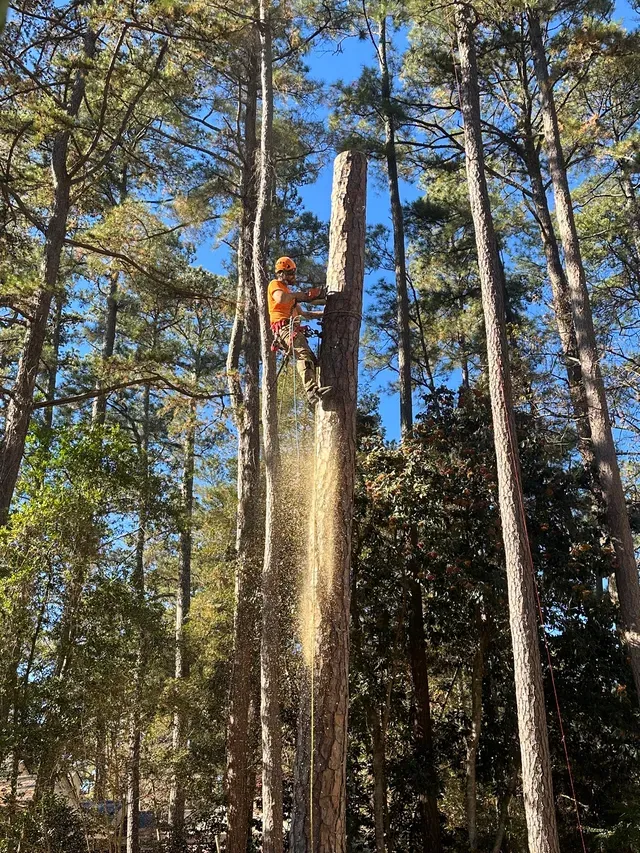
If we can get a bucket truck within twenty feet of the tree, the job is faster. If the tree is in a fenced backyard with a narrow gate, up a slope, past a septic field, we climb it. Climbing is slower than bucket work. Slower is more expensive.
Declining trees
A stressed tree is harder to trim safely because the wood doesn’t behave the way live wood does. Rigging can fail at the branch attachment instead of at the cut — one of the main reasons climbers get hurt on removals. If a tree is in real decline, sometimes the honest conversation is whether trimming is even the right call or whether you should be thinking about removal instead. We’ll tell you straight if we think that’s the case. For more on how to tell, see our post on dead and dying trees.
What drives the price down
Bundle multiple trees
This is the easiest way to lower your per-tree cost. Most of what a trimming job costs is mobilization — trucks, chipper, crew, gear, all showing up at your driveway. That cost is the same whether we do one tree or four. If you’ve been thinking about three different trees on your property, do them all in one visit. The per-tree number drops a lot.
Maintenance cycles
A tree we trimmed two years ago is cheaper the second time because the structural work is already done. We’re just keeping up with new growth and removing what died since the last visit. A tree that hasn’t been touched in a decade is a different story — deadwood built up, crossing branches, structural problems that should have been handled when the tree was younger. The first visit on a neglected tree is always the most expensive.
Dormant season scheduling (with an oak-specific warning)
Late winter — roughly January through early March — is the right window for most pruning in Eastern NC. The trees are dormant, wounds close faster once growth resumes, and you avoid the active-growth stress of April through May.
For oaks specifically, winter pruning isn’t just preferred, it’s important. Oak wilt is a fungal disease spread by sap beetles attracted to fresh pruning wounds during the warm months. If you prune a water oak, willow oak, or white oak between roughly April and July, you’re inviting the beetles in. Do oak work between November and February. Don’t let anyone talk you into a summer oak trim unless there’s a real safety reason to take a branch now.
Spring-flowering trees — dogwood, redbud, cherry — are the exception to the “winter is best” rule. Prune those right after they finish blooming, or you’re cutting off next year’s flower buds.
Avoid fall pruning if you can. The tree is moving energy into root storage, wound closure is slow, decay fungi are still active, and you can stimulate a late flush of growth that won’t harden off before frost. If it’s not an emergency, wait until winter.
Right-sizing the scope
Sometimes the job is smaller than you think. If someone calls me worried about an 80-foot oak and what they actually need is deadwood removal and a clearance lift, I’m going to quote that — not a full crown reduction that would double the price and stress the tree for no reason.
This is the part that most customers don’t know to ask about: ANSI A300, the industry pruning standard. One of the core rules is you don’t remove more than 25% of a mature tree’s live canopy in a single visit, and for older specimen trees, 15 to 20% is closer to the limit. Remove too much and the tree responds by throwing out watersprouts everywhere, stressing itself trying to rebuild what you just took.
Here’s something you can use: if a company is trying to sell you a heavy reduction on a healthy tree in one visit, ask them what percentage of the canopy they’re removing. Ask whether they’re following A300. A real arborist will know. A guy with a chainsaw and a ladder will look at you funny.
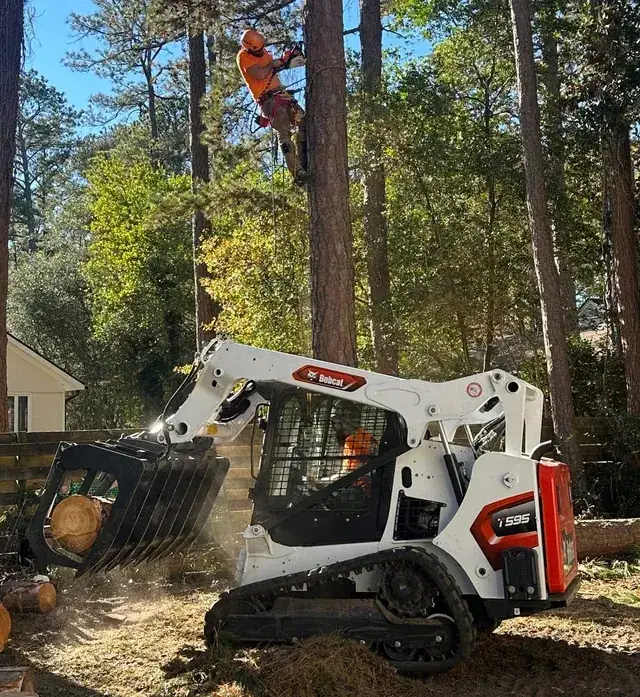
When we do make cuts, they go just outside the branch collar — the slight swelling where a branch meets the parent branch or trunk. That swelling contains the tree’s wound-closing chemistry. Cut outside it and the tree walls off the wound and moves on. Cut into it and you’ve opened a pathway for decay straight into the trunk. This is a small detail that separates proper pruning from wood butchery, and it’s why topping is so destructive — topping cuts are made well past any collar.
Real jobs from our service area
Prices rounded. These are representative of what we see, not promotional numbers.
Three crape myrtles in a Rocky Mount front yard. Proper cluster pruning — no topping, no knuckles, crossed branches out, suckers removed. About an hour and a half in the tree. Around $550.
A 45-foot water oak in a Wilson backyard. Deadwood out, canopy thinned by about 15%, clearance lift off the garage roof. Half-day job, two guys, good truck access. Around $1,200.
A 65-foot pecan in Wayne County. Heavy deadwood plus reduction on three long lateral limbs extending over the neighbor’s driveway. Full day with rigging on the reduction work. Around $2,100.
An 80-foot willow oak in a Nash County front yard. Crown reduction, deadwood, clearance work over the house. Specimen tree, three-man crew, full day. Around $2,800.
Five medium pines along a fence line in Goldsboro. Clearance lifts and deadwood removal on all five in a single visit. The per-tree cost dropped because we were already on-site. Around $2,400 total — roughly $480 per tree versus $700-plus each if we’d done them one at a time.
Hurricane prep trimming
If you own mature trees in Eastern NC and you’re not thinking about hurricane season, you should be. The best time to get hazard limbs off your house is in winter, months before storms start rolling up the coast. A lot of our January and February work is structural reduction and deadwood removal done specifically as hurricane prep.
The math is simple: a $1,200 preventive trim beats a $4,000 emergency removal after a limb goes through your roof, and your insurance carrier is a lot happier when there’s documented maintenance on the property.
Why we don’t top trees
Topping is cutting the main leaders of a tree straight across at an arbitrary height. It’s the cheapest way a tree service can “make your tree smaller,” and it’s the worst thing you can do to a tree. Here’s what actually happens:
- Most of the canopy — the part feeding the tree — gets removed at once.
- The cuts are made past any branch collar, in the middle of old wood. Those wounds don’t close. Decay moves into the trunk.
- The tree panics and throws out hundreds of fast-growing watersprouts from each cut. They’re weakly attached to the outer layers of wood only, and the first real storm breaks them off.
- Two years later, the tree either dies or looks worse than before and needs more work to fix.
We don’t top. If a tree needs to be smaller, we reduce it properly — cutting each branch back to a lateral large enough to take over as the new terminal. That’s a reduction cut, and it’s what ANSI A300 actually prescribes. Costs more than topping. Tree actually lives.
DIY or hire a pro?
If you can reach the work from the ground with a pole pruner, and you know where the branch collar is, small stuff is fine to do yourself. Thinning a crape myrtle, suckers off a small fruit tree, a few low branches you can reach without a ladder. Go for it.
Anything over head height, anything requiring a ladder, anything near power lines — don’t. Every year in North Carolina, people die doing their own tree work. It’s almost always a ladder plus a chainsaw plus a branch that didn’t go where they thought it would.
If it involves climbing, rigging, or working above anything you can’t afford to break, hire someone.
Permits, HOAs, and heritage trees
Most cities and counties in Eastern NC don’t require a permit for residential tree trimming on private property. A few historic districts have tree ordinances, and some HOAs restrict cuts on specimen or heritage trees. If you’re not sure, we’ll check before we start. We won’t knowingly trim a protected tree in a way that violates a local rule.
Sanity check a quote you already have
If you’re reading this because someone gave you a quote and you’re trying to figure out if it’s fair, here’s the quick gut check:
- Under $400 for a small tree, clearance only. Probably fair.
- Under $800 for a 60 to 75-foot tree in tight quarters with rigging. Ask what’s not included. Cleanup? Haul-off? Insurance?
- Over $3,500 for a single tree that isn’t 75-plus feet and hanging over a structure. Ask what makes the tree unusual. There may be a real reason — crane, decline, power lines — or there may not.
- Any quote where the company won’t email you a certificate of insurance with your name on it before they start. Walk away.
- Any quote that says “we’ll top it.” Walk away.
How we quote, and when you pay
We walk your property with you before anything gets priced. Every tree gets looked at individually, and we’ll tell you what it needs and, just as important, what it doesn’t. We don’t take deposits. We don’t ask for money upfront. You pay when the work is done, you’ve walked the property with the crew lead, and you’re satisfied with how we left it. If something isn’t right, we fix it before you pay.
Why we’re not the cheapest
Same conversation I had in the tree removal cost post. If you call around, you’ll find cheaper. I’m fine with that.
DC Tree Cutting carries all three insurance types that matter — liability, workers comp, and commercial auto. That’s not free. Our pricing covers what it actually costs to pay a trained crew and run our equipment legally.
Companies quoting 40% less are cutting something. Usually it’s workers comp. If a climber falls out of your tree and he’s not covered, that bill lands on your homeowner’s policy, and you’ll be finding out about it for months. Ask every company you call for a COI with your name on it — not “yeah we’re insured” over the phone, an actual certificate. We wrote a full post on what “fully insured” actually means if you want the details.
Get a free tree trimming estimate
Every tree is different and the only real answer on cost comes from eyes on the tree. We offer free estimates across all nine counties, and most customers hear back within a few hours of calling.
Call (252) 506-0099 or request an estimate online. For the full pricing breakdown on everything we do, see our pricing page.
Common questions
How often should trees be trimmed?
Mature yard trees usually benefit from attention every 3 to 5 years. Fast growers like water oak and sweetgum may need it every 2 to 3 years. Young trees benefit from structural pruning every 1 to 2 years, and that’s the cheapest tree work you’ll ever pay for because it prevents expensive problems later. Oaks should be pruned in winter specifically to avoid oak wilt.
Can I just have the limbs over my house removed?
Yes. Clearance-only trimming is one of the most common jobs we run, and it’s usually on the lower end of the range because the scope is narrow. If the rest of the tree is fine, we leave it alone.
Do you chip and haul the debris?
Always, on every job. We chip brush on-site, haul everything out, and rake the area before we leave. When we’re gone, the only difference is the tree looks better.
Is tree trimming worth it if I can barely afford it?
Depends on the tree. A healthy mature tree is almost always worth maintaining — the property value and shade are worth more than the cost of periodic trimming, and putting it off usually makes the next job more expensive. A declining tree that needs $2,000 of work every couple years is a harder call, and that’s when removal sometimes makes more sense. We’ll give you both numbers during the estimate and you can decide.
Frequently Asked Questions
How much does tree trimming cost in Eastern NC?
Is tree trimming cheaper than tree removal?
What makes tree trimming more expensive?
How often should trees be trimmed?
Can I trim a tree myself?
Do you offer free estimates for tree trimming?
Operations, DC Tree Cutting and Land Service
Anthony runs DC Tree Cutting from Rocky Mount, NC. Every article is based on real jobs, real equipment, and real pricing from across Eastern North Carolina. More about Anthony →