Land Clearing for Home Building in NC (2026)
 Anthony Caracappa 9 min read


Want a firm price instead of a ballpark? Free estimate in about 2 minutes.
Get Free EstimateTable of Contents
What’s Different About Land Clearing for Home Building
Clearing for a house is not the same as clearing overgrown property. When you’re building, the clearing crew is the first trade on site and every trade after us depends on what we leave behind. I’ve seen foundation contractors walk off a job because the last clearing crew left stumps four inches above grade and called it “done.” If the grade is wrong, the framing crew is shimming everything. If you damage a tree the homeowner wanted to keep, that’s a conversation nobody wants to have.
I’m Anthony Caracappa, owner of DC Tree Cutting and Land Service. We handle land clearing for home building across nine counties in Eastern NC — half-acre subdivision lots in Clayton, 2-acre homesites in rural Nash County, everything in between.
I wrote a separate land clearing cost guide that covers general pricing per acre for all types of clearing. This post is specifically about clearing for new home construction: what the process looks like, how it fits into a build schedule, what to tell your builder, and the things most people forget until it’s too late.
The Timeline: Where Clearing Fits in a Build
Land clearing for home building is the first thing that happens after you own the dirt and have a plan. Here’s how it fits:
- Close on the lot and have a site plan or at least a rough idea of where the house goes
- Soil evaluation and perc test — if you’re on septic (and most rural Eastern NC lots are), get this done before clearing. The perc test location dictates where the septic field goes, and you do not want an excavator compacting that soil. Flag the drain field area before we show up.
- Call 811 — North Carolina law. One Call marks underground utilities before any digging. We don’t put a machine on a lot without utility locates.
- We walk the site with you or your builder, mark keep-trees, flag the building footprint, and identify equipment access
- Clearing: 1-3 days depending on lot size and density
- Stump removal: same day or next day — stumps in the building footprint and driveway path ground 6-12 inches below grade (deeper than standard stump grinding because the foundation needs clean soil)
- Rough grading and site prep — we push dirt, fill stump holes, and establish approximate pad elevation. Your grading contractor handles final grade and compaction.
- Surveyor and foundation contractor come in on a clean, graded site
The whole clearing-to-ready-for-foundation window is 3-5 business days on a standard residential lot — a half-acre lot is a single-day job for this equipment spread. If your builder needs the lot ready by a specific date, we work backward from that. One crew, one mobilization, done.
Land Clearing Costs for New Construction
Home building jobs have a specific cost profile because they almost always include stump removal and rough grading, which general clearing sometimes skips.
What to Expect by Lot Size
| Lot Size | Vegetation | Scope | Cost Range |
|---|---|---|---|
| Quarter-acre | Light brush, young pine | Clear + grind stumps in footprint | $2,500 - $3,500 |
| Half-acre | Pine and sweetgum under 12” | Clear + full stump removal + rough grade | $3,500 - $5,500 |
| 1 acre | Mixed hardwood and pine | Clear + stump removal + rough grade + haul-off | $6,000 - $10,000 |
| 2+ acres | Heavy timber | Full crew, multi-day, excavator + mulcher + grapple truck | $10,000 - $20,000+ |
These numbers include debris removal. We don’t leave brush piles for you to deal with. On rural lots where burning is permitted, we can burn debris on site with an NC Forest Service burn permit instead of hauling — that saves $700-$2,000 depending on volume.
What pushes the price up:
- Large hardwoods over 24 inches. Oaks and pecans are the worst — more crew time, more rigging, and you can’t just push them over with an excavator like you can with pine
- Trees near property lines or keep-trees that need directional felling instead of a straight push
- Wet ground or poor access
- Full stump removal across the entire lot instead of just the building footprint — that can add $1,000-$2,000 on a one-acre lot
- Haul distance to the nearest dump site. At $900 a grapple truck load, five loads to a dump 30 minutes away eats real money
What keeps it down:
- Pine. Pine is lighter, doesn’t need rigging, and falls predictably.
- Flat ground with road frontage — equipment drives off the trailer and straight to work
- Fall and winter scheduling when demand drops
- Combining clearing with stump grinding in one mobilization instead of two trips
Real Numbers
Our land clearing cost guide has our real recent invoices — actual jobs with the acreage, scope, and final price on each one. If you want to see what lots like yours have actually cost, start there.
Permits and Regulations in Eastern NC
Rural unincorporated land (most of our service area): No tree removal permit. Your builder pulls the building permit and handles erosion control. We need to know the lot boundaries and where the house goes.
Inside town limits (Clayton, Smithfield, Wilson, etc.): Grading permits. Clayton requires one for land disturbance over 10,000 square feet — other towns vary. A few have tree ordinances protecting certain species or diameter thresholds, and if you cut a protected tree without approval, they’ll fine you before the foundation is poured. Check with your local planning office. We can tell you who to call.
Erosion control: North Carolina requires an erosion and sedimentation control plan for land disturbance over one acre. Your builder files the plan. We follow it. On smaller residential lots, silt fence around the perimeter handles it.
Wetlands and stream buffers: Eastern NC is flat and wet. If your lot has a creek, drainage ditch, or low wet area, it may have jurisdictional wetlands or Neuse River basin buffer rules that restrict clearing within 50 feet of the waterway. Ask about this before buying the lot. Clearing in a protected buffer without a permit is a federal violation, and “I didn’t know” doesn’t help.
Your builder handles most of the paperwork. We just need to know the lines and what we can’t touch.
Working With Builders
Builder and GC work is a growing share of our land clearing. The rest comes from homeowners coordinating their own build.
If you’re a builder: Call us with the parcel info, site plan, and your target date. We’ll walk the site and give you a fixed price. We carry general liability, workers comp, and commercial auto — all three — and we’ll send a COI to whoever needs it before we unload the first machine. We work on your schedule, not ours.
If you’re a homeowner building your own home: Get a clearing estimate before you finalize your construction budget. Land clearing is one of the costs that surprises people because it’s usually not in the builder’s standard pricing. A common surprise: a “tree removal” budget of a couple thousand dollars meets a lot with 30 loblolly pines on it — real clearing on a lot like that runs multiples of that number. Better to know before signing the construction loan.
If you’re not sure what clearing will cost, call us for a free walk-through before you close on the property. We’ll tell you what you’re looking at so you can budget accurately.
Johnston County: Where the Building Is
Johnston County is where the building is, and lot clearing there is a focus for us. Clayton alone has more than tripled in population since 2000, and development is pushing east along US-70 through Smithfield toward Selma.
We serve Johnston County from our Goldsboro office at 102 Little River Drive — 25-35 minutes from most job sites. Close enough to keep mobilization costs low.
The eastern side of the county — Princeton, Micro, Kenly — still has large parcels of former farmland that went idle 10-15 years ago. Loblolly pine moved in, and now those parcels are being cleared for new homes as development pushes east. The soil shifts from red clay near Clayton to sandy loam out toward Princeton. We know the difference because it changes how the equipment handles and what the grade looks like when we’re done.
If you’re building in Johnston County, we’re set up for lot clearing across the county. Call (252) 506-0099 or request a free estimate.
What to Have Ready When You Call
The more you give us upfront, the tighter the estimate:
- Parcel address or PIN — so we can look at the lot on GIS before the walk-through
- Lot size — approximate acreage or dimensions
- Site plan — even a rough sketch showing where the house, driveway, and septic field go
- Perc test results — if you’ve done the soil evaluation, tell us where the drain field is so we keep equipment off it
- Well location — if you’re drilling a well, flag it. Heavy equipment over a planned well site can contaminate shallow aquifers
- Keep-trees — any trees you want to save, or let us advise during the walk-through
- Builder/GC contact — if someone else is running the build, we’ll loop them in
- Timeline — when do you need the lot ready?
One more thing: if your lot has a creek, wet area, or drainage ditch, mention it. We’ll check for buffer restrictions before we scope the job.
We do free on-site estimates. No obligation. We walk the lot, mark the scope, and give you a fixed price that includes clearing, stump removal, debris removal, and rough grading.
Equipment for Construction Clearing
People ask why we don’t just rent equipment per job. Because rental machines show up with whatever attachment the depot has, and the operator doesn’t know your site. We own our core fleet and bring in partner operators for crane and excavator work.
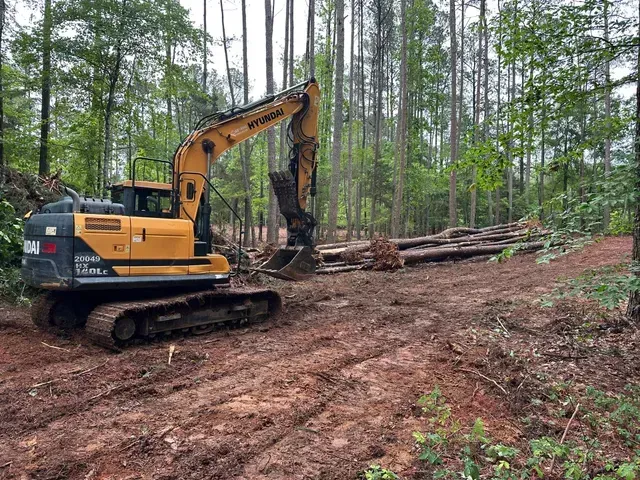
- Excavator (via our operator partners) — pushes pine, stacks logs, handles rough grading. For large hardwoods over 18 inches, the excavator holds the trunk while the chainsaw crew makes the cut. On smaller stumps it can pop them out of the ground, but for anything over 12 inches we grind with a dedicated machine — stump grinding goes deeper and doesn’t leave a crater.
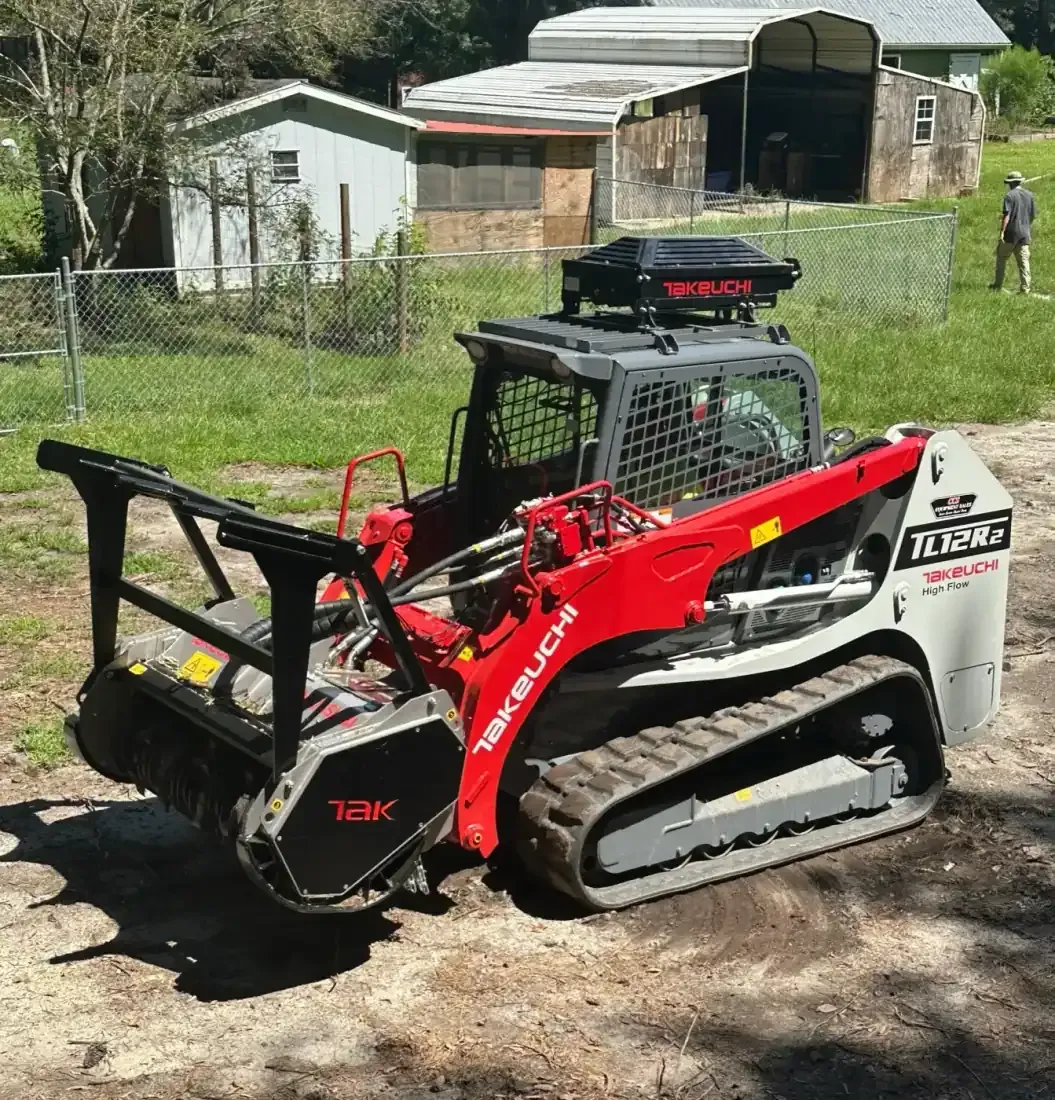
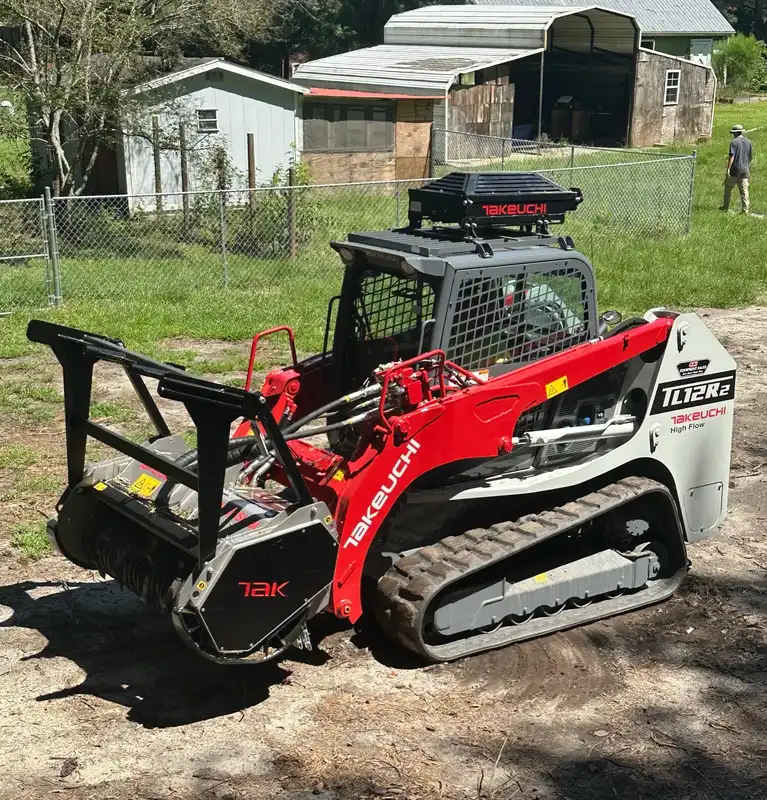
- Takeuchi TL12R2 with FAE mulcher head — grinds brush and small trees up to 6-8 inches in a single pass. Faster and cheaper than hand-clearing for underbrush on building sites.
- Peterbilt grapple truck — hydraulic claw loads logs and brush in minutes. One load replaces hours of hand-loading a dump trailer. $900 per load, or $700 at a three-load minimum.
- Chainsaws and climbing gear — precision tree removal near keep-trees, power lines, and property line trees that can’t be pushed.
For a broader look at what all our services cost — tree removal, stump grinding, forestry mulching, and more — see our full cost guide.
Call (252) 506-0099 or request your free estimate online.
Frequently Asked Questions
How much does land clearing for new construction cost in NC?
How long does it take to clear a lot for a new home?
Do I need a permit to clear land for a house in NC?
Should I clear the land before or after I close on the property?
What's the difference between land clearing and site prep?
Who is responsible for land clearing — the builder or the homeowner?
Owner, DC Tree Cutting and Land Service
Anthony runs DC Tree Cutting from Rocky Mount, NC. Every article is based on real jobs, real equipment, and real pricing from across Eastern North Carolina. More about Anthony →