How to Choose a Tree Service (Without Getting Burned)
 Anthony Caracappa 9 min read

Want a firm price instead of a ballpark? Free estimate in about 2 minutes.
Get Free EstimateTable of Contents
Why This Guide Exists
I’m Anthony Caracappa, owner of DC Tree Cutting and Land Service. I run crews across nine counties in Eastern NC — Nash, Wayne, Wilson, Edgecombe, Halifax, Johnston, Pitt, Greene, and Lenoir.
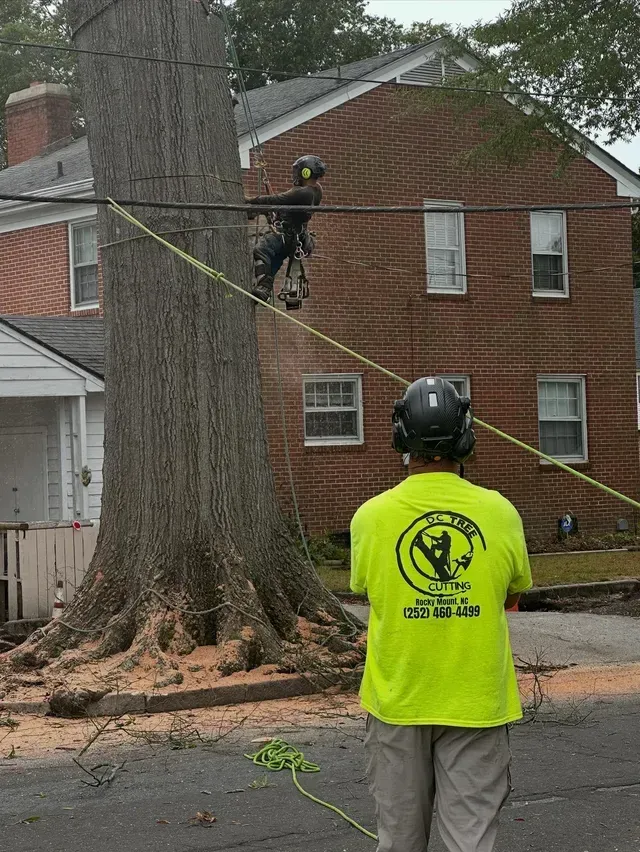
I get calls every month from homeowners who already hired someone else and got burned. The tree company disappeared after collecting a deposit. Left half the debris in the yard. Dropped a limb on the fence and won’t return calls. Homeowners tell us about crews showing up in a pickup with a chainsaw and a come-along for jobs that need a crane and a grapple truck.
North Carolina doesn’t require a license for tree work. No arborist certification, no state exam, nothing. Anyone can print business cards and start knocking on doors after a storm. That’s why choosing a tree service is harder than it should be — you can’t just check a license number and move on.
This guide is everything I’d tell a friend before they hired a tree company. Whether you hire us or someone else, these are the things that actually matter.
Check Insurance First — All Three Policies
This is the single most important step. I wrote a full guide on how to verify tree service insurance that covers every detail. Here’s the short version.
“Fully insured” should mean three active policies. Not one. Not two.
- Commercial general liability — if a section of trunk punches through your roof, this pays for the damage. Without it, you’re filing a claim on your own homeowner’s policy.
- Workers’ compensation — tree work is one of the most dangerous jobs in the country. If an uninsured worker gets hurt on your property and the company doesn’t carry workers’ comp, you could end up in a legal claim. Workers’ comp keeps you out of it.
- Commercial auto — our equipment is heavy commercial iron. A personal auto policy explicitly excludes commercial use. If a chip truck cracks your driveway apron and the company doesn’t carry commercial auto, nobody’s insurance covers it.
Most tree companies in Eastern NC carry liability only and call themselves fully insured. I see it every week.
Ask for an ACORD certificate naming you as the certificate holder. Any real company can produce one within a day. If they can’t, don’t hire them. If they dodge the question, you have your answer.
Look at What They Pull Up In
You can tell a lot about a tree company before they make a single cut. Look at the equipment.
A one-truck operation with a pickup and a chainsaw can handle small jobs. But a 70-foot water oak leaning over your roof? A loblolly tangled in power lines? A five-acre overgrown lot? Those need real equipment and people who know how to run it.
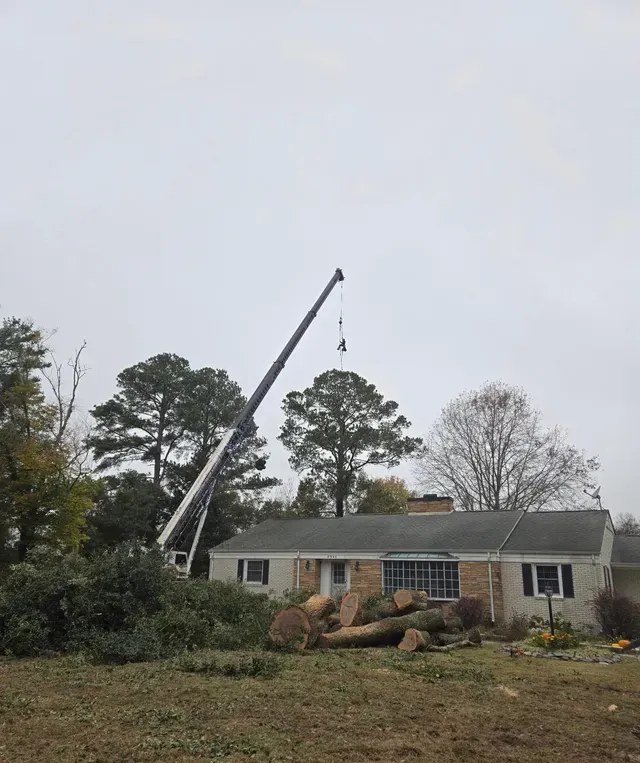
Crane access. Large removals near structures often need a crane. If a company tells you they can drop a 60-foot tree between your house and your neighbor’s fence with nothing but ropes, get a second opinion. We’ve quoted jobs where a previous crew’s shortcut had already put a limb through a window.
Stump grinding. Some companies cut the tree and walk away. Others sub out the grinding to someone you’ve never met. Ask if stump grinding is included, and ask what machine they’re running. A commercial grinder like the Vermeer SC48TX grinds to 6 inches below grade. A guy with a rented walk-behind leaves you with a bump in the yard.
Debris hauling. A grapple truck clears a job site in a fraction of the time it takes to hand-load a dump trailer. We run a Peterbilt with a hydraulic boom. Ask how they plan to move the debris and whether full site cleanup is in the price — or if you’re paying extra.
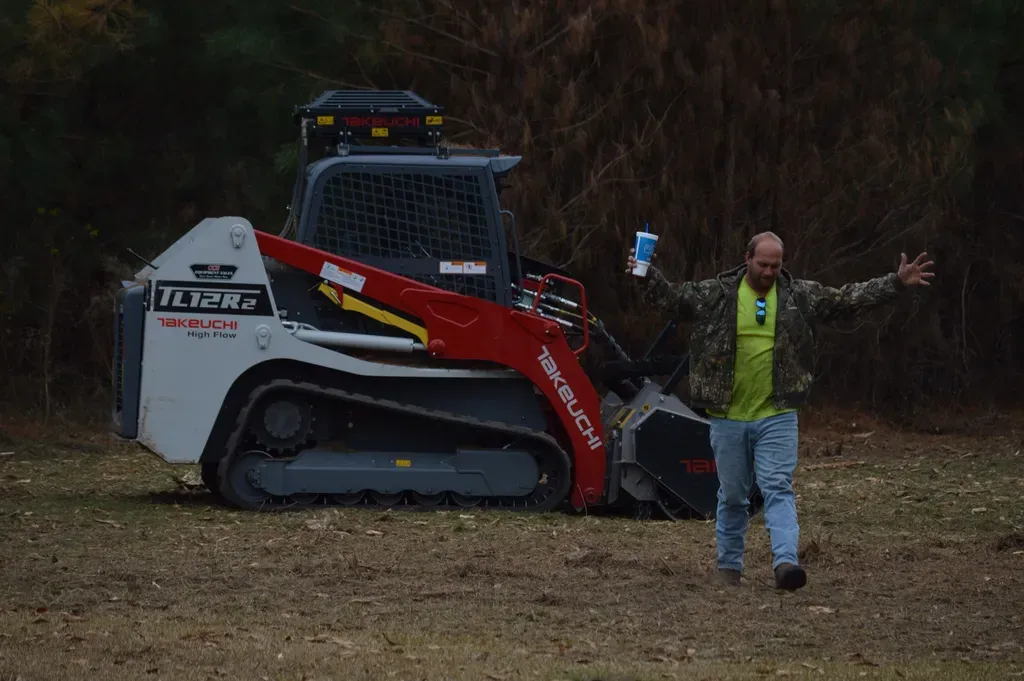
Land clearing equipment. If you’re clearing more than a handful of trees, ask about forestry mulching. Our Takeuchi TL12R2 with a FAE mulcher head handles 1-5 acre jobs faster and cheaper than felling and hauling individual trees. Not every company owns a tracked mulcher. Most don’t.
Ask About Their Crew
Equipment doesn’t climb the tree. People do.
W-2 employees vs. day labor. Companies that hire W-2 employees train their crew, provide safety gear, and carry workers’ comp on every person. Companies that pull day labor off Craigslist the morning of your job are cutting the one cost that protects you if someone gets hurt on your property. Ask the question directly: “Are your crew members W-2 employees?”
Experience with your type of job. A company that mostly does land clearing may not be the right call for a delicate removal next to your house. A company that trims ornamentals may not own a crane. Ask about recent jobs similar to yours.
Crew consistency. Do they send the same guys every time, or do you get whoever picks up the phone that morning? You want the crew that knows each other’s next move 50 feet up in a tree, not three strangers who met in the parking lot.
At DC Tree Cutting, our core crew are W-2 employees — same standards on every job. On bigger jobs we bring in vetted contract climbers and operators. That’s not how everyone operates.
How to Compare Tree Service Estimates
Get at least three written estimates. But don’t just compare the number at the bottom. The cheapest bid usually means something got left out.
| What to Compare | Why It Matters |
|---|---|
| Scope of work | Does the bid cover the full job? Cutting, hauling, stump grinding, cleanup? Or just cutting? |
| Insurance coverage | All three policies, or just liability? |
| Crew type | W-2 employees with workers’ comp, or “contractors”? |
| Cleanup terms | Debris hauled offsite, or left in a pile for you to deal with? |
| Timeline | When do they start? How long will it take? |
| Payment terms | Deposit amount? When is the balance due? |
Put two quotes side by side for the same tree: one itemizes removal, stump grinding to 6 inches below grade, grapple haul-off, and raking; the other says “tree removal” and a number a third the size. They are not quoting the same job.
Watch out for big upfront deposits. A small material fee on large jobs is normal. But a company that wants 50% before they’ve touched a tree is telling you something. Either they don’t trust their own work enough to bill after, or they’re planning to take the money and ghost. I’ve seen both.
Tree Service Red Flags That Should End the Conversation
I’ve been in this business long enough to spot these from the driveway. If you see any of them, move on.
No written estimate. A verbal quote is worth nothing. If they won’t put the scope, price, and terms in writing, they’re leaving themselves room to change the deal after the tree is down.
No insurance, or insurance they won’t prove. I covered this above but it’s worth saying again. No certificate, no hire.
Door-knocking after storms. Storm chasers roll through neighborhoods after every hurricane and ice storm in Eastern NC. They knock on doors, quote low, collect deposits, and disappear. Some do the work badly. Others never come back at all. If you need emergency tree service after a storm, call a company that was here before the storm hit. Read our storm damage cleanup guide for what to do and what to watch for.
Cash-only, no receipt. They’re avoiding taxes, operating without insurance, or both.
No real address in your area. Check their Google Business Profile. Do they have an actual office or yard in your county, or are they a phone number and a PO box two hours away? A company with a landing page for your city isn’t the same as a company with a yard in Rocky Mount or Goldsboro and trucks that drive past your house every week.
“This price is only good today.” That’s a high-pressure sales move, not a real offer. A fair estimate stands for at least two weeks. If they’re rushing you, ask yourself why.
What to Expect From a Good Tree Service
Here’s what should happen when you hire someone who knows what they’re doing. If any of this doesn’t happen, you hired the wrong company.
Before the job:
- Written estimate with clear scope, price, and timeline
- Insurance certificate provided when you ask for it
- Crew confirms the start date and gives you an arrival window
Day of:
- Crew shows up on time with the right equipment
- The crew lead walks the site with you, confirms the plan, answers your questions
- If they show up and start cutting without talking to you first, that’s a problem
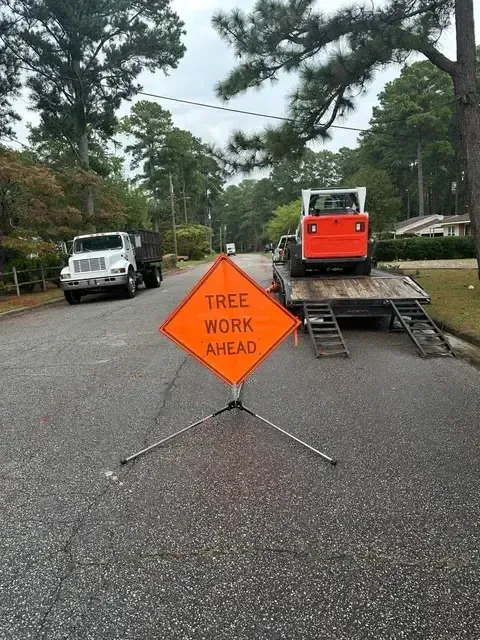
- Work areas near roads or sidewalks get coned off
- Tree work is done with proper rigging, proper cuts, proper gear
- If a neighbor’s yard could be affected, they tell you before they start
After the job:
- They haul all the debris offsite, not just push it to the property line
- They grind the stumps if that’s in the scope
- They rake the yard clean
- You walk the site with the crew lead before they leave
- Nobody disappears. Nobody stops answering the phone
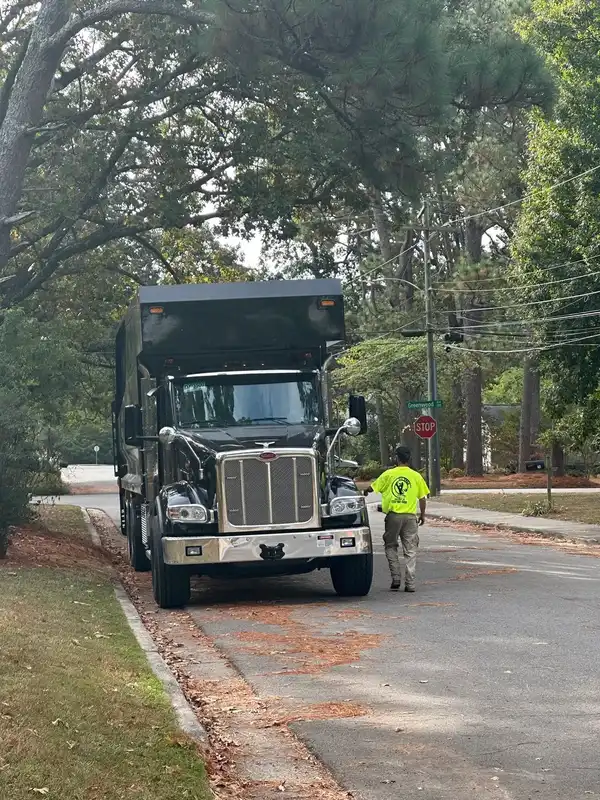
That’s the standard at DC Tree Cutting. It should be the standard everywhere, but it isn’t.
The Bottom Line
There are good tree companies in Eastern NC, and there are guys with a truck and a chainsaw who’ll be gone by next season. The difference isn’t always obvious from a Facebook ad or a door knock. It shows up in the insurance certificate they can or can’t produce, the equipment they do or don’t own, and whether the crew that shows up has done this a thousand times or is figuring it out on your property.
Take the time to ask the questions. Check the insurance. Compare the estimates on what’s actually included, not just the price. It’s the difference between a clean yard and a lawsuit.
For the full checklist on hiring a tree service, see our hiring guide for Eastern NC.
How to Get Started
If you’re choosing a tree service in Eastern NC, here’s what I’d do:
- Ask neighbors and check Google reviews. Real reviews from people in your area are the best filter. We have 100+ Google reviews at a 4.9-star rating.
- Get three estimates. Compare scope, insurance, and crew — not just the bottom number.
- Verify insurance. Ask for the ACORD certificate. Read it. Check the dates.
- Pick the company you trust, not the cheapest bid.
If you want to start with us, call (252) 506-0099 or request a free estimate online. We serve all nine counties from our offices in Rocky Mount and Goldsboro. If you’ve got questions about hazardous trees, storm damage, or how to pay for the work, those guides are worth reading too.
Frequently Asked Questions
How do I know if a tree service is legitimate?
Should I get multiple estimates for tree work?
What's a fair price for tree removal in Eastern NC?
Do tree services need to be licensed in North Carolina?
What should I expect on the day of the job?
Is it worth paying more for a fully insured tree service?
Owner, DC Tree Cutting and Land Service
Anthony runs DC Tree Cutting from Rocky Mount, NC. Every article is based on real jobs, real equipment, and real pricing from across Eastern North Carolina. More about Anthony →