Why We're Not the Cheapest Tree Service (And Why That Matters)
 Anthony Caracappa 9 min read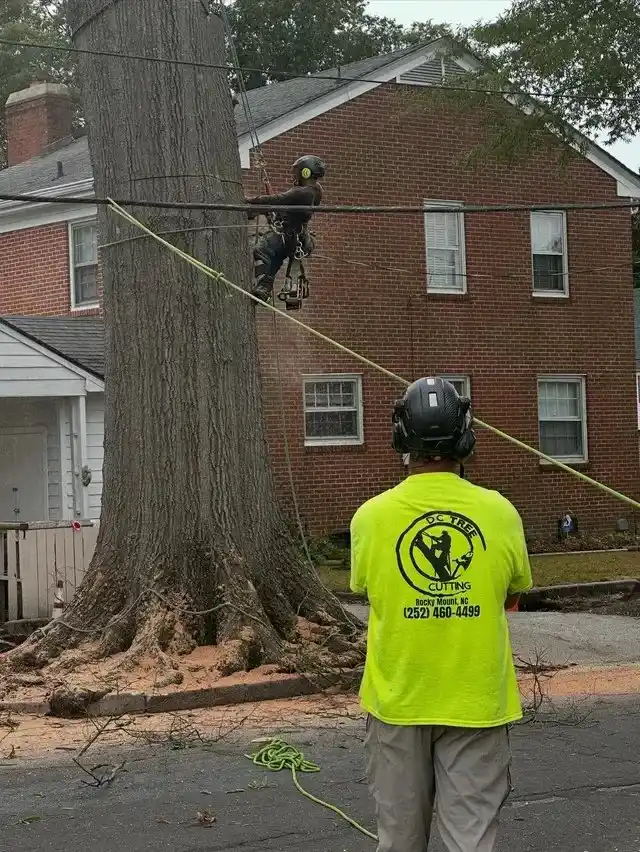


Want a firm price instead of a ballpark? Free estimate in about 2 minutes.
Get Free EstimateTable of Contents
The Call I Keep Getting
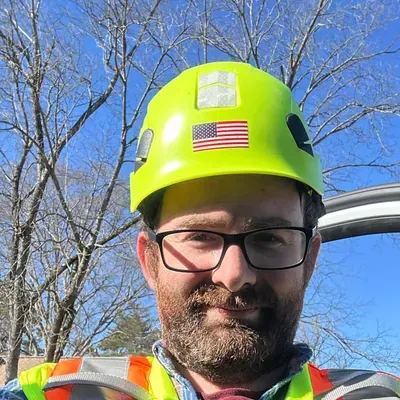
I’m Anthony Caracappa, owner of DC Tree Cutting and Land Service. People keep calling me with some version of the same thing: “I got a cheaper quote from another company, but something feels off.”
They’re right to trust that instinct.
I run crews across nine counties in Eastern NC — Nash, Wayne, Wilson, Edgecombe, Halifax, Johnston, Pitt, Greene, and Lenoir. We are not the cheapest tree service in any of them. I know that. I also know exactly why, and I think you deserve to understand the difference before you make a decision.
If budget is the only thing that matters, we are probably not the right fit. But if you want to understand what you’re actually paying for when you hire a tree company — and what the cheaper bid is leaving out — keep reading.
Why Is Tree Service So Expensive?
Three Insurance Policies — Not One
Most tree companies in Eastern NC carry general liability insurance and call themselves “fully insured.” That’s one policy. We carry three.
-
General liability — covers damage to your property. A limb through your roof, a trunk into your fence, equipment cracking your driveway. Without it, the damage comes out of your homeowner’s policy.
-
Workers’ compensation — covers injuries to our crew. Tree work is one of the most dangerous occupations in the country. If an uninsured worker gets hurt on your property and the company doesn’t carry workers’ comp, you could face a personal liability claim. Workers’ comp keeps you out of it entirely.
-
Commercial auto — covers our trucks and equipment on the road and on your property. Our Peterbilt grapple truck is a commercial vehicle — not a pickup. A personal auto policy explicitly excludes commercial use. If something happens with a commercial vehicle and the operator only carries personal auto, nobody’s insurance covers it.
Those three policies are one of our biggest monthly costs. That cost is built into every quote we give you. The company that quotes you 40% less isn’t absorbing that cost — they just don’t carry the coverage. For more on what to look for, read our guide to verifying tree service insurance.
W-2 Employees, Not Day Labor
Our crew — Chris, Chris, and the rest of the team — are W-2 employees. They’re paid above market rate, they show up every day, and they know our equipment and our standards. When Ben L. in Rocky Mount praises the communication between Anthony, Dominick, and their go-to ground man Chris, he’s talking about a team that has worked together long enough to function as a unit.
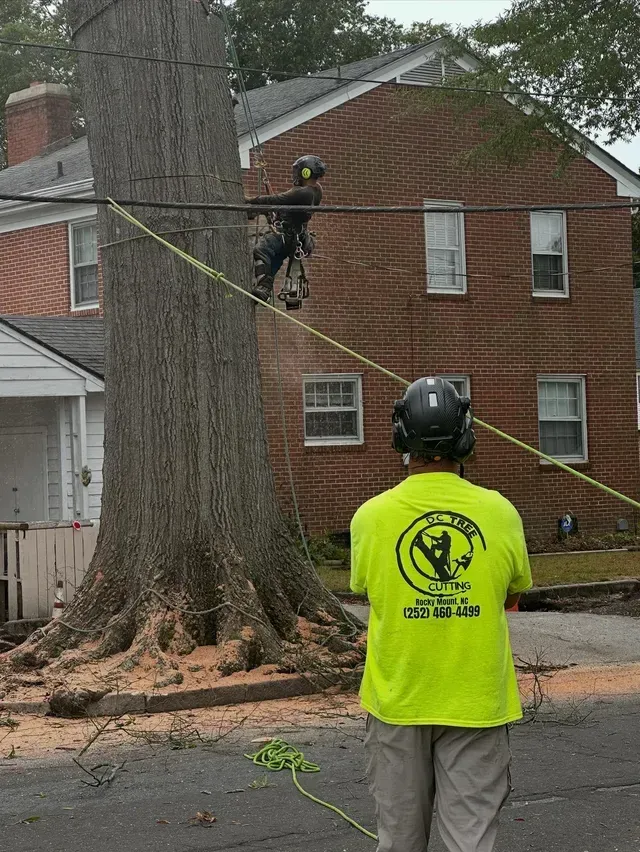
The cheaper alternative is day labor. A guy with a truck pulls up to the parking lot at 6 AM, picks up two helpers who’ve never worked together, and drives to your property. No training, no safety protocols, no accountability. If something goes wrong — a dropped section, a saw kickback, a rigging failure — there’s no system to catch it.
Day labor is cheaper. It’s also how trees end up through roofs.
Real Equipment
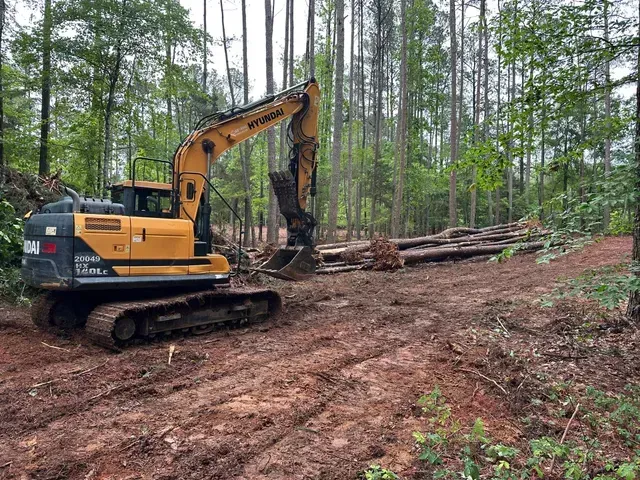
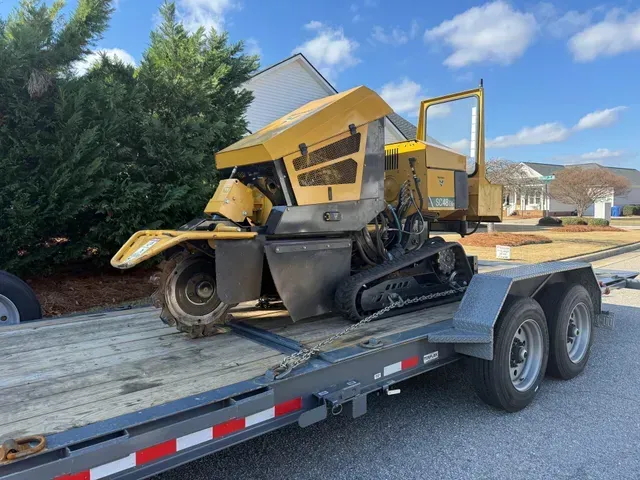
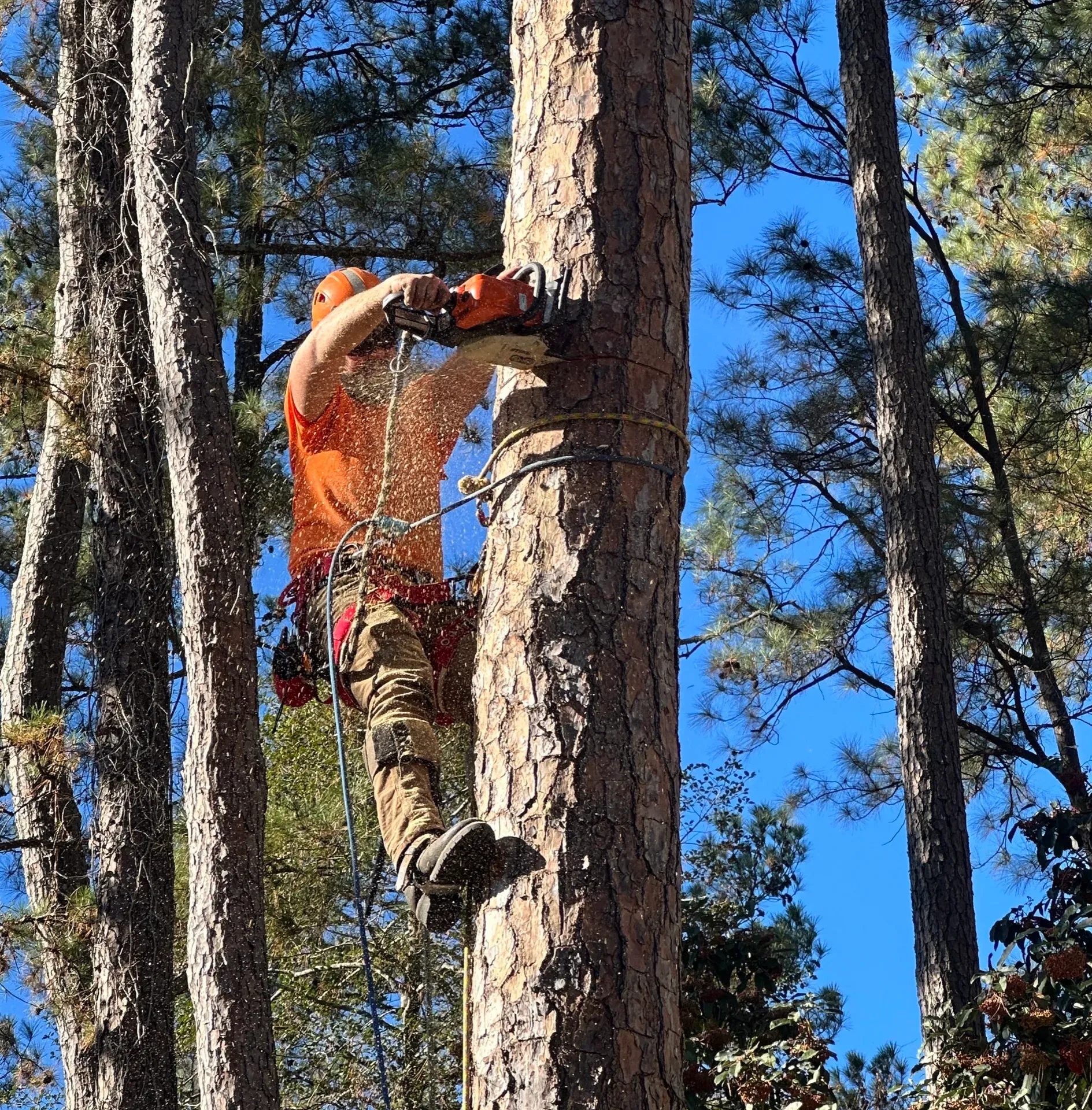
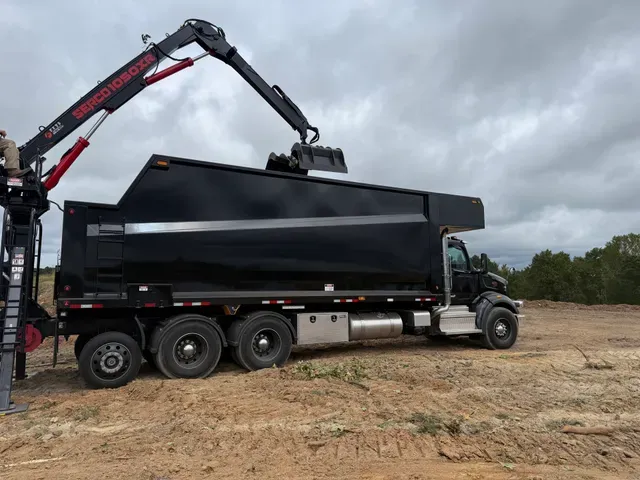
We own our core fleet — grapple truck, Takeuchi forestry mulcher, commercial stump grinders, full climbing and rigging gear — and bring in partner operators for crane and excavator work. Most operators in Eastern NC are running a pickup and a chainsaw. That works for small jobs. It doesn’t work when you need a grapple truck to haul 10 tons of debris, a mulcher to clear an acre of brush, or a climber to rig sections out of a canopy over your house.
Complete Site Cleanup
Every job we do includes full cleanup. That means:
- All debris removed from your property (not pushed into a pile in the back corner)
- Stump grinding available on the same visit (quoted separately, but one mobilization)
- Rake lines in the dirt where the tree stood
- Grapple truck hauls everything — logs, brush, root balls, chips
I’ve lost count of how many calls we get from people who hired a cheaper crew and ended up with a yard full of brush piles and a stump sticking out of the ground. “Cleanup included” means different things to different companies. Ask what it means before you sign.
What the Cheaper Bid Is Actually Leaving Out
When another company quotes a job 30-50% lower than us, one or more of these things is missing:
No workers’ comp. This is the most common gap. Workers’ comp for tree work in North Carolina is expensive — the classification rate is one of the highest in the construction trades. Dropping it saves thousands per month. It also transfers the injury risk from the company’s insurer to you.
No commercial auto. If they’re running a pickup and a trailer instead of a commercial truck, the auto coverage gap is invisible until something happens.
Day labor instead of employees. Hiring helpers off Craigslist or from a parking lot eliminates payroll taxes, unemployment insurance, training costs, and accountability. It also means the people on your property have no relationship with the company, no safety training, and no reason to care about your fence.
Incomplete cleanup. The cheap quote gets the tree on the ground. Getting it off your property — and getting the stump out of the ground — is either not included or costs extra. Some operators don’t own a grapple truck or a commercial stump grinder. They chip what they can, leave the trunk sections, cut the stump a foot below grade, and call it done. Six months later you’re mowing around a rotting stump and a brush pile nobody came back for.
The Math on “Saving Money”
Here’s the scenario, and versions of it play out across Eastern NC.
A homeowner has a 60-foot water oak near the house. It’s declining — internal decay, weak branch unions, one major limb over the roof. We quote $3,200 for the removal, including rigging, a climber, full debris removal with the grapple truck, and leaving the stump ready for grinding.
Another company quotes $1,800. The homeowner goes with the cheaper bid.
What happens:
- The crew shows up with a pickup, a chipper, and two guys. No climber — they try to fell the whole tree directionally.
- A scaffold branch hits the gutter and tears off 12 feet of fascia board. The company says it was unavoidable.
- The homeowner files a claim on their homeowner’s policy. $1,000 deductible. Premium goes up $300/year for three years.
- The crew chips the small stuff but leaves the trunk sections on the ground because they don’t have a way to move them. “We’ll come back with a trailer.” They don’t come back.
- The homeowner hires us to haul the trunk sections. One grapple truck load: $900.
Total cost of the “cheaper” bid: $1,800 + $1,000 deductible + $900 in additional premium + $900 debris removal = $4,600. Our original quote was $3,200.
The numbers are illustrative; the pattern is real.
When the Cheaper Bid Is Actually Fine
I’ll be honest — not every job needs us.
A 25-foot pine standing alone in the middle of an open yard with nothing around it is a simple job. A competent operator with a chainsaw and a truck can handle it safely. If someone quotes you $400 for that job and we quote $600, the cheaper bid might be perfectly reasonable — as long as they carry at least liability insurance.
And here’s the part most companies won’t say: there are smaller tree services in Eastern NC that are insured, competent, and charge less than us because their overhead is lower. They run a two-man crew, own their truck outright, and don’t carry the equipment spread we do. For mid-range residential jobs — a couple of pines in an open yard, a straightforward hardwood away from the house — those operators can do solid work at a fair price. If you verify their insurance and check their reviews, you might save $500-$1,000 and get a good result. That’s a legitimate choice.
Where the price gap becomes dangerous is on jobs with real complexity:
- Trees within falling distance of your house, your neighbor’s house, or power lines
- Large hardwoods (water oak, pecan, white oak) that need a climber and rigging
- Storm-damaged trees with unpredictable lean and compromised structure
- Multi-tree jobs where debris management matters
- Land clearing projects where the wrong approach destroys the soil
On those jobs, the equipment, the crew experience, and the insurance coverage aren’t optional — they’re what stands between a clean removal and a damage claim. That’s where the difference between a $1,800 bid and a $3,200 bid stops being about price and starts being about risk.
How to Compare Bids the Right Way
Get at least three written estimates. Then compare these five things:
- Insurance — ask for an ACORD certificate naming you as certificate holder. All three policies. If they can’t produce it, they don’t have it.
- Scope — does the price include debris removal? Stump grinding? Full site cleanup? Or just “cut the tree down”?
- Crew — are they W-2 employees? How long have they worked together? Who’s climbing?
- Equipment — what are they bringing? A pickup and a chainsaw, or a grapple truck and climbing gear?
- Timeline — when will they start, how long will it take, and what does “done” look like?
The cheapest bid that covers all five is a good bid. The cheapest bid that can’t answer questions 1 and 2 is a liability.
For the full breakdown on evaluating tree companies, read our guide to choosing a tree service.
What Our Pricing Actually Looks Like
I publish real pricing from our last 200+ completed jobs. Most residential tree removals run $1,500-$5,000. Stump grinding runs $250-$1,000 per stump. Land clearing starts around $2,500 per acre. Full breakdown with job examples in our pricing guide and individual cost guides for tree removal, stump grinding, land clearing, forestry mulching, and tree trimming.
We also offer monthly payment options through Wisetack for jobs from $500 to $25,000. Details on our financing page.
The Bottom Line
We are more expensive than some of the companies you’ll find in Eastern NC. We’re also the company you call when the cheaper company doesn’t show up, leaves half the job unfinished, or puts a limb through your roof.
Every dollar of our pricing covers something specific: three insurance policies, W-2 employees who know what they’re doing, commercial equipment that matches the scope of the work, and a clean property when we leave. Every line item on your estimate maps to something real.
Hiring the right crew matters as much as knowing the price. Our tree service hiring guide covers what to check before you commit.
If price is your only consideration, we’re probably not the right fit. If you want the job done right, done safely, and done completely — call (252) 506-0099 or request a free estimate.
Frequently Asked Questions
Why is DC Tree Cutting more expensive than other tree services?
How much more does a fully insured tree service cost?
What happens if an uninsured tree company damages my property?
Should I always choose the cheapest tree service estimate?
Why is tree service so expensive?
Owner, DC Tree Cutting and Land Service
Anthony runs DC Tree Cutting from Rocky Mount, NC. Every article is based on real jobs, real equipment, and real pricing from across Eastern North Carolina. More about Anthony →