Southern Pine Beetle in NC: Identification & Removal
 Anthony Caracappa 12 min read


Want a firm price instead of a ballpark? Free estimate in about 2 minutes.
Get Free EstimateTable of Contents
Southern Pine Beetle: The Bug That Kills More Pines Than Hurricanes
I’m Anthony Caracappa, owner of DC Tree Cutting and Land Service. We remove beetle-killed pines across Eastern NC every week.
Southern pine beetle is the single most common reason we remove loblolly pines on residential properties in North Carolina. Not storms. Not lightning. A bug half the size of a grain of rice that can kill a 90-foot tree in a few weeks and spread to every pine within throwing distance.
I’ve watched SPB move through neighborhoods in Rocky Mount and wipe out a dozen pines in one summer. I’ve seen pine plantations east of Goldsboro where every single tree was dead standing. And every year, someone calls us about a pine that “just turned brown overnight” — it didn’t. The beetles were working for weeks before you noticed. By the time the needles change color, that tree is gone.
How to Identify Southern Pine Beetle Damage
You’re not going to see the beetles themselves. They’re 2-3 millimeters long — smaller than a pencil eraser. SPB identification comes down to four signs, roughly in the order you’ll notice them.
1. Needles turning brown from the crown down. Not a few brown tips on lower branches — that’s normal seasonal shedding. SPB damage starts at the top and works down. If the top third of your pine is brown while the bottom is still green, that’s active beetle kill. The crown dies first because SPB preferentially attacks the mid-trunk and upper trunk first, where the bark is thinnest.
2. Pitch tubes on the trunk. These are small lumps of white or pinkish resin — they look like popcorn stuck to the bark. The tree pushed resin out to try to drown the beetles as they bored in. On a healthy tree fighting off a light attack, the pitch tubes are large and wet. On a losing tree, they’re small, dry, and crumbly. Lots of small dry pitch tubes means the tree lost the fight.
One thing to know: SPB attacks higher on the trunk than most people think. The pitch tubes you can see from the ground — waist height, chest height — may actually be from black turpentine beetle, a different species that attacks the lower trunk. SPB pitch tubes are often 15 feet up or higher. If you see any pitch tubes at all, assume the tree needs assessment regardless of which beetle made them.
3. Reddish-brown boring dust. Check the bark crevices on the lower trunk and the ground at the base of the tree. Fine reddish-brown sawdust (foresters call it frass) collecting in the bark plates and at the root flare is one of the earliest and easiest signs to spot. You can see it before the crown starts to fade.
4. Pinhead-sized bore holes and S-shaped galleries under the bark. Peel a piece of loose bark off the trunk. You’ll see tiny round holes — smaller than a BB, more like a pinpoint — and distinctive S-curved tunnels carved into the wood underneath. Those S-shaped galleries are where the adult female beetles laid eggs. The larvae then feed outward from those galleries, destroying the phloem — the layer just under the bark that carries nutrients through the tree. Meanwhile, the beetles introduce a blue-stain fungus (Ophiostoma) that clogs the tree’s water-conducting tissue. Between the larvae eating the phloem and the fungus blocking water transport, the tree is killed from two directions at once.
If you see brown crown and boring dust, don’t wait for the bark to peel. That tree will start dropping limbs within months and could fall within a year. Dead pine becomes brittle fast — it snaps clean instead of bending, and it falls like a telephone pole.
Why Treatment Doesn’t Work
I get asked about this constantly. Can you spray? Can you inject something? Can an arborist save it?
No.
By the time you see brown needles, the beetles have been inside the tree for weeks. The adults have carved their egg galleries, the larvae are feeding through the phloem, and the blue-stain fungus is spreading through the sapwood. The tree’s circulatory system is destroyed. It’s like cutting the fuel line on a truck and plugging the exhaust — the engine’s done.
Preventive treatments exist. Carbaryl (Sevin) and bifenthrin can be sprayed on the bark of healthy, uninfested pines to deter beetles from boring in. The NC Forest Service has documented this. But the key word is preventive. You’re spraying trees that don’t have beetles yet, and you need to re-apply roughly once a year. On a property with 3-5 pines near the house, preventive treatment might make sense. On a lot with 30 pines, you’re spending more on spray than removal would cost.
The practical answer for most homeowners in Eastern NC: remove infested trees fast, inspect the neighbors, and remove anything else that shows signs.
Preventing Pine Beetle Damage
Prevention is about tree health and spacing. Healthy, well-spaced pines can fight off beetle attacks with their resin defenses. Stressed, overcrowded pines can’t.
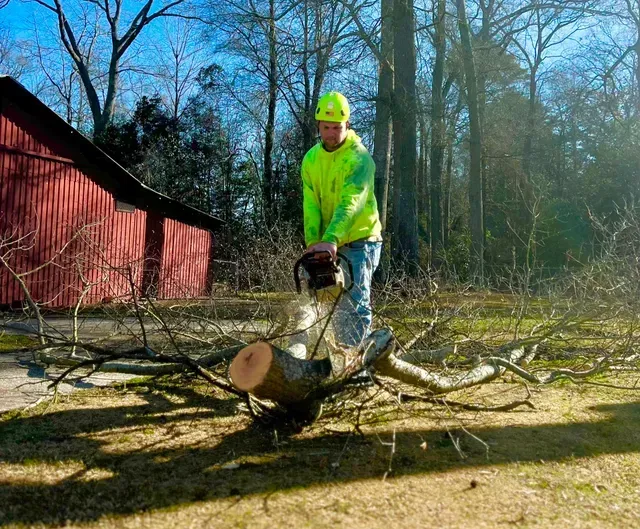
Thin dense stands. If your pines are growing 8-10 feet apart in plantation rows or in a thick volunteer cluster, they’re competing for water and light. We get called to properties where someone planted 40 loblolly pines on a half acre twenty years ago and now half of them are dead. Spacing matters. Thinning to 15-20 feet between trees gives the survivors room to grow stronger root systems and produce more resin. We do selective thinning with the forestry mulcher for underbrush and chainsaws for the larger removals.
Remove the weakest first. The runts, the leaning ones, the ones with thin crowns — beetles go for stressed trees. Taking out the weak ones before the beetles arrive is always cheaper than removing dead ones after. If you’re not sure which trees to keep, we’ll walk it with you.
Mix species. Don’t plant loblolly in dense clusters. Space pines 15-20 feet apart and mix in hardwoods. SPB doesn’t attack oaks, maples, or sweetgum. Species diversity breaks up the host continuity that beetles need to build a spot.
The NC Forest Service tracks SPB activity statewide and publishes annual surveys. If you want to know whether your county is in an active outbreak year, their forest health team is the source — homeowners can also report suspected infestations to their county ranger, and the Forest Service will do a free site visit to confirm.
How Southern Pine Beetle Spreads
This is the part that makes SPB dangerous. It’s not just one tree.
When beetles colonize a pine, they release aggregation pheromones — chemical signals that attract thousands more beetles to the area. Once a tree is fully colonized, the beetles shift to anti-aggregation pheromones that redirect the swarm to adjacent trees. That’s what drives the expanding infestation pattern that the state ag department calls a “spot.” A spot starts with a few trees and grows outward along a leading edge, following the nearest available pines.
What this means for your property: If you have one infested pine, inspect every loblolly within 100 feet. Look at the crowns first — any fading from green to yellow-green at the top? Then check the base for boring dust. We regularly remove clusters of beetle-killed pines across Nash and Edgecombe counties. Three trees turns into five turns into eight if you wait.
The areas we see the heaviest SPB pressure in Eastern NC:
- Dense pine plantations east of Goldsboro in Wayne County. Former farmland planted in tight rows 20-30 years ago. Trees stressed, crowded, and perfect beetle habitat. Beetle kills routinely take out 10-15 tree clusters in stands like these — the interior pines die while the edge trees survive because they had room to grow resin defenses.
- Spring Hope through southern Nash County and rural Nashville. Overgrown idle farmland where volunteer loblolly seeded in thick.
- Tarboro and eastern Edgecombe County. Scattered but consistent every summer.
Drought stress makes it worse. A dry spring followed by a hot summer weakens trees already competing for water in dense stands. The beetles move into stressed trees first.
Pine Beetle Tree Removal: What It Takes and What It Costs
Removing beetle-killed pine is straightforward but time-sensitive. The longer a dead pine stands, the more brittle it gets. A pine that’s been dead for three months drops differently than one that died last week. The wood dries from the outside in, the root plate loosens, and the trunk can snap mid-cut instead of hinging the way a live tree does. A standing dead pine in a storm is the worst combination — live pine bends, dead pine snaps clean and falls like a telephone pole with no warning.
We prefer to get beetle-killed pines down within a few months of death. After six months of standing dead, the risk goes up and so does the price.
Single Tree
A standalone beetle-killed loblolly on a residential property runs $800-$3,000 depending on:
- Height. Most loblolly in Eastern NC are 60-90 feet. Taller means more sections to cut and lower.
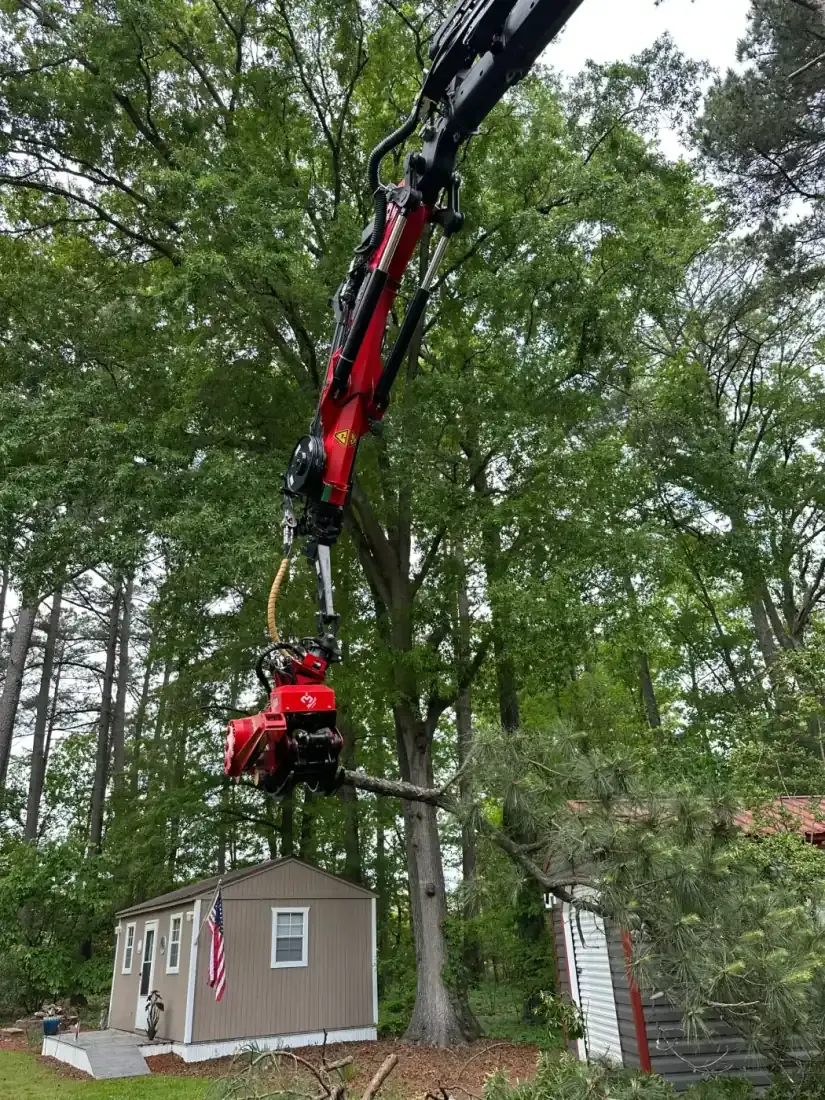
- Proximity to structures. A pine in the middle of the yard is a simple drop. A pine leaning toward the house with a power line on the other side needs rigging — a climber takes it apart from the top, roping each section down.
- Access. Can we get the grapple truck close enough to load directly, or are we hand-carrying rounds 200 feet to the street?
A straightforward 60-footer in an open yard: $800-$1,200. That same tree 10 feet from the house with overhead lines: $2,000-$3,000. For a full breakdown of tree removal costs, I wrote a separate guide with pricing from 200+ jobs.
Cluster (3-5 Trees)
This is the more common SPB job. Beetles don’t stop at one tree. We’ll get called for one dead pine and find two or three more with fading crowns while we’re on site.
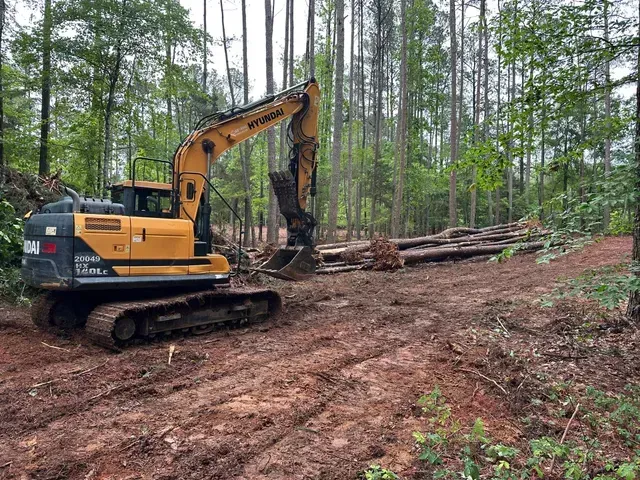
Cluster removals run $3,500-$6,000 for 3-5 trees. Per-tree cost drops because the equipment is already mobilized. An excavator from our operator partners stacks logs while the chainsaw crew drops the next tree. The Peterbilt grapple truck hauls everything in one run.
Catch it early and the price stays down. The cheapest cluster removal is the one you call about the week the needles turn brown. Recently-dead pine still fells and hinges close to how live wood does. Wait six months and you’ve got brittle standing deadwood — harder to fell safely and more expensive to remove. Beyond timing, what drives the number is tree count, height, how close they stand to structures, and whether the grapple truck can get near the pile.
Large-Scale (10+ Trees)
On rural properties where SPB ran through a dense stand or failed plantation, this becomes a land clearing job. The excavator pushes dead pine while the chainsaw crew handles anything near structures or keep-trees. The forestry mulcher handles underbrush and smaller dead material.
A 15-tree beetle-kill cluster on a couple of acres is the typical shape of this job — all plantation pine, all dead. Flat ground with good access is the cheapest version. Hilly ground, poor access, and scattered hardwoods mixed in push the price up fast.
What to Do Right Now
If you think you have pine beetle:
- Look at the crown. Brown from the top down? Walk to the trunk.
- Check the base for boring dust. Reddish-brown sawdust in bark crevices or on the ground is the earliest sign you can spot without climbing.
- Look for pitch tubes on the bark. White or pink resin lumps, especially from mid-trunk up. Any pitch tubes — high or low — mean the tree is under attack.
- Inspect every pine within 100 feet. Look for crowns just starting to fade from green to yellow-green — that’s the next tree in the spot. If you catch it early, you can contain it by removing infested trees before the beetles move to the neighbors.
- Call us. (252) 506-0099. We come look for free and tell you what you’re dealing with. Don’t wait — every week a dead pine stands is a week it’s getting more brittle and a week the beetles have to spread.
For more on recognizing a dead or dying tree beyond beetle damage — root heave, trunk lean, fungal growth, crown dieback — I wrote a full guide with 8 warning signs.
When It Becomes an Emergency
Most beetle-killed pine removal is scheduled work. But sometimes it’s urgent:
- Dead pine leaning toward the house with the root plate lifting. That’s a hazardous tree — call (252) 506-0099 any time, including nights and weekends.
- Dead pine over a driveway or walkway. A brittle pine dropping limbs on a path people use daily is a liability.
- Multiple dead pines ahead of hurricane season. If you have standing dead pines and a tropical system is approaching, get them down. Our pre-hurricane tree hazard audit covers what to check before June 1.
An emergency tree service call gets immediate response. We’re based in Rocky Mount with a second yard in Goldsboro, which keeps response times short across Nash, Wayne, Wilson, Johnston, Edgecombe, Halifax, Pitt, Greene, and Lenoir counties.
The Bottom Line
Southern pine beetle is not going away. Loblolly pine is everywhere in Eastern NC, the climate supports 3-5 beetle generations per year, and there’s no shortage of dense, stressed pine stands across our nine-county service area. Pine beetle is one of the top tree problems affecting Eastern NC properties.
If you see a fading crown, boring dust, or pitch tubes — call (252) 506-0099 or request a free estimate. We’ll walk the property, identify what’s infested, assess the neighbors, and give you a plan. Free, no obligation.
The cost of removing a beetle-killed pine before it falls is always less than the cost after it falls on something. And grinding the stump after removal prevents it from becoming termite habitat — dead pine stumps are a welcome mat for subterranean termites, which is a whole different problem you don’t need.
Call (252) 506-0099 or request your free estimate online.
Frequently Asked Questions
Can you save a pine tree that has southern pine beetle?
How much does it cost to remove a beetle-killed pine?
How fast does southern pine beetle spread?
What time of year is southern pine beetle most active in NC?
Does homeowner's insurance cover pine beetle removal?
How do I know if my pine tree has southern pine beetle?
Owner, DC Tree Cutting and Land Service
Anthony runs DC Tree Cutting from Rocky Mount, NC. Every article is based on real jobs, real equipment, and real pricing from across Eastern North Carolina. More about Anthony →