Tree Problems in Eastern NC: 5 Issues Property Owners Face
 Anthony Caracappa 11 min read


Want a firm price instead of a ballpark? Free estimate in about 2 minutes.
Get Free EstimateTable of Contents
The Most Common Tree Problems in Eastern NC
I’m Anthony Caracappa, and I run DC Tree Cutting out of Rocky Mount and Goldsboro. After 200+ jobs across nine counties, I kept having the same four conversations with homeowners. Different address, same problem, same tree, same “I wish I’d known sooner.” So I wrote it all down.
What are you seeing? Find your situation below:
| What you’re noticing | Jump to |
|---|---|
| Mushrooms at the base, hollow-sounding trunk, bark falling off | Internal Decay |
| Tree down, leaning after a storm, branches through the roof | Storm Damage |
| Pine needles turning brown/red, sawdust at the base | Pine Beetle |
| Dead limbs dropping, canopy too heavy, branches over the roof | Deferred Maintenance |
If you already know you’ve got a problem, skip the reading and call (252) 506-0099 or request a free estimate.
1. Internal Decay — The Tree That Looks Fine Until It Doesn’t
This is the #1 problem we deal with. A tree can look perfectly healthy from the street and be completely hollow at the base.
Water oaks are the worst. They’re everywhere — lining the streets of Rocky Mount’s older neighborhoods, filling yards in Goldsboro, Wilson, and Tarboro. They grow fast, put on a big canopy, and look great for decades. But they rot from the inside. By the time a water oak is 50-60 years old, the heartwood can be extensively decayed while the canopy is still full and green. The tree doesn’t know it’s dying, and neither do you — until a storm finds the weak spot.
Willow oaks do the same thing, just slower — they’ll last a decade or two longer before the decay catches up. Pecans are a different failure mode altogether. The wood is hard as hickory (because it is a hickory), but pecans develop heavy lateral limbs with wide crotch angles that are prone to splitting. One ice storm cracks the whole tree open at the union. Sweetgum trunks crack under ice loads too, and the wound never seals right — it just rots from the crack inward over years.
Warning signs you can see from the ground:
- Mushrooms or fungal conks growing at the base of the trunk
- Bark falling off in large sections (not normal species flaking)
- Carpenter ants or heavy woodpecker activity
- Cavities visible in the trunk or major branch unions
- The trunk sounds hollow when you knock on it
The classic version of this call: the lawn guy notices mushrooms at the base of a water oak. From the street the tree looks perfect — full canopy, green leaves, no dead branches. Then a probe at the base finds the trunk 70% hollow. That tree is one windstorm from dropping on the house, and it needs to come down within the week, not next season.
How urgent: Get it assessed this season. Internal decay doesn’t reverse. The tree isn’t getting stronger, and every storm is a roll of the dice. Most single-tree removals for decay run $1,500-$5,000 depending on size and proximity to structures.
Insurance note: Homeowner’s insurance generally does not cover removal of a standing decaying tree. This is considered maintenance — it’s out-of-pocket. Catching it early and removing it on your schedule is almost always cheaper than waiting for it to fail and dealing with the damage.
What to do: If your tree is over 50 years old and you’ve never had it assessed, call us. Especially water oaks, willow oaks, and pecans. A 15-minute walk-around can tell you if you’re sitting on a problem. Free, no obligation.
Read the full guide: Dead or Dying Tree? 8 Warning Signs
Not sure if the tree needs to come down or if trimming would buy you more years? When to Remove vs. Trim a Tree walks through the decision.
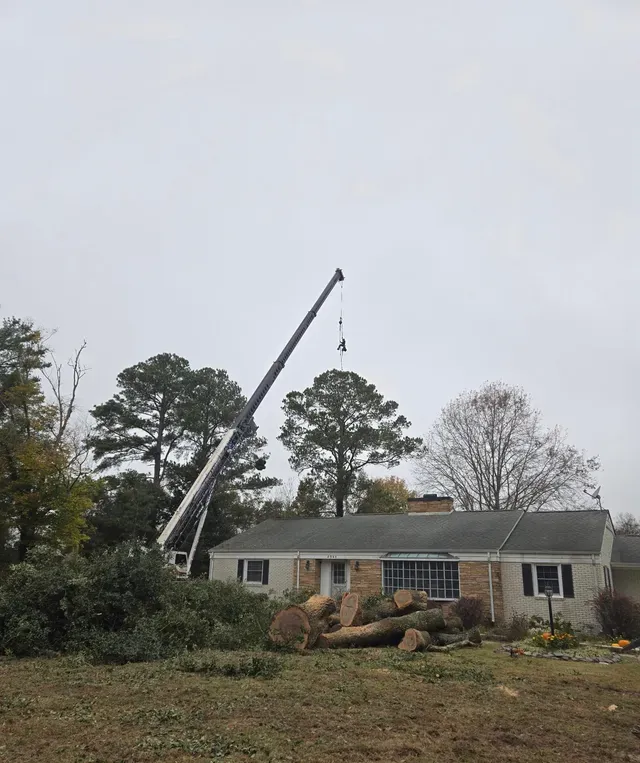
2. Storm Damage — Before, During, and After
Eastern NC is hurricane country. The Tar River corridor through Nash and Edgecombe counties, the Neuse River floodplain through Wayne and Lenoir, the Contentnea Creek drainage through Wilson — all of it floods when tropical systems push inland. Between hurricanes, we get severe thunderstorms May through September and ice storms in January and February.
Storm damage isn’t random. It follows patterns.
Before the storm — this is where the real money is. Most storm “damage” is actually deferred maintenance. The water oak that was hollow, the pine that had beetle damage, the dead limb that had been sitting in the canopy for two years — the storm just picked the day. Emergency tree removal after a storm carries a 25-50% premium over planned work. Every year we see homeowners who knew a tree was a problem in March and are calling us in September with it through the roof. Get your trees assessed before June 1 — there’s still time to deal with the problems on your schedule and your budget.
During the storm. Loblolly pines snap at the trunk or uproot entirely in saturated Coastal Plain soil — both failure modes are common here. Water oaks uproot when the ground is soaked. Ice loads break pecan limbs and bend pine canopies to the ground. If a tree is on your house, get out of the affected rooms, call 911 if anyone is hurt, and then call us.
After the storm. Storm chasers roll in from three states away with a pickup and a chainsaw they bought at Home Depot. They’ll quote you $500 cash, do half the work, and disappear. No insurance, no workers comp, no phone number that works next week. And if one of them gets hurt on your property, guess who’s liable — you are. We answer the phone 24/7 at (252) 506-0099 and we carry three insurance policies on every job.
Homeowner’s insurance usually covers storm damage tree removal when the tree fell due to a covered event and damaged a structure. We work directly with adjusters and document everything for your claim. Most storm removals run $2,000-$6,000 depending on size and damage.
How urgent: If a tree is on a structure or blocking access, call now. If you’ve got storm-damaged trees still standing (leaning, cracked, partially uprooted), get them assessed within a week — they can fail again without warning.
Read the full guides:
- Storm Damage Tree Cleanup — what to do when a tree comes down
- Pre-Hurricane Tree Hazard Audit — what to check before June 1
- Hazardous Tree Removal — signs, liability, and cost
3. Southern Pine Beetle
Southern pine beetle kills trees faster than anything else we deal with. A healthy loblolly pine can go from green to dead in 4-6 weeks once the beetles move in.
The problem isn’t just one tree. SPB spreads through pheromone signals — once beetles establish in a pine, they release chemicals that attract more beetles to the neighbors. A single infested tree becomes a cluster of 3, then 10, then 30. Catching a beetle cluster at 3 trees instead of 15 is the difference between a normal removal bill and a multiple of it.
How to spot it:
- Crown fade — needles turning from green to yellow to red-brown, starting at the top
- Pitch tubes — popcorn-sized resin blobs on the bark surface
- Boring dust — fine reddish-brown sawdust in bark crevices and at the base
- S-shaped galleries — peel back loose bark and you’ll see winding tunnels carved by the beetles
Can you treat it? No. By the time you see symptoms, the beetles and the blue-stain fungus they carry have already killed the tree from two directions — beetles destroying the phloem, fungus blocking water transport. No spray or injection will save it. The only decision is whether you remove it now on your schedule or later when it falls.
How urgent: This week. Remove infested trees before the beetles fly to the next pine. If you’ve got a cluster of pines and one is turning brown, call now — waiting a month could mean losing all of them. Single beetle-killed pine removal runs $800-$3,000. A cluster can run $3,500-$6,000+.
Insurance note: Pine beetle damage is not covered by homeowner’s insurance. It’s considered a maintenance issue, not a covered event. This is out-of-pocket.
Read the full guide: Southern Pine Beetle in NC: Identification & Removal
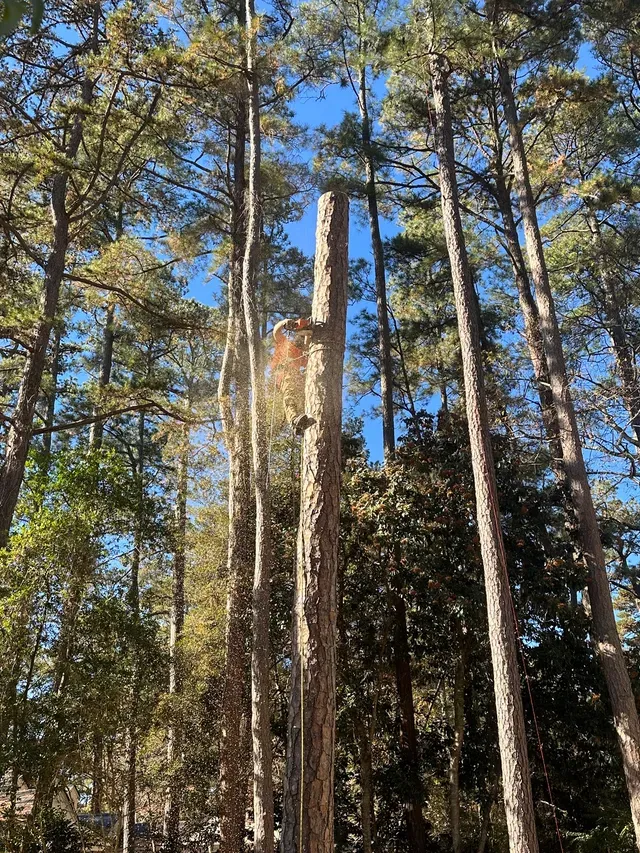
4. Deferred Maintenance — The Problem That Grows Every Year
This one doesn’t make the news. No storm, no beetle, no dramatic failure. It’s slow. A branch grows over the roof. The canopy gets heavier every season. Deadwood piles up in the upper crown where you can’t see it from the ground. A root system gets compromised by 20 years of soil compaction.
Then one day the branch drops during a regular Thursday afternoon thunderstorm, or the canopy catches too much ice, or the root plate gives up in a 40-mph gust. And now you’re paying emergency prices for a job that would have cost a third as much on a Tuesday in March.
The neighborhoods where we see the worst deferred maintenance are the mid-century subdivisions — Forest Hills in Wilson, Benvenue and Country Club Colony in Rocky Mount, Saulston and Greenleaf in Goldsboro, the historic blocks in Tarboro. Trees planted when these neighborhoods were built are now 50-80 years old. They’ve been through every hurricane and ice storm since. The accumulated stress shows up as weakened branch unions, internal decay, and canopy weight that exceeds what the root system can anchor.
What regular tree trimming looks like:
- Crown reduction every 3-5 years on large hardwoods near structures
- Deadwood removal from the upper canopy (the stuff you can’t see from the ground)
- Clearance trimming over roofs, driveways, and power lines
- Professional assessment of trees over 50 years old, especially water oaks and pecans
The math: A mature oak trim runs $1,500-$2,500. Emergency removal of the same oak after it fails runs $3,000-$6,000 plus whatever it damaged on the way down. The trim-to-emergency cost ratio is almost always 3:1 or worse. See our tree service cost guide for full pricing on every service.
How urgent: Schedule it this season. Deferred maintenance isn’t an emergency today, but it becomes one the next time the wind picks up.
Read the full guides:
- How Much Does Tree Trimming Cost in Eastern NC? — pricing by job type
- When to Remove vs. Trim a Tree — the decision framework
- How to Choose a Tree Service — what to look for when hiring
Common Trees in Eastern NC and How They Fail
Knowing what’s in your yard is the first step to knowing what to watch for.
- Loblolly pine — the most common tree we remove. Grows fast, seeds everywhere, vulnerable to pine beetle and ice loads. Snaps at the trunk in high winds or uproots entirely in saturated soil — both are common in our area.
- Water oak — rots from the inside out. The #1 hazard tree in our service area. Looks healthy from outside while being hollow at the base. Start assessing at 50 years.
- Willow oak — similar to water oak but longer-lived. Develops heavy lateral limbs that fail under ice or wind load.
- Pecan — heavy limbs with wide crotch angles, prone to catastrophic splits at the branch unions. Hard, dense wood (it’s a hickory) but the geometry fails before the wood does.
- Sweetgum — fast-growing, shallow-rooted. Uproots in saturated soil during tropical storms.
- Red maple — weak branch attachments. Included bark at branch unions leads to sudden splits without warning.
Full species guide: Common Trees in Eastern NC: Owner’s Guide
What to Do Right Now
If something on this page hit close to home, here’s your next move:
If you’ve got a tree you’re worried about — call (252) 506-0099 or request a free estimate. We’ll come look at it, tell you honestly whether it needs to come down or if trimming buys you more time, and quote the work on the spot. Free, no obligation.
If you’re not sure whether it’s serious — that’s the most common call we get. “I don’t know if this is a big deal, but can you come look?” Yes. That’s exactly what the free assessment is for. Better to call and find out it’s fine than to ignore it and find out it wasn’t.
If you want to get ahead of hurricane season — schedule a pre-storm assessment before May. Planned work is cheaper, faster, and less stressful than emergency calls.
If a tree just came down — call (252) 506-0099 right now. We answer 24/7 and respond to emergencies across all nine counties.
For pricing on all our services, see our complete tree service cost guide.
Frequently Asked Questions
What is the most common tree problem in Eastern NC?
How do I know if my tree is dangerous?
Should I remove a tree or just trim it?
Does homeowner's insurance cover tree removal?
Does a dead tree cost more or less to remove?
How much does it cost to remove a hazardous tree?
Owner, DC Tree Cutting and Land Service
Anthony runs DC Tree Cutting from Rocky Mount, NC. Every article is based on real jobs, real equipment, and real pricing from across Eastern North Carolina. More about Anthony →