Tree Removal vs. Trimming: How to Decide
 Anthony Caracappa 8 min read


Want a firm price instead of a ballpark? Free estimate in about 2 minutes.
Get Free EstimateTable of Contents
Tree Removal vs. Trimming: This Guide Is for the Trees in the Middle
I’ve written a full guide on dead and dying tree signs and another on hazardous trees and NC liability law. If your tree is clearly dead, clearly rotten, or clearly about to fall on something, the answer is removal. Go read those posts.
This one is for the trees in the middle. The water oak that’s getting big. The loblolly that’s 20 feet from the house. The row of Leyland cypress that looked great 10 years ago and now looks like a wall of brown. The Bradford pear you kind of like but kind of worry about every time the wind picks up.
I’m Anthony Caracappa, owner of DC Tree Cutting and Land Service. I give tree removal and trimming estimates on the same visit, and plenty of times I tell people to trim instead of remove. Other times, I tell them the truth — the tree is going to keep costing them money and they’re better off taking it out now.
If you’re asking yourself “should I remove my tree or can I just trim it,” here’s the framework.
Should I Remove My Tree? Five Questions That Give You the Answer
You don’t need an arborist certification to work through this. You need five honest answers.
1. Is the tree sound enough to respond to pruning?
A sound tree walls off pruning cuts and keeps growing — arborists call it compartmentalization. A stressed or declining tree can’t do that well. Every cut becomes an entry point for decay. If your tree has 30% or more dead canopy, major trunk wounds, or fungal growth at the base, trimming won’t help. It’ll just cost money now and cost more later.
For trees in the early stages of decline — thinning canopy, some deadwood, smaller leaves than usual — trimming can buy years. But you’re managing decline, not reversing it. Know that going in.
2. Does trimming actually solve the problem long-term?
If the issue is deadwood over the roof, a one-time trim handles it for 2-3 years. Done.
If the issue is the tree is too big for the space, trimming is a temporary fix. You can reduce a canopy by about 25% per session without hurting the tree — that’s the ANSI A300 standard, and it’s the line we follow. A 60-foot water oak with a 50-foot lateral spread isn’t becoming a 40-foot tree through trimming. It’s becoming a 55-foot tree this year and a 60-foot tree again in three seasons. At some point you’re paying $1,500 every other year for a tree that will never fit the lot.
And if the tree overhangs a neighbor’s yard, that changes the math. A limb that drops on their car or their roof is your problem under NC law if you knew the tree was a concern and did nothing. See our hazardous tree guide for the legal details.
3. What will the ongoing maintenance cost you?
Get both estimates — trimming and removal — and run the five-year comparison.
| Scenario | Trim | Remove |
|---|---|---|
| Sound 50-ft oak, deadwood and clearance | $800-$1,200 every 3 years | $2,500-$3,500 one time |
| 60-ft water oak crowding the house, full reduction | $1,500-$2,000 every 2 years | $3,000-$4,500 one time |
| 80-ft loblolly pine, 15 ft from garage | Can’t be trimmed to safe distance | $3,000-$5,000 one time |
| Row of 3 Bradford pears near driveway | $500-$600 each per trim, but they split anyway | $1,500-$3,000 total removal |
The sound oak is a keeper. No question. Over five years you’ll spend $1,600-$2,400 and keep a tree that adds shade, value, and character. The water oak crowding the house? $3,000-$4,000 in trimming and it’s still too close. The loblolly can’t be trimmed shorter. Pines don’t work that way. And the Bradford pears are going to split in a storm no matter what you do.
If the cost of preventive removal is more than you can handle at once, we offer financing through Wisetack — see all your payment options here.
4. What species are you dealing with?
Some trees earn decades of maintenance. Others don’t. Here’s how the most common Eastern NC species break down — see our NC tree guide for full profiles.
Keep these:
- Willow oak — deep roots, strong wood, 100+ year lifespan. The best shade tree in Eastern NC. A mature willow oak might need trimming once a decade. Every dollar you spend on it is money well spent.
- Pecan — the only tree on this list that feeds you. Long-lived, valuable, strong trunk. The long lateral limbs are the only concern — they get heavy, and summer branch drop is real with pecans. Keep the deadwood out and address any V-crotches before they become the weak point. Don’t cut down a sound pecan unless you absolutely have to.
- White oak — slow growing, nearly indestructible. A mature white oak might need trimming once a decade. If you have one, keep it for your grandkids.
Judgment calls:
- Water oak — fast growth, 60-80 year lifespan, but internal rot starts showing up after 40. Worth maintaining when young and sound. Past 50 with a thinning canopy or mushrooms at the base, start planning the removal. The longer you wait, the bigger the bill.
- Red maple — codominant stems are the problem. If the main fork has tight bark pinched between the leaders, that union will split eventually. Consider removal before it splits on its own and hits something. Clean structure with a single leader? Trim and maintain.
- Sweetgum — sound trees are fine to maintain above ground. But the roots run shallow and they’ll heave a driveway right up. If your concrete is already cracking, trimming the canopy doesn’t fix what’s happening underground. That’s a removal.
Don’t bother:
- Bradford pear — structural defect at every branch union. Included bark, weak wood. Trimming them is like patching a tire with a bad sidewall. Remove it.
- Leyland cypress rows past 30 feet — brown and dead on the inside, can’t regenerate from old wood. Cutting them to 20 feet leaves dead sticks. Remove and replant with something that works at the right scale.
- Any tree with confirmed internal rot — mushrooms at the base, hollow trunk when you knock on it, soft spongy bark. Trimming the canopy doesn’t fix what’s rotting inside. That’s not a trim-vs-remove decision anymore. That’s a removal and stump grinding call. See our dead tree guide for the full diagnostic.
5. Is trimming just delaying an inevitable removal?
This is the question people don’t want to answer. And it’s the one most tree companies won’t bring up, because trimming a declining tree every couple years is steady revenue for them.
Run the math on a declining water oak: $1,500 in trimming every couple of years, on a tree that’s rotting from the inside out and coming down eventually anyway. I’d rather tell you to spend $3,500 now and be done with it than watch you spend $6,000 in trimming over four years and then pay for the removal on top of it. That’s the trap — paying maintenance on a tree you already know is going to come down.
And with hurricane season starting June 1, a tree you’re on the fence about becomes a very different conversation when there’s a storm warning in the forecast. The question stops being “trim or remove” and starts being “why didn’t I deal with this in April.” For an overview of all the issues that lead to this decision, see our guide to common tree problems in Eastern NC.
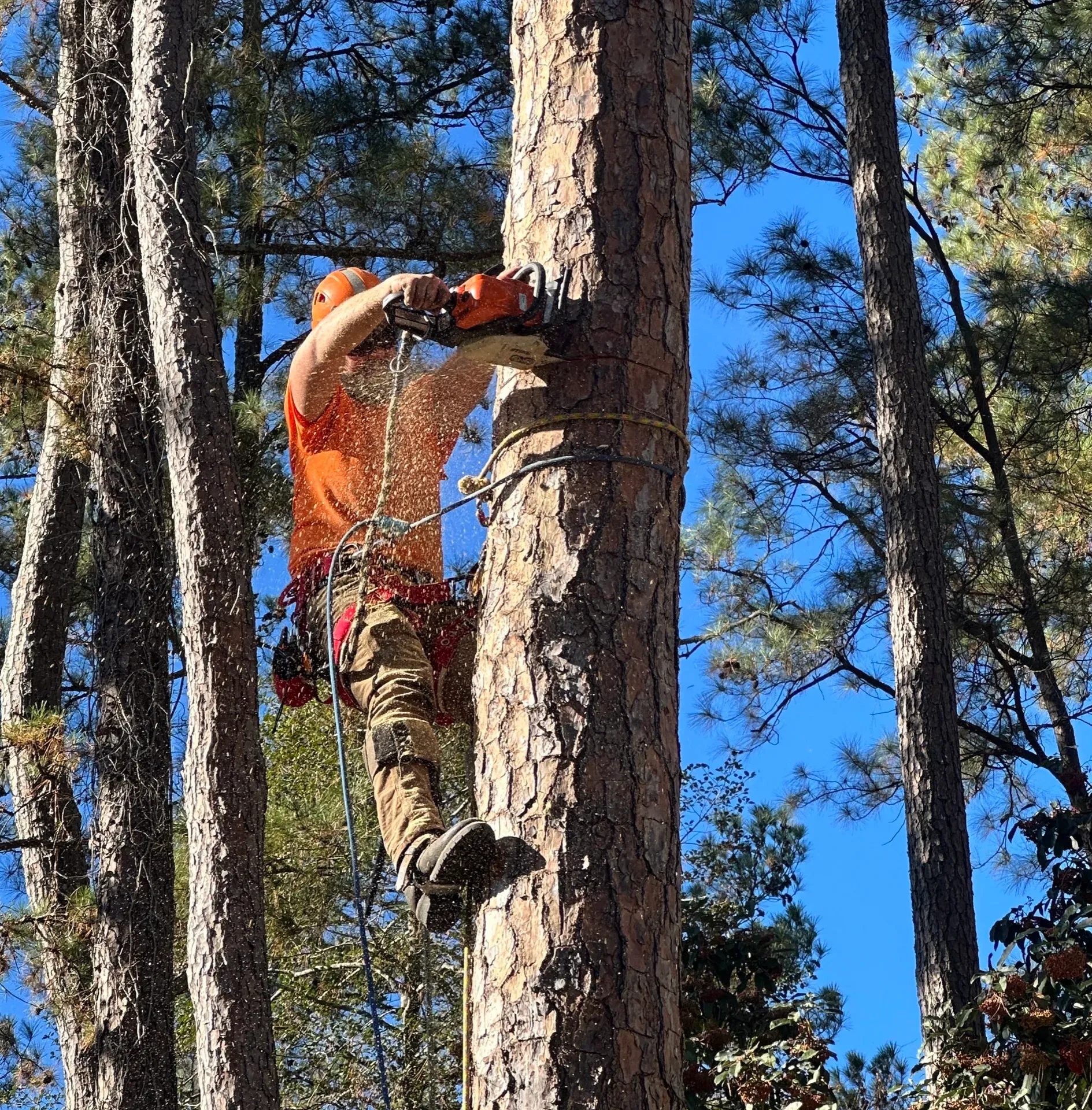
Trim vs. Remove: Real Numbers From Our Recent Jobs
These are completed jobs from our records — place, season, and rounded invoice — to show what each side of the decision actually costs:
- Tree removal in Rocky Mount - about $500 (summer 2025). Small tree, simple decision: it was cheaper to remove than to keep maintaining.
- Trimming in Wayne County - about $1,250 (winter 2025-26). A sound tree worth keeping — exactly the case where trimming wins.
- Tree removal in Wilson - about $2,750 (spring 2026). A bigger removal, right around what a few rounds of repeat trimming would have cost.
The pattern in our records matches the framework above: when the tree is sound, one round of trimming is the cheaper call. When it’s declining, the removal usually costs about the same as two or three trimming cycles — and then the spending stops.
When to Call Us
If you’re on the fence about tree removal vs. trimming, call and we’ll walk the tree with you. We give both estimates on the same visit so you can compare the numbers side by side. No pressure to pick one. If trimming is the right answer, I’ll tell you. If the tree needs to come down, I’ll tell you that too.
If you’re comparing tree services, our guide to choosing a tree company covers what to look for.
Call (252) 506-0099 or request a free estimate online. We serve Nash, Wayne, Wilson, Edgecombe, Halifax, Johnston, Pitt, Greene, and Lenoir counties from our offices in Rocky Mount and Goldsboro.
The Bottom Line
A solid willow oak that needs trimming every three years is a tree you keep for your grandkids. A declining water oak that eats $2,000 every couple years and sits 15 feet from your roof is a tree you take out before it takes out something of yours.
Most people already know which one they’re looking at. The hard part is admitting it.
Get both numbers. Compare them honestly. Then pick the option that makes sense for the next five years, not the next five months.
Frequently Asked Questions
How do I know if my tree should be removed or just trimmed?
Can a tree be trimmed to make it smaller?
Is it cheaper to keep trimming a tree or just remove it?
Should I remove a tree that's too close to my house?
What trees are not worth trimming in Eastern NC?
Will removing a tree hurt my property value?
Owner, DC Tree Cutting and Land Service
Anthony runs DC Tree Cutting from Rocky Mount, NC. Every article is based on real jobs, real equipment, and real pricing from across Eastern North Carolina. More about Anthony →