Property Manager Tree Service: NC Hiring Guide & Requirements
 Anthony Caracappa 16 min read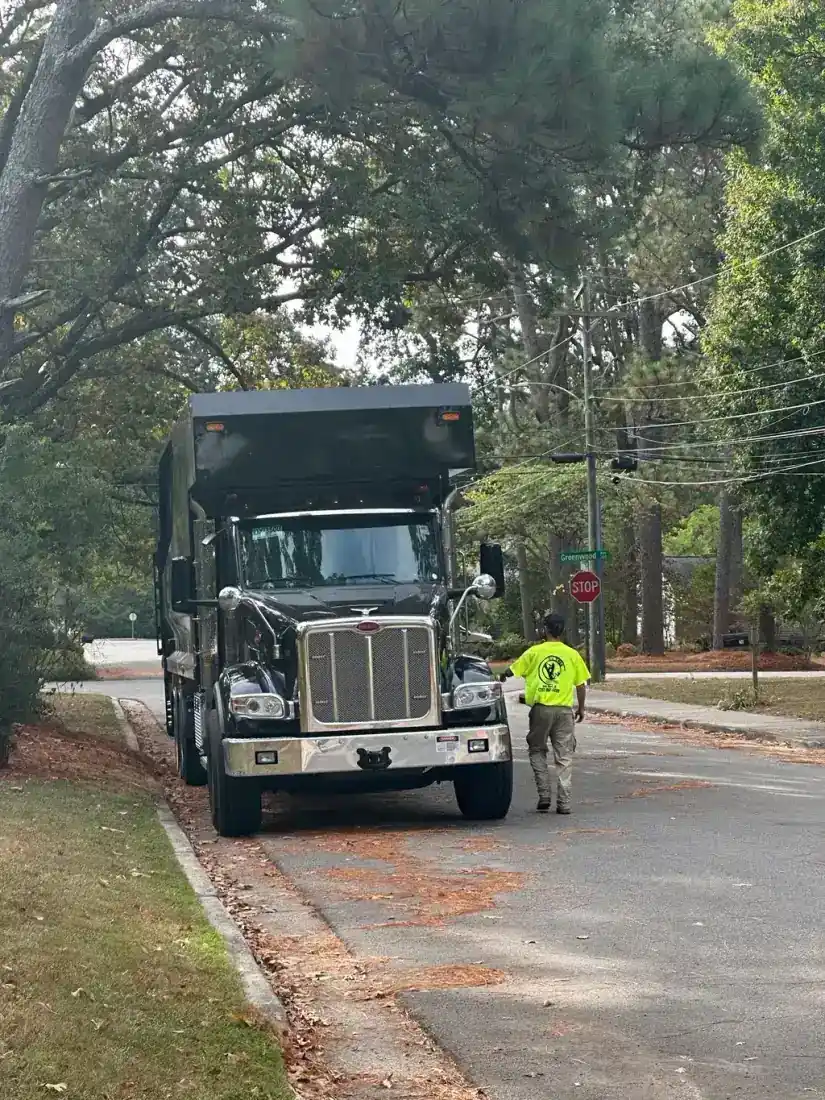


Want a firm price instead of a ballpark? Free estimate in about 2 minutes.
Get Free EstimateTable of Contents
Property Manager Tree Service: A Guide for NC Commercial Portfolios
Here’s the scenario that keeps property managers up at night - and versions of it happen in this industry every year. A crew without workers’ comp drops a trunk section wrong and a groundman gets hurt on a managed property. The injured worker’s attorney goes after the property owner, and the owner’s first call is to the manager who hired the crew. Legal defense bills cross five figures before a case is even filed.
That’s the extreme version. The common version is smaller: a verbal estimate that turns into an invoice three times bigger, a tenant’s car dented by a dropped limb and a contractor who won’t return calls, a scope that was “handled” and left half the debris in the parking area.
Every one of these calls ends the same way — the property manager is now paying us to do the job correctly, plus cleaning up whatever the previous contractor left behind. The cheap bid was never cheap.
I’m Anthony Caracappa, owner of DC Tree Cutting and Land Service. About half our work is commercial — property management companies, HOAs, apartment complexes, retail centers, office parks, medical office buildings, churches, and engineering firms across Eastern NC. This post is what I’d tell a property manager tree service shopper before they hire anyone — us included.
For commercial tree service for property managers who handle HOA accounts specifically, see our HOA tree maintenance guide. For construction project work, see tree removal for utility and waterline construction.
Tree Service Insurance Requirements for Commercial Properties
Insurance is the single most important filter when hiring for commercial work. Get this wrong and one bad day costs you more than five years of contractor savings would have.
Commercial insurance isn’t the same as “residential fully insured” — specific limits, specific endorsements, specific form numbers. Any real commercial contractor handles these without pushback.
General Liability — Per Occurrence AND Aggregate
Minimum for commercial work: $1M per occurrence / $2M general aggregate. Note the two numbers. Per-occurrence is what a single claim pays up to; aggregate is the total the policy pays across all claims in the policy year. COIs show both. Check both.
Standard for larger portfolios: $2M per occurrence / $4M aggregate. Institutional or REIT-owned properties commonly require this plus a $5M-$10M umbrella or excess liability policy sitting on top. If your owner’s insurance requirements sheet specifies an umbrella, ask the contractor for evidence of excess coverage on the COI, not just primary GL.
Workers’ Compensation — NC Statutory + Why It Matters
North Carolina requires workers’ compensation for any business with three or more employees (N.C.G.S. § 97-2). If a contractor doesn’t carry it and a worker gets hurt on your property, the liability doesn’t just evaporate — under N.C.G.S. § 97-19, the property owner can be pulled in as a statutory employer if they contracted with an uninsured sub. “The claim comes back at the property” is the short version of that statute.
The red flag is any contractor who “1099s everyone” to avoid carrying workers’ comp. The IRS 20-factor test and NC common-law control test both say: if the contractor directs the work, uses the contractor’s equipment, and follows the contractor’s schedule, those workers are employees for workers’ comp purposes regardless of how they’re paid. Misclassification doesn’t make the liability go away — it just routes it through your property.
Ask for the EMR. An Experience Modification Rate of 1.00 is industry average; under 1.00 means better safety history than average; over 1.20 is a red flag. Any contractor doing real commercial work knows their EMR cold.
Commercial Auto
$1M Combined Single Limit standard. Personal auto policies exclude commercial use — a tree truck and a personal pickup are different animals to an underwriter. If the contractor’s truck hits a tenant’s car in your parking lot and they’re running personal auto, the carrier denies and the claim routes through your property’s master policy or the owner’s umbrella.
Additional Insured Endorsement — Forms Matter
Not just “additional insured.” Specifically:
- CG 20 10 — adds your entity to the GL policy for ongoing operations. Covers claims that arise during the work.
- CG 20 37 — adds your entity to the GL policy for completed operations. Covers claims that arise after the crew leaves. For tree work this matters because claims often surface later — a tree failing months after a trim, or defective rigging causing delayed damage.
You want both forms, not one. Verify the endorsement numbers on the COI or ask for the actual endorsement page.
Primary and Non-Contributory
This is the language that makes the contractor’s policy pay first without trying to share the loss with your insurance. Without “primary and non-contributory” wording, the contractor’s carrier can file for contribution from your owner’s carrier, which means your insurance still pays part of the claim and your loss history still takes the hit. Institutional owners require this wording as standard boilerplate.
Waiver of Subrogation
Prevents the contractor’s insurance from coming after the property owner to recover claim payouts. Required by most commercial master policies. Standard on workers’ comp policies as endorsement WC 00 03 13. On the GL policy, typically blanket waiver added by endorsement.
Certificate Tracking
We send ACORD 25 certificates within 24 hours of contract execution, naming your firm and the owner as additional insured. If your compliance checklist requires specific endorsement wording, we confirm it with our agent before work starts.
For a deeper walkthrough of what to look for on the certificate document and how to confirm policies are active, I wrote a full guide to verifying tree service insurance.
Industry Standards That Matter for Commercial Work
Commercial vendor packets increasingly ask about industry-specific credentials. For tree service:
- TCIA accreditation. Tree Care Industry Association accreditation verifies safety programs, training cadence, insurance compliance, and business practices. TCIA-accredited companies are a small fraction of the tree service market. If a contractor claims it, verify on the TCIA website.
- ISA Certified Arborist. International Society of Arboriculture certification for tree assessment and care. For commercial work where assessments have evidentiary weight in litigation, ISA-credentialed assessment is a different legal posture than “a guy looked at it.”
- ISA Tree Risk Assessment Qualification (TRAQ). Specific credential for hazard tree assessment using standardized methodology. Most commercial hazard assessments should be TRAQ-documented.
- ANSI A300 compliance. The industry standard for tree care practices — pruning, removal, fertilization, lightning protection. Commercial contracts should reference A300 compliance.
- ANSI Z133 compliance. The safety standard for arboricultural operations. Non-compliance on a commercial site creates OSHA exposure.
- Pesticide applicator license (NCDA&CS) if the scope includes herbicide work — stump treatment to prevent regrowth, invasive vine control, etc.
A contractor who can name these standards and document compliance operates at a different level than one who can’t.
Documentation Expectations
Property managers report to owners. Owners want documentation. Tree contractors who treat documentation as optional create problems every month.
What you should expect from any commercial tree contractor:
- Itemized invoicing — not a single lump line that says “tree work, $4,500.” Every property, every scope, every line item separated. If you’re managing multiple properties, cost allocation has to be clean.
- Before/after photos on every job, uploaded to your property file or vendor portal.
- Scope-of-work confirmation in writing before the work starts — not just a verbal “we’ll handle it.” Both sides sign. Prevents the “you said it included stump grinding” conversation.
- Daily field reports on larger scopes — crew classification, hours, quantities completed, weather, delays, incidents. Most institutional commercial contracts require them.
- Annual property assessment reports for ongoing accounts — condition of significant trees, maintenance recommendations, budget projection for the coming year. What you take to the owner at budget time.
- OSHA 300 log access on request. Some contracts require contractors to share injury history or report any injuries within 24 hours.
- Per-property reporting for multi-property accounts. We format reporting to match whatever system the client runs — we’ve pushed clean PDFs and CSV exports into AppFolio, Yardi Voyager, Buildium, and MRI work order tickets.
- Certified payroll (WH-347) on Davis-Bacon construction projects only. For routine tree maintenance at federally-assisted multifamily (HUD, LIHTC, USDA RD), certified payroll is typically not required — only on capital construction scopes. A contractor who demands extra for “certified payroll” on routine tree work probably doesn’t understand when it actually applies.
A contractor who pushes back on documentation isn’t the right fit for commercial work.
Vendor Onboarding and Portal Integration
Modern commercial property management runs on vendor platforms. Tree contractors who can’t operate in them are operationally incompatible.
COI verification platforms. ComplianceDepot is dominant in multifamily. NetVendor and RMIS serve institutional and REIT-owned portfolios. Property managers upload vendor COIs to the platform, the platform verifies endorsement language, flags expiring policies, and blocks work until compliance is current. We upload certificates and W-9s directly into ComplianceDepot and whatever platform the client uses.
Property management software. Yardi Voyager, AppFolio, Buildium, MRI, Entrata, RealPage. Vendor portals inside these systems handle W-9 submission, ACH payment setup, 1099 filing, work order tickets, invoice submission. Contractors who can’t navigate a vendor portal create onboarding friction every month.
Vendor onboarding packet. National property management firms typically have 20-40 page vendor onboarding packets. Standard contents: W-9, COI, references, background check attestation, safety program documentation, sometimes DEI/supplier diversity disclosures. We fill them out without complaint — a contractor who treats these as an imposition isn’t ready for institutional work.
REIT-specific requirements. Public REIT and non-traded REIT owners often require COIs naming specific legal entities — the REIT, the TRS, the property LLC, and the property management company separately. Ask your risk department for the exact entity list.
Property Type Segments
Different property types have different tree service needs. Commercial tree service for property managers means knowing which is which.
Apartment complexes. Mature trees 20-40 years old overhanging occupied units and parking. The recurring issues are deadwood over cars, root heave on sidewalks, and declining hardwoods that need managed removal before they fail. Notification template for residents, parking coordination, same-day access restoration.
Retail centers and office parks. Aesthetics matter. Deadwood over parking creates liability fast. Root conflicts with lights, signage, ADA paths. Weekend or pre-opening hours preferred to avoid customer impact.
Medical office buildings (MOBs). Patient access, noise restrictions, after-hours scheduling. Ambulance access must not be blocked. Hospital-owned MOBs may have additional risk management requirements.
Senior living and ALF/SNF. Resident safety paramount. Fall-risk hazards around walkways get priority. Work scheduled around resident activity and meal times. Dust and noise coordination with facility management.
Industrial, warehouse, and flex. Growing segment in Eastern NC with logistics buildout. Larger parcels, perimeter tree lines along fencing and detention ponds, often straightforward access. Different insurance specs because of the property value.
Self-storage. Simple tree needs on most sites — perimeter maintenance, occasional removal. Access around occupied units.
Mixed-use. Combination of retail ground floor and residential upper floors. Blended scheduling around both tenant populations.
HOAs. See our HOA tree maintenance guide for HOA-specific liability, governance, and reserve study considerations — different buyer than commercial property management, same contractor.
Municipal / government. Different procurement rules (RFP process, open meeting requirements, sometimes prevailing wage). NCDOT and local government work requires separate bonding and documentation.
What to Look For in the Crew
Insurance paperwork is the contractor’s front office. The crew on your property is everything else.
W-2 employees vs 1099 arrangements. A real commercial contractor employs their core crew - payroll taxes, workers’ comp, consistent training - and tells you plainly when a bigger job brings in vetted contract climbers or operators.
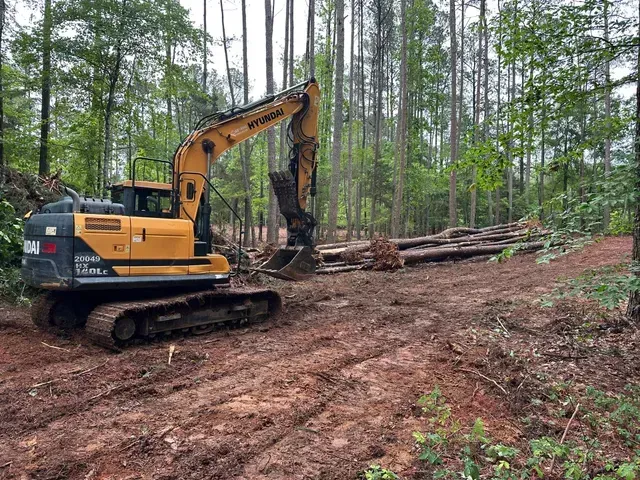
Equipment fleet and ownership. Real commercial tree contractors own their equipment — Hyundai HX120LC tracked excavator, Takeuchi TL12R2 forestry mulcher, Peterbilt grapple truck, Vermeer SC48TX stump grinder, full climbing and rigging gear. A contractor who subs the equipment-heavy work to other crews you’ll never meet is taking a margin and adding unaccountability. Ask whose equipment will be on your property.
Branded gear and uniforms. Not a guarantee of skill, but matching shirts and branded hard hats prove somebody’s paying payroll taxes and running a real business.
Communication on site. The crew lead checks in with the onsite manager when they arrive, walks the scope, confirms anything ambiguous, and reports completion with photos. They notify you of anything they find that wasn’t in scope. They don’t leave debris piles for “tomorrow” that turn into next week.
For residential context on evaluating tree services generally, how to choose a tree service covers the homeowner angle. The commercial filter is stricter on insurance, documentation, and crew accountability.
Red Flags Specific to Commercial Work
Patterns I see when property managers tell me about contractors that didn’t work out:
“Cash discount” pricing. On residential this might mean “we don’t take cards.” On commercial it almost always means unreported labor and no workers’ comp. The “discount” is subsidized by liability that transfers to your property when something goes wrong.
Reluctance on COI with proper endorsements. If the contractor hesitates on CG 20 10 / CG 20 37 or claims primary and non-contributory wording costs extra, they probably don’t have the coverage they claim. Any real commercial contractor handles this on every contract.
Refusal to put scope in writing. “We’ll just handle it” sounds easy until the invoice arrives with work you didn’t authorize. Every commercial scope gets written. Full stop.
No multi-property pricing structure. A contractor quoting the same per-property rate whether you have 5 properties or 50 isn’t built for portfolio work. The routing math is the whole game: cluster the properties into shared dispatch days, quote the portfolio as one contract, and the per-property price drops - same scope, different structure.
Undisclosed subcontractors. If the contractor sells you on their crew and equipment but actually subs the work out, you’re hiring two contractors and vetting one. Ask explicitly: “Will your crew and your equipment do the work, or are you subbing?” Get it in writing.
Vague timeline commitments. “We’ll get to it when we can” works on a residential job. Commercial needs scheduled response with contract language.
Pricing 40%+ below other bids. Bid variance of 15-20% is normal — routing efficiency, equipment fit, access assumptions. A 40%+ spread means the low bidder is cutting insurance, workers’ comp, crew pay, or documentation. Ask how they price that low. The answer tells you everything.
Multi-Property Tree Service in NC: Portfolio Math
A worked example of how the structure changes the number. Take a hypothetical 7-property portfolio — two retail strips, four apartment complexes, and a church spread across two counties. Quoted per-property at residential rates, every property carries its own mobilization, its own scheduling call, its own paperwork pass. Structured as a portfolio contract, the math changes:
- Routing efficiency. Apartment complexes scheduled on the same day. Retail strips paired with the apartment route when they’re minutes apart. The church handled on a separate day with larger scope.
- One mobilization per dispatch day instead of seven. Same crew, same equipment, same documentation pass.
- One vendor relationship for compliance paperwork, not seven.
- A multi-year term lets us plan crew schedule and equipment capacity against the portfolio.
The savings are real precisely because the structure is different. A contractor who quotes portfolio work at per-property residential rates doesn’t understand commercial, regardless of what their website says.
Contract Structures for Multi-Property Tree Service in NC
Different portfolios need different structures.
Annual maintenance contract. Fixed annual price, defined scope, scheduled visits, included emergency response up to a volume cap. Best for properties with ongoing maintenance needs and predictable scope. Multi-year terms lock Year 1 and escalate Years 2+ with CPI (commonly 3-4% annually).
Per-visit retainer. Set per-visit rate, scheduled cadence (monthly, quarterly, semi-annual). Works well for low-tree-density properties that need regular maintenance but don’t justify a full annual contract.
Unit-price contracts. Used on larger campuses, HOAs, or portfolios where scope varies visit to visit. Per-inch DBH pricing for removals, flat rate for pruning by tree size class, per-load debris hauling. Client authorizes specific scope against unit rates.
Project-based pricing. Fixed price for a one-time scope — clearing a section of a property, removing a group of dead trees, post-storm cleanup. Used for one-off work outside ongoing contracts. For utility corridor and waterline construction projects specifically, project-based is standard.
Not-to-exceed (NTE) authorizations. Common for post-storm work where the property manager authorizes up to $X without further approval, with the contractor invoicing actual scope completed up to the cap.
Multi-property volume pricing. For 5+ properties under one contract. Routing efficiency, volume discount, one vendor relationship. See the portfolio math section above.
Time-and-materials. Avoid on commercial work whenever possible. T&M billing creates incentive for the contractor to take longer and use more equipment than necessary. Fixed pricing aligns incentives.
Questions to Ask Before You Sign
Run these with any contractor bidding commercial work. Answers tell you quickly whether they’re ready for the account.
- Insurance: What’s your GL per-occurrence and aggregate? Do you carry umbrella or excess? Send a COI naming my company with CG 20 10, CG 20 37, primary and non-contributory, and waiver of subrogation.
- Workers’ comp: What’s your Experience Modification Rate? Are your workers W-2 or 1099?
- Credentials: Are you TCIA accredited? Do you have ISA Certified Arborists or TRAQ-qualified assessors on staff?
- Crew and equipment: Will your crew and your equipment do the work, or are you subbing out? If sub’d, who?
- Vendor portal: Can you upload COI and W-9 through our vendor management platform (ComplianceDepot / Yardi / AppFolio / etc.)?
- Emergency response: What’s your response time commitment? Can you put it in the contract with a storm-event trigger?
- References: Who are three commercial property managers in Eastern NC I can call?
A contractor who handles these cleanly is probably worth working with. A contractor who hedges, gets defensive, or can’t answer is telling you what you need to know.
Commercial Tree Service for Property Managers in Eastern NC
We work commercial accounts across Eastern NC — single properties, small portfolios, and multi-county management companies. Insurance is current and commercial-limit. Documentation is standard, not upcharged. Contracts get structured around how you actually manage the work, not how our back office wants to bill.
See our guide to hiring a tree service in Eastern NC for the complete decision framework — it covers residential and commercial.
If your portfolio includes properties in Nash, Wayne, Wilson, Edgecombe, Halifax, Johnston, Pitt, Greene, or Lenoir counties — or cities like Rocky Mount, Goldsboro, Greenville, Wilson, Kinston, or Clayton — call (252) 506-0099 or request a property assessment. We’ll walk every property in your portfolio, give you a written proposal, and structure the contract around how you actually manage the work.
For HOA boards specifically, see HOA tree maintenance. For construction project work with engineering firms and GCs, see tree removal for utility and waterline construction. For the full scope of our commercial tree service including emergency, storm response, and large-scale removal, see the service page.
Frequently Asked Questions
What are the tree service insurance requirements for commercial property work?
What is an EMR and why does it matter for hiring a tree service?
What's an additional insured endorsement and why does it matter?
Can I just hire the cheapest tree service for my commercial properties?
How does multi-property tree service pricing work in NC?
Should commercial tree contracts be put out to bid every year?
Can a tree service upload COIs through ComplianceDepot or our vendor management platform?
Owner, DC Tree Cutting and Land Service
Anthony runs DC Tree Cutting from Rocky Mount, NC. Every article is based on real jobs, real equipment, and real pricing from across Eastern North Carolina. More about Anthony →