HOA Tree Maintenance in NC: Annual Plans That Save Money
 Anthony Caracappa 14 min read


Want a firm price instead of a ballpark? Free estimate in about 2 minutes.
Get Free EstimateTable of Contents
HOA Tree Maintenance in NC: Annual Plans That Save Money
I’m Anthony Caracappa, owner of DC Tree Cutting and Land Service. HOA boards tend to learn the same lesson the same way.
A pine at the entrance dies over the summer. Nobody’s sure when. Now it’s leaning toward the sign and the board needs it gone before the fall meeting. Emergency removal with rigging: $2,500. Six months earlier, when it was just showing brown needles from the top down, a scheduled trim-and-assess would have run $400 and the tree would have been scheduled for winter removal on the annual cycle.
That gap — between reactive work and proactive maintenance — is what this post is about. We work with HOAs across Eastern NC, from 40-home subdivisions with one retention pond to multi-amenity communities with walking trails and a hundred-plus mature trees on common land.
This post is for HOA directors, community association managers (CAMs), and the homeowners who sit on landscape and architectural review committees. It covers what an annual program actually delivers, what it costs in NC, the 5-year math vs. reactive work, and the liability and insurance architecture most boards don’t see until they’re in a deposition.
Five Years of Reactive HOA Tree Spend
What reactive management usually looks like on a mid-sized Eastern NC subdivision with about 20 significant common-area trees:
- Year 1. No tree budget. A Tuesday storm drops a hickory limb on a tenant’s Camry in the parking area. Emergency removal and cleanup runs $1,800. Board eats the deductible and a week of unhappy phone calls from neighbors.
- Year 2-3. Two reactive calls. A leaner behind the clubhouse after a named tropical system in September — cleanup runs $2,400 because the tree crossed a fence into the adjacent property and took out a section. Then in March of Year 3, an entrance pine that had been showing brown needles for eight months finally has to come down — $3,200 with rigging and traffic control, plus $800 to replant the entrance.
- Year 4. A homeowner emails the property manager about a “weird-looking pine” on HOA land behind her back fence. Manager forwards the email to the board. Board tables it for the next meeting. Next meeting gets canceled. Tree comes down in a January ice storm across her fence and shed — $4,100 cleanup plus the shed claim routed through her homeowner’s policy. The email thread becomes Exhibit A in the subrogation claim.
- Year 5. Multiple deadwood events during a summer thunderstorm week. Board finally calls around for annual contracts. Total reactive spend through five years: roughly $12,300, plus one subrogation claim on the master policy that bumps the premium at renewal.
An annual contract on the same property over the same five years — $3,200/year, locked under a 5-year term with a 3% annual escalator — runs about $17,000 total. Yes, that’s more than the reactive number. But the reactive number doesn’t include the dead trees still standing at Year 5, the deferred work, the premium increase, or the legal exposure from undocumented hazards. The proactive contract produces a maintained property with documented assessments. The reactive spend produces a pile of emergency invoices and one plaintiff’s attorney with a subpoena for board minutes.
Every HOA hits this wall eventually. The reactive approach feels cheaper because it doesn’t show up as a budget line. It shows up in special assessments, angry meetings, and the occasional subrogation fight. I’ve never seen it go the other way.
What a Homeowner Association Tree Contract Includes
A real HOA tree contract is not “we’ll show up if you call us.” It’s a defined scope with scheduled visits, credentialed assessments, and documented deliverables.
Spring Assessment (March-April)
We walk every common area, every amenity, and any other HOA-owned land. Every significant tree gets evaluated using ISA Best Management Practices for Tree Risk Assessment — assessments follow ISA Best Management Practices for tree risk assessment, and the documentation is written so it holds up if a hazard ever becomes a claim.
Each tree gets rated for:
- Dead or dying condition — brown crown, fungal conks at the base, root heave, trunk lean, woodpecker flaking
- Structural defects — co-dominant stems, included bark, large deadwood, crown asymmetry
- Clearance issues — overhanging walking trails, parking, signage, lighting, residential structures along the perimeter
- Pest pressure — southern pine beetle is the biggest threat on Eastern NC pines, with 3-4 generations per year in our climate. We also flag borers, fungal disease, and storm damage from prior seasons.
- Root conflicts with sidewalks, retaining walls, and infrastructure
Output: a written report with photos, condition ratings, recommended action, and cost estimates per tree. The board sees exactly what’s on the property and what addressing it would cost.
Fall Follow-Up (October-November)
Single spring assessment isn’t enough in Eastern NC. Pest damage that emerges late summer — especially southern pine beetle strikes in dense pine stands — needs a second pass before hurricane season wraps up and before insurance inspection season starts. We do a shorter fall walk to catch new issues and verify that trees flagged in spring that didn’t need immediate action are still stable.
Scheduled Maintenance
We sequence based on the assessment and the contract scope:
- Critical items (dead trees, large deadwood over high-traffic areas) within 2-4 weeks of the assessment
- Standard maintenance (tree trimming, clearance, deadwood removal) within the quarter
- Aesthetic and lower-priority items as budget allows
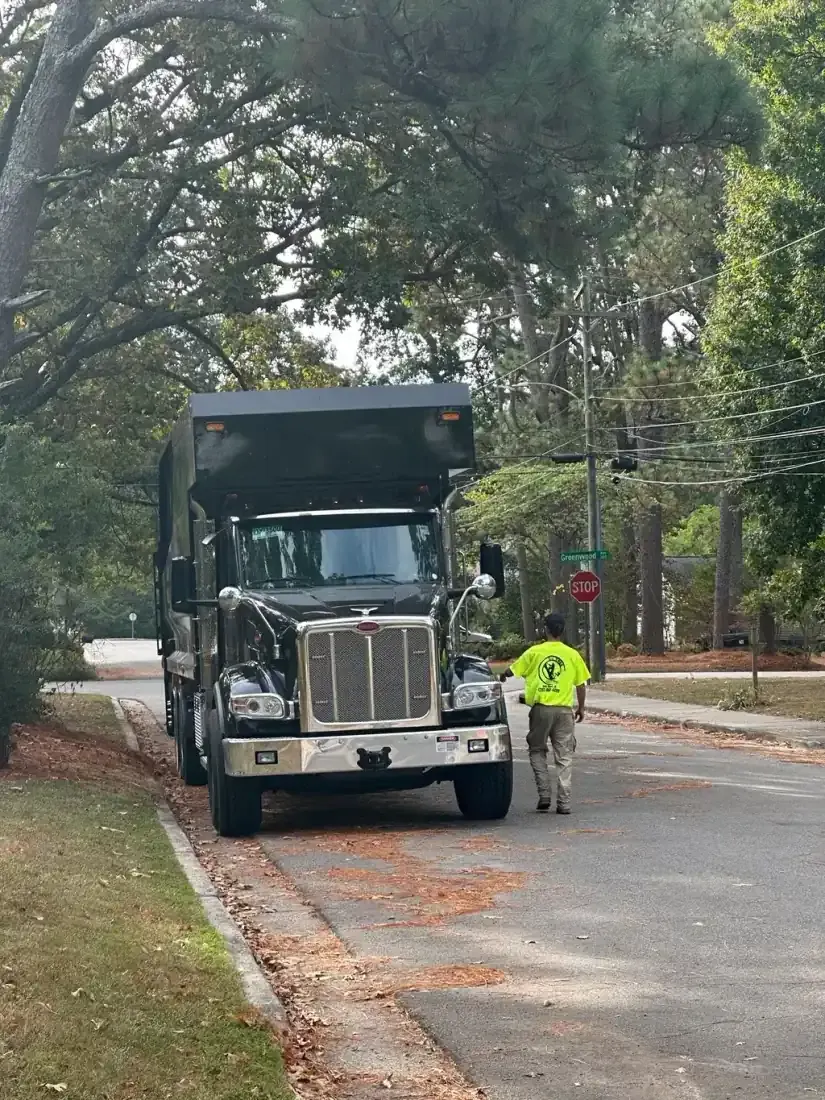
When we show up to common areas we’re running the same Peterbilt grapple truck, Vermeer SC48TX stump grinder, and climbers in W-2 branded gear that show up on every other job. Our core crew are W-2 employees; on bigger jobs we bring in vetted contract climbers and operators. Same crew over the life of the contract so we actually know your property.
Storm Response
Contract clients get priority dispatch. After major storms — named tropical systems, declared emergencies, or sustained winds above 50 mph — we work through contract clients first. For emergency tree service calls (tree on the entrance sign, tree blocking parking, tree leaning into the amenity center), contract clients get same-day or next-day response while non-contract callers wait. For a complete pre-storm checklist, see our pre-hurricane tree hazard audit which covers what to inspect before June 1.
Annual Report
End of each contract year, the board gets a written report covering work completed, condition changes from the prior assessment, recommendations for the coming year, and a budget projection. Share it with your insurance agent — carriers increasingly want to see loss-control documentation, and an annual tree assessment can help you avoid coverage denials when something eventually does fail.
Where Trees Fail on HOA Property
Five places boards underestimate, in rough order of how often they become claims:
Retention pond banks. Pond-bank trees are the classic example: a big water oak can look perfectly healthy from the walking path while the root plate has been undermined for years - and the failure lands wherever gravity says, four feet from a path or eight feet from a fence.
Entrance features. The trees flanking the entrance are the most visible if they fail. They’re also usually planted in compacted soil close to signage, lighting, and irrigation. Stress shows up 10-15 years in. If there’s an Architectural Review Board (ARB) or landscape committee, any removal of an entrance tree usually requires their approval before the maintenance contract can execute it — your contract should spell out how that approval flows.
Walking trails and amenity areas. Trails winding through wooded common areas mean residents walking under trees daily. Every overhanging limb is a liability conversation if it ever drops on someone. These trees need annual deadwood inspection, not just emergency response after storms.
Common area perimeters along homes. Trees on HOA land whose trunks are on the HOA side of the line but whose canopies overhang homeowner property. Ownership follows the trunk in NC — if the trunk is HOA, the HOA owns the tree. The perimeter trees adjacent to individual homes are the ones most likely to generate written homeowner complaints, which are the ones most likely to become the “notice” that supports a negligence claim later.
Drainage easements. Trees in drainage swales between properties or along channelized creeks often get ignored because they’re not on a residential lot. But these are often not HOA property either — drainage infrastructure is frequently dedicated to the municipality or held as utility easement. The HOA may have maintenance responsibility per the declaration even when it doesn’t have ownership. That distinction matters for permitting and liability allocation, and the board should know which drainage features the HOA is actually responsible for maintaining.
HOA Tree Liability in NC
Here’s the part most boards don’t hear until the deposition.
The “Known or Should Have Known” Standard
NC applies the urban landowner duty of reasonable care to HOA common property — the board has a duty to inspect for hazardous conditions and to abate them within a reasonable time. The standard is “known or should have known.” Constructive notice (should have known) can come from:
- Duration and visibility of the defect (a leaning tree that stood for six months)
- Obviousness to a reasonable inspector
- Prior complaints — written, verbal, or anything that ended up in property manager records
Documentation doesn’t create notice. Notice exists the moment any reasonable person could have observed the defect. Documentation is what the plaintiff’s attorney subpoenas to prove the duration.
The Insurance Architecture
Two policies, not one:
Master property / CGL policy covers sudden, accidental damage from common-area hazards. This policy has several things boards miss:
- Debris removal sub-limits — typically 25% of loss or a flat $10K-$50K cap. After a hurricane, debris removal exhausts the sub-limit fast and the rest comes out of the budget.
- Known-hazard denial — not usually an explicit “known hazard” exclusion, but denial routes through the neglect and expected or intended exclusions present in every CGL form.
- Wear and tear exclusion — covers the declining tree itself (no coverage to remove it proactively) but not necessarily the damage from a sudden collapse.
D&O (Directors & Officers) policy covers board decision liability — failure to maintain, failure to inspect, failure to act on known hazards. This is not the master property policy. If a homeowner sues individual directors for breach of fiduciary duty under the NC Planned Community Act (NCGS Chapter 47F) or Condominium Act (NCGS Chapter 47C), D&O defends and indemnifies. Most self-managed boards don’t know whether their D&O policy has adequate limits for tree-related claims. Worth a review.
When an HOA Tree Falls on a Homeowner
Common misunderstanding: “the HOA is on the hook.” Not exactly. Here’s the actual flow:
- The homeowner files their own HO-3 policy — falling trees are a covered peril under most homeowner policies.
- The homeowner’s carrier pays the damage (subject to deductible and policy limits).
- The homeowner’s carrier then subrogates against the HOA’s master liability policy if the HOA had notice.
- The HOA’s carrier either pays or denies based on the known-hazard / neglect analysis.
- If the HOA carrier denies, the subrogation claim may come back at the HOA directly.
The HOA’s real exposure isn’t a direct first-party claim from the homeowner — it’s subrogation and coverage denial. Annual assessments, documented and dated, are the board’s primary defense against both.
For broader context on commercial tree contract insurance and what CAMs and property managers should require of any contractor, see what property managers should know before hiring a tree service.
Fiduciary Duty to Seek Comparative Pricing
Even though NC has no statutory bid requirement for HOA contracts, directors have a common-law fiduciary duty of care to make informed decisions. For a contract above typical declaration thresholds ($5K or $10K most commonly), boards should document that they solicited comparative pricing — otherwise a disgruntled homeowner can allege breach of fiduciary duty under NCGS 47F-3-102.
Many declarations also include “three-bid rules.” Check your governing documents before signing any multi-year term.
HOA Tree Maintenance Cost in NC
Typical numbers for Eastern NC HOA contracts:
| HOA Profile | Common Area Scope | Typical Annual Contract |
|---|---|---|
| Small subdivision | Entrance + 1 retention pond + perimeter trees | $2,500 - $4,000 |
| Mid-size subdivision | Entrance + amenity area + walking trail + 2-3 ponds | $5,000 - $9,000 |
| Larger development | Multiple amenity areas + extensive trails + multiple ponds + clubhouse grounds | $10,000 - $20,000+ |
| Townhome/condo community | Common-area canopy + perimeter (excluding foundation-line landscaping) | $4,000 - $12,000 |
Urban NC markets (Raleigh metro, Charlotte) run 20-40% above these numbers. Eastern NC pricing reflects lower overhead and shorter mobilization from our Rocky Mount HQ and Goldsboro yard.
Multi-year structure. 3-year terms typically price at 5-8% annual discount. 5-year terms at 10-12%. These assume either flat pricing for the term or CPI-adjusted escalators (commonly 3-4% annually). Flat 5-year pricing is unusual given current labor and fuel inflation — most contracts lock Year 1 and escalate Years 2+ by a defined formula.
Emergency response caps. Standard contracts include a defined volume of emergency response — something like 8 emergency hours or 2 response events per year. Major storm events (named tropical systems, declared emergencies, sustained winds above 50 mph) trigger separate emergency rates because they’re outside the baseline contract scope.
Operating vs capital. Annual tree maintenance is an operating expense. Large-scale canopy replacement (entrance features, significant common-area replanting) should be a capital item in the reserve study under NCGS 47F-3-114. Hardwood replacement cycles typically run 30-50 years; pine plantings 20-30 years. Most HOA reserve studies underfund canopy replacement — worth flagging for your reserve specialist.
What We Need to Quote Your HOA
When we quote an HOA, we’re not guessing. To put together real numbers:
- Common area map or plat showing HOA-owned land and stormwater/drainage easements
- Site walk window — best done with the CAM or board president, ideally both
- Current tree concerns — any Board Action items, any homeowner complaints on file with the property manager
- Governing documents excerpt covering common-area maintenance authority — particularly the declaration’s maintenance clause and any ARB approval requirements for removals
- Term preference — single year, 3-year, 5-year
- Insurance requirements — what limits and additional insured language your master policy or governing documents specify
The site walk is free. We walk the property, take notes, photograph any trees of immediate concern, and follow up with a written proposal within a week. If the board wants us at a meeting, I’ll attend.
What an HOA Program Looks Like Here
We built our HOA maintenance program around the common-area profile of Eastern NC communities: entrance features, retention ponds with loblollies on the bank, perimeter pines between the subdivision and adjacent farmland, and walking trails through wooded common land. Whether your community is a 40-home subdivision with one retention pond or a multi-amenity community with a hundred-plus mature trees, the structure is the same - spring assessment, fall follow-up, scheduled work, storm priority, annual report - and the contract is scaled to the tree inventory, not the home count.
The commercial reference we point every board to is our municipal work: a four-phase, two-year street-tree contract for a town in Halifax County - dozens of mature trees around live power lines, with two general contractors who brought us back phase after phase. The full writeup is in our utility and infrastructure post. Boards ask for track record; that’s ours.
Get a Proposal
If your HOA is doing tree work reactively — calling around when something falls — request a proposal. Free site walk, written assessment, fixed annual pricing.
Before signing with any contractor, walk through our Eastern NC tree service hiring guide — it covers insurance verification, crew checks, and red flags that apply to HOA contracts too.
Call (252) 506-0099 or request a free estimate. For related commercial work across property management and municipal accounts, see our commercial tree service page. For property managers with mixed portfolios (HOA + apartments + retail), see what property managers should know before hiring a tree service. For engineering firms and GCs with tree removal in construction scope, see tree removal for utility and waterline construction projects.
If your board wants to talk this through before committing to a site walk, I’ll attend a meeting and walk through what an annual program looks like on your property. No pitch deck, no obligation — just a conversation.
Frequently Asked Questions
How much does HOA tree maintenance cost annually in NC?
What should a homeowner association tree contract include?
Who is responsible for trees in an HOA common area?
Is the HOA liable if a tree falls on a homeowner's property?
Does the HOA's master insurance cover tree damage?
Can you present to the HOA board?
Owner, DC Tree Cutting and Land Service
Anthony runs DC Tree Cutting from Rocky Mount, NC. Every article is based on real jobs, real equipment, and real pricing from across Eastern North Carolina. More about Anthony →